The answers are: Yes, Maybe, No, and No.
We have nothing to fear but nothing to fear. The stock market likes to climb a wall of worry. So too much optimism tends to be bearish, while too much pessimism tends to be bullish. Fortunately, there is plenty to fear these days. Indeed, in a recent LinkedIn post, billionaire Ray Dalio reiterated that recent events confirm that the US is on course for a debt crisis. Jeremy Grantham shares Dalio's deep pessimism, but his primary thesis focuses on an equity valuation "super-bubble" rather than an explicit sovereign debt crisis. Grantham believes the stock market is in the late stages of a historic bubble driven by AI exuberance, which he compares to the 1929 crash, the 2000 dot-com bubble, and the 1840s railroad mania.
Let’s examine the markets’ latest fears:
I. Fearing The Bond Vigilantes. In recent days, plenty of panic has focused on the Bond Vigilantes' role in pushing long-term Treasury yields higher. But panics often trigger a policy response. Sure enough: Treasury Secretary Scott Bessent recently responded with yen-buying so the Japanese government wouldn't be forced to sell its US Treasuries, announced larger Treasury bond buybacks, and suggested making those purchases through the Treasury General Account, which currently has close to $1 trillion in cash. These measures may be gimmicks, but they show the Treasury is intent on calming the Bond Vigilantes.
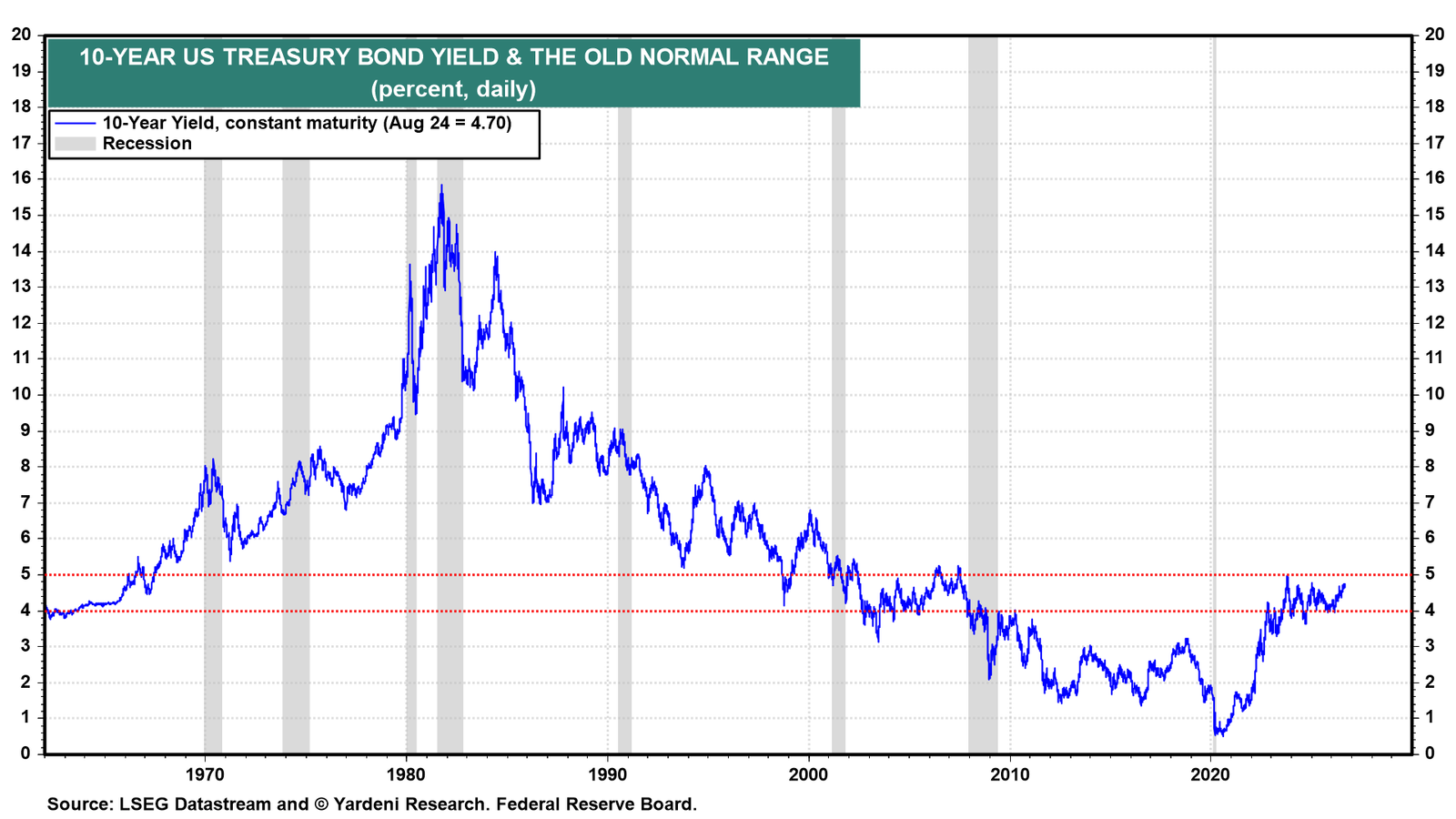
So far, so good. The 10-year Treasury yield is back down to 4.64% this evening from a recent high of 4.74% last Friday. It remains in what we call the "old normal" range of 4.00%-5.00%, which reflects a healthy economy (chart). Falling oil prices helped lower yields too today, reflecting mounting evidence that Iran no longer has the military means to effectively close the Strait of Hormuz.
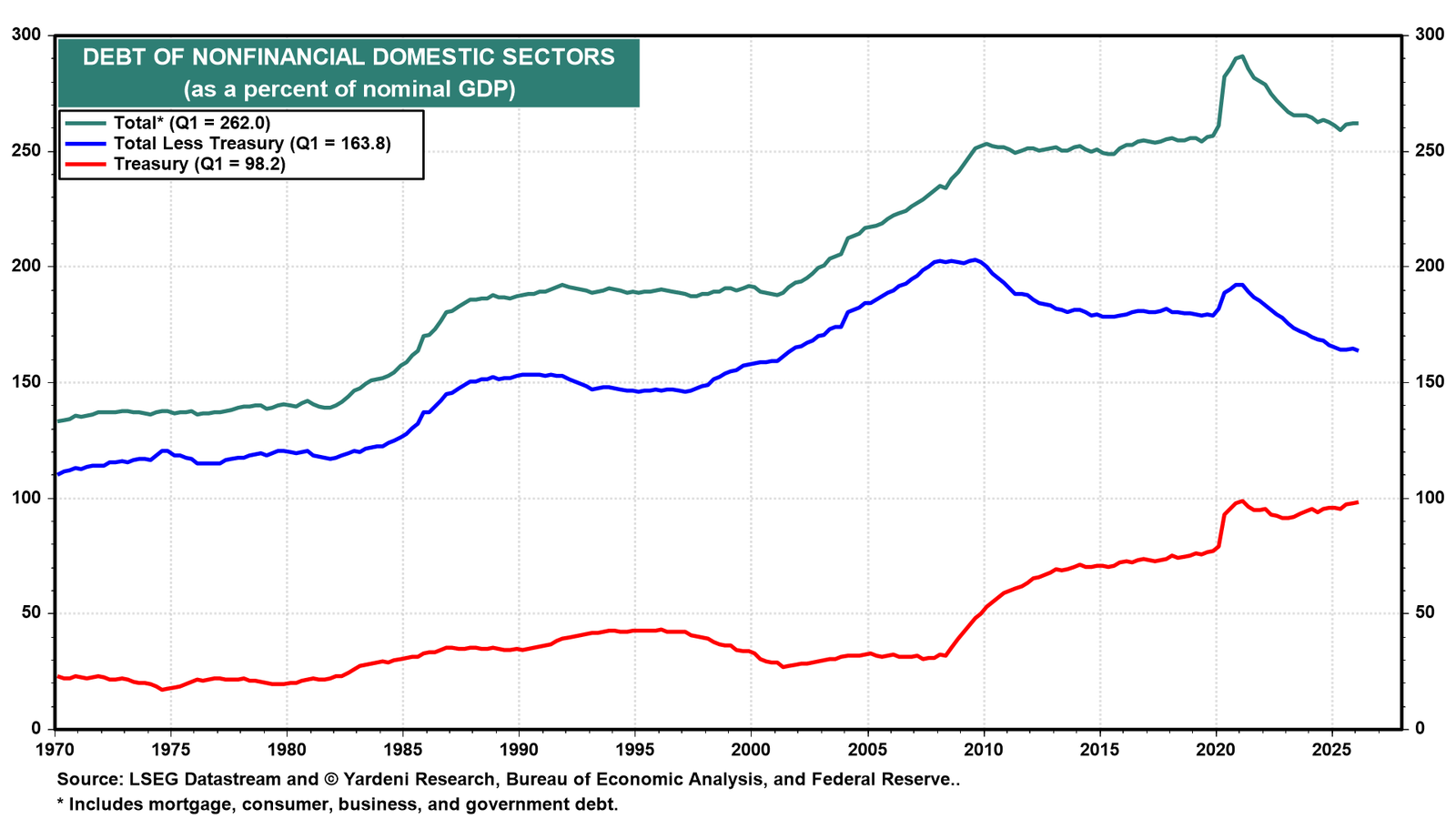
The relatively tiny rise in bond yields in recent weeks has been largely blamed on large federal budget deficits and mounting federal government debt. Indeed, last Wednesday the national debt rose to $40 trillion. Excluding roughly $8 trillion in intragovernmental holdings, Treasury debt is now up to 100% of nominal GDP (chart). While elevated, the rise in this ratio has been offset by a decline in the comparable private-sector debt ratio, leaving total nonfinancial debt relative to GDP broadly stable since 2010, except during the pandemic years.
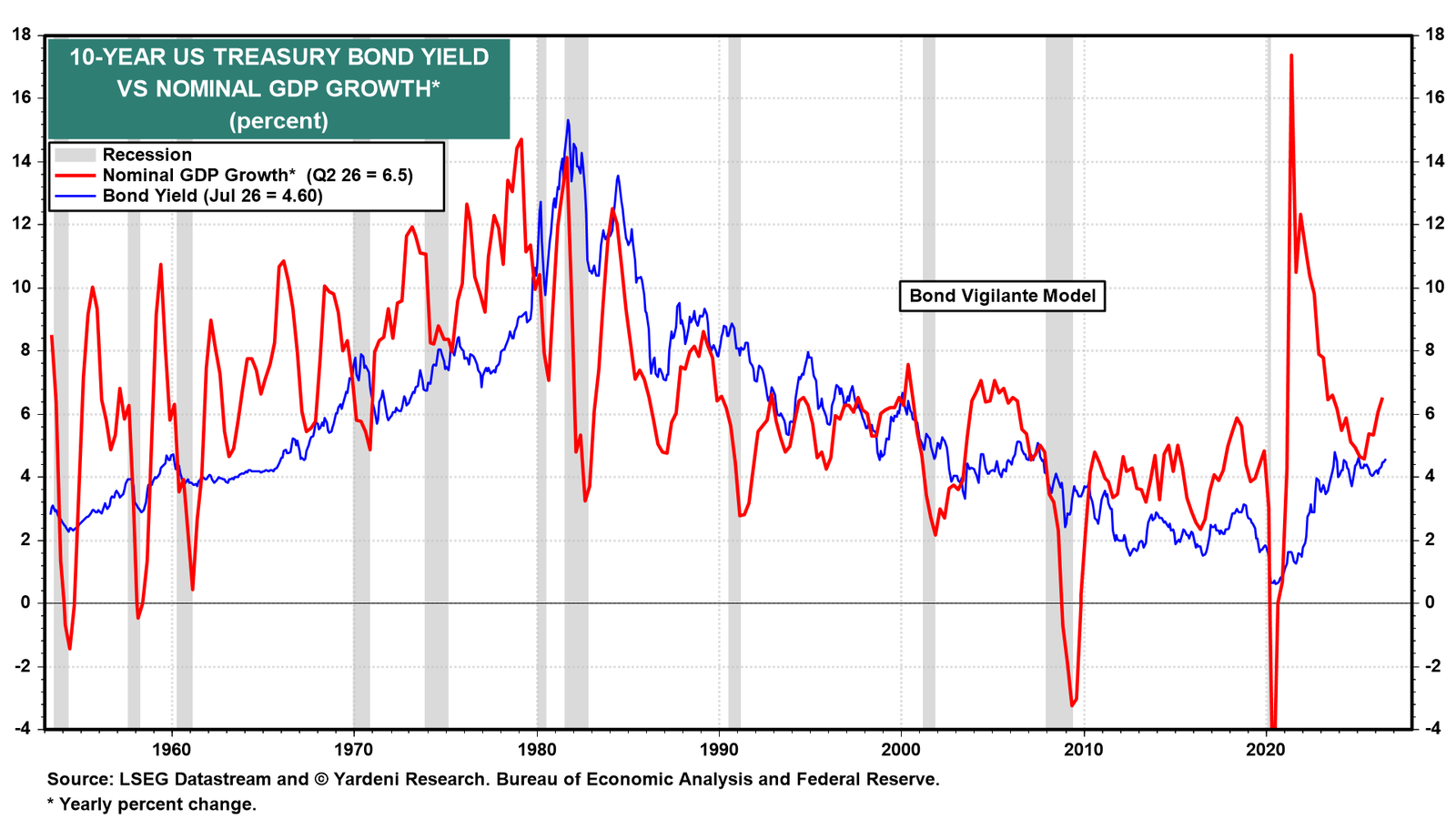
Our Bond Vigilante Model suggests that the Bond Vigilantes have yet to saddle up. Historically, the 10-year Treasury yield has tracked nominal GDP growth (chart). The 10-year yield remains well below Q2's nominal GDP growth of 6.5% y/y. We believe that the recent rise in yields reflects the economy's strength rather than bond market vigilantism. We would worry only if yields moved above levels consistent with economic fundamentals.
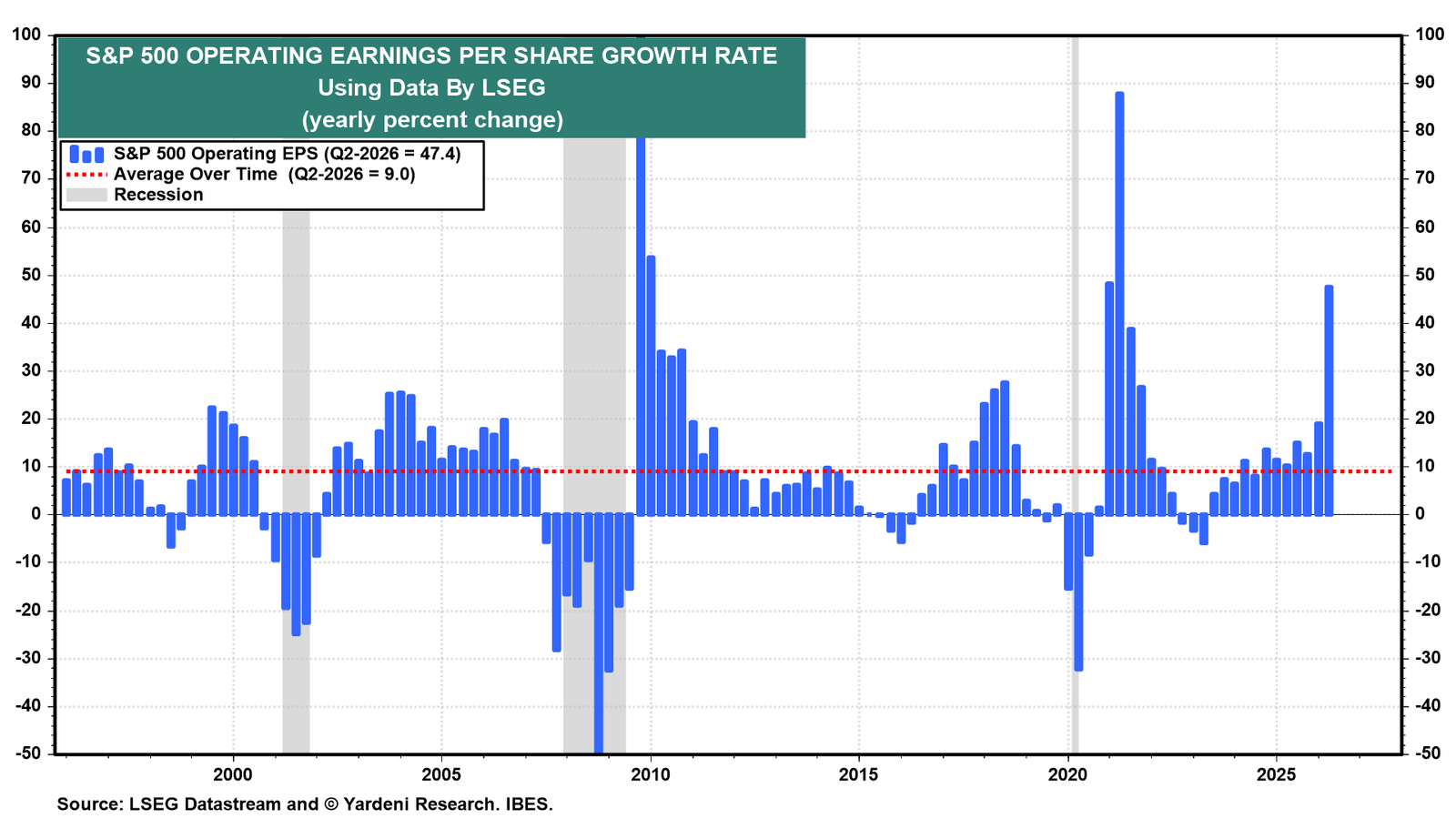
II. Fearing Irrational Earnings Exuberance. Just as we don't think it's time to fear the Bond Vigilantes, we don't think it's time to worry about the quality of earnings. S&P 500 operating EPS surged nearly 50% y/y in Q2 (chart). Even stripping out non-cash mark-to-market (MTM) accounting gains, earnings growth was still an impressive 25.7%. Usually, earnings growth this strong is seen only during a post-recession rebound.
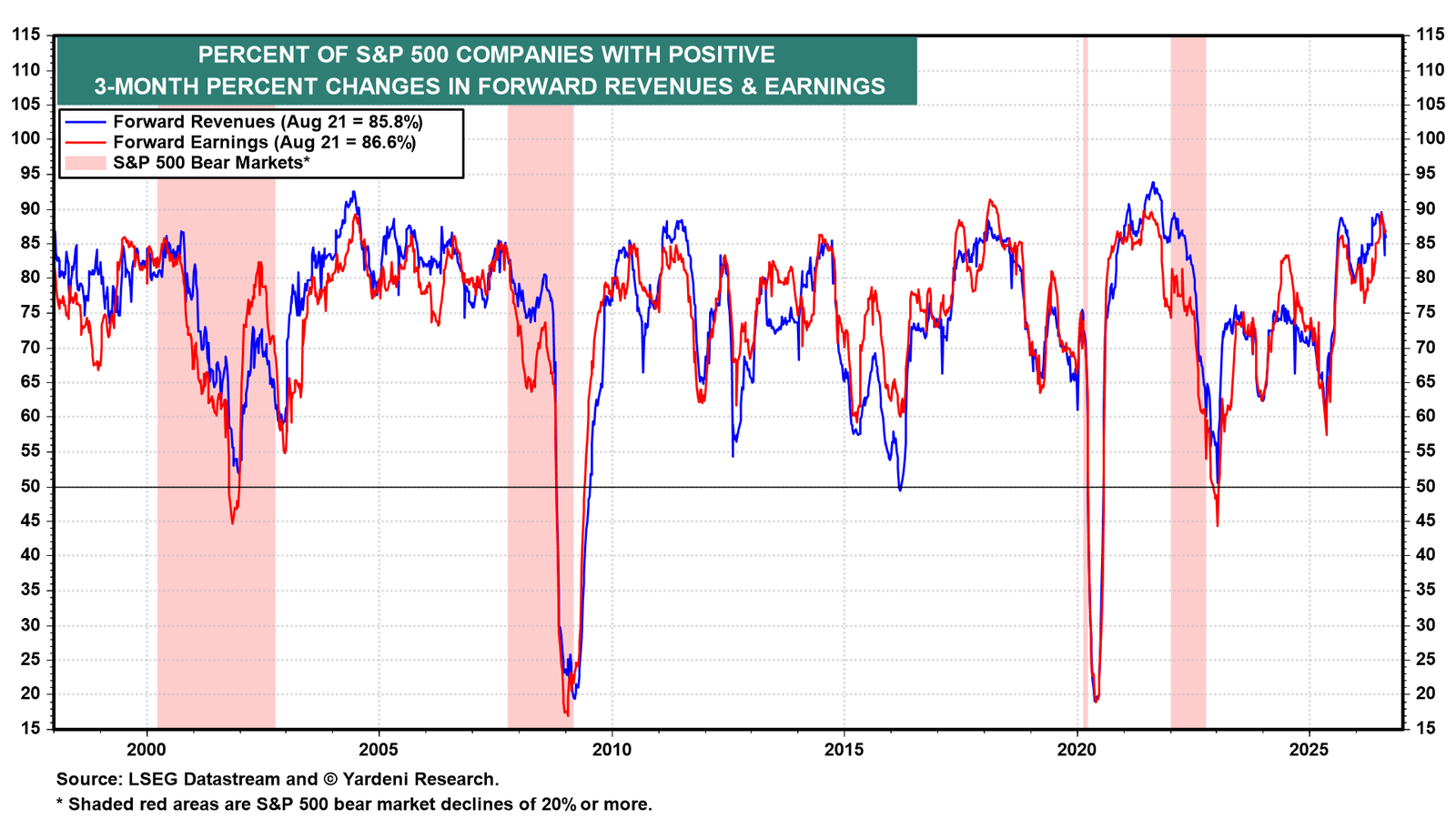
Is "circular financing" among the AI companies inflating the S&P 500 earnings numbers? We doubt it because positive earnings breadth is near previous cyclical highs (chart).
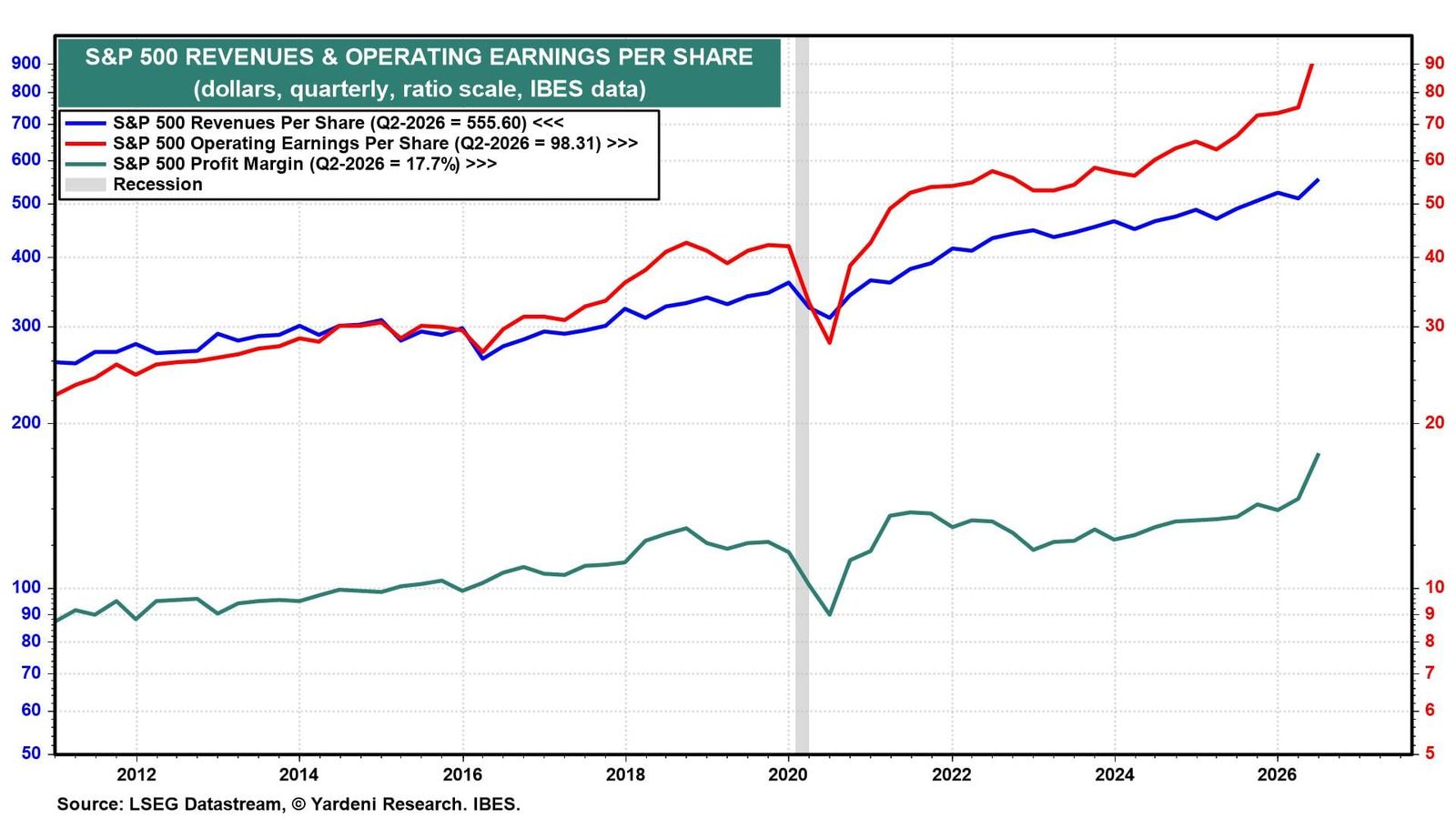
Earnings growth is unusually strong because profit margins are expanding alongside strong revenues growth (chart). MTM gains have inflated profit margins, but they do not inflate revenues.
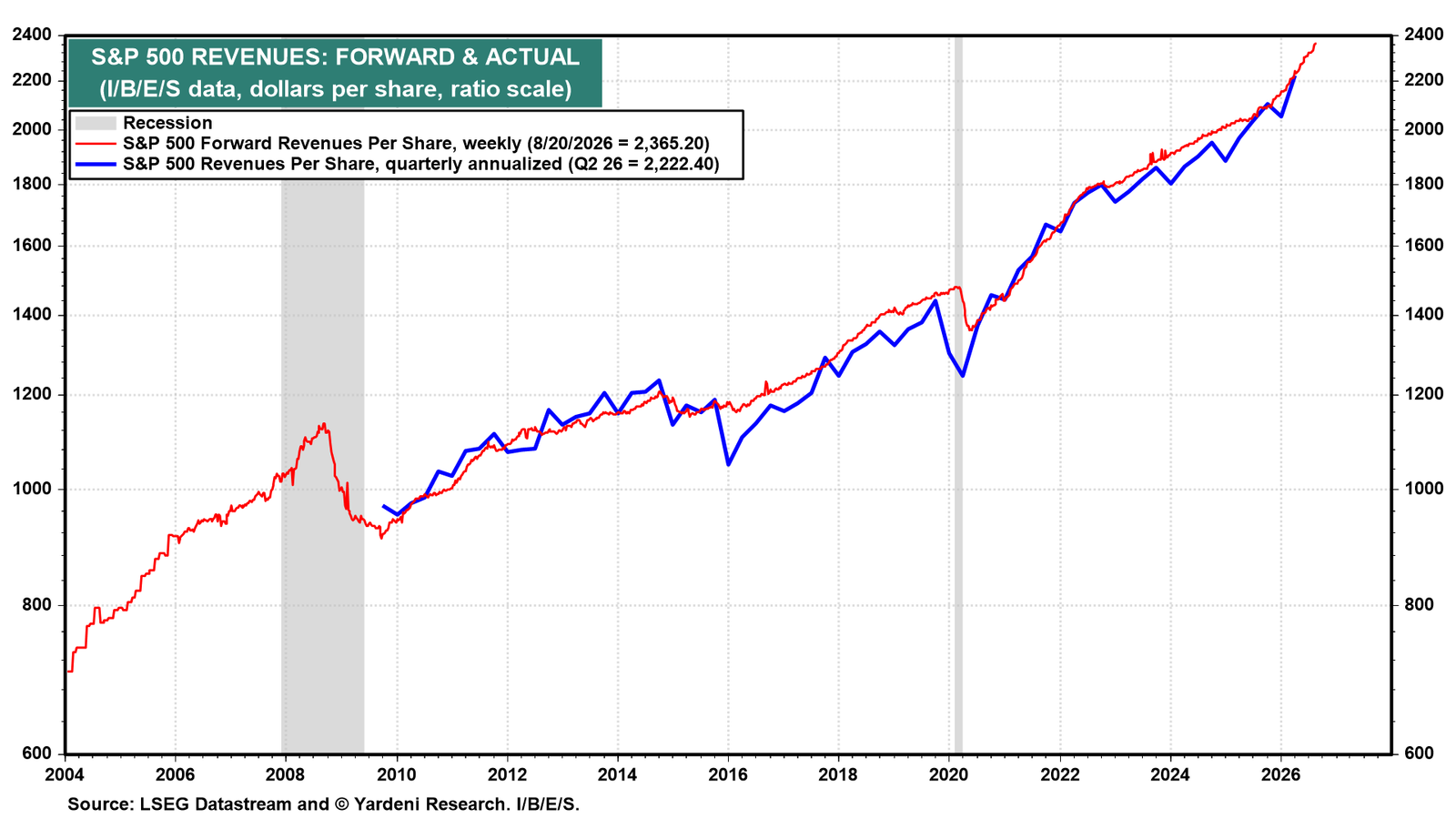
S&P 500 forward revenues continues to make new highs alongside actual revenues, indicating that analysts expect solid demand and sales growth to persist (chart). So do we.
S&P 500 forward earnings has climbed to a record high again, reinforcing the view that the earnings boom remains intact (chart).
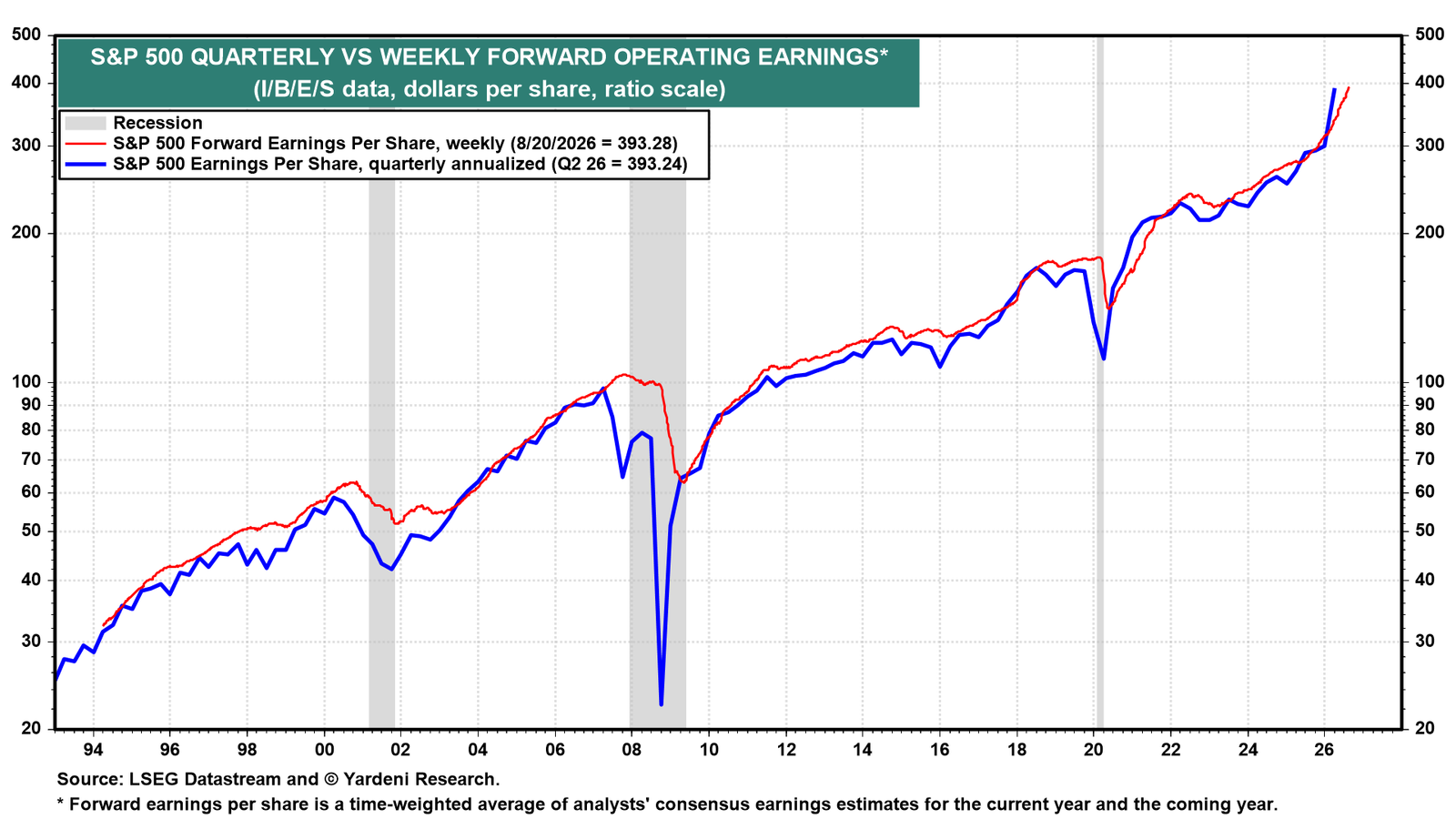
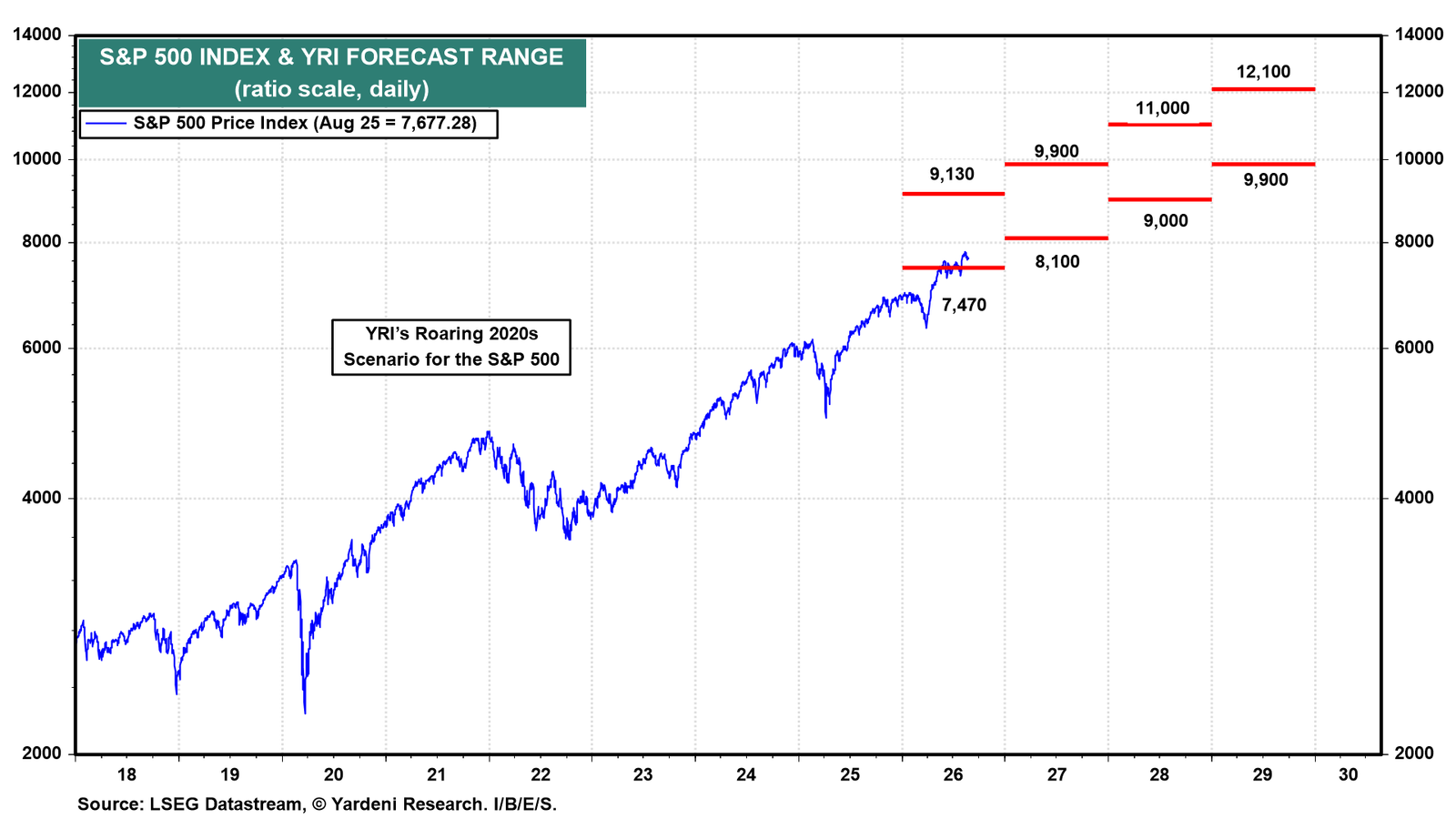
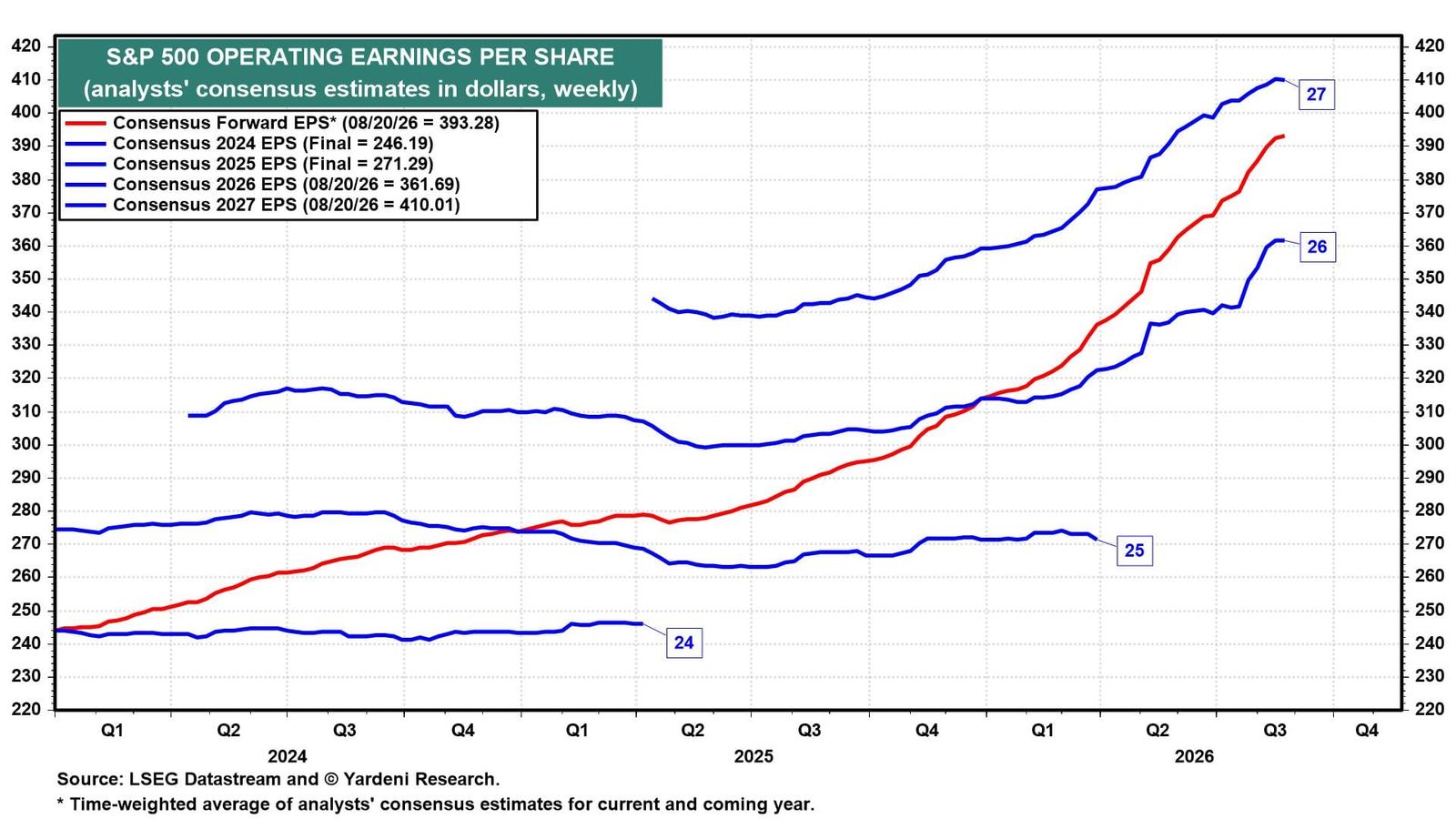
Analysts keep raising earnings estimates, with 2027 operating EPS now at $410 per share (chart). That's consistent with our forecast for forward earnings to reach $415 by year-end. Applying a valuation multiple of about 20 gets us to our S&P 500 year-end target of 8,400. (The 2027 estimates are not distorted by MTM issues.)
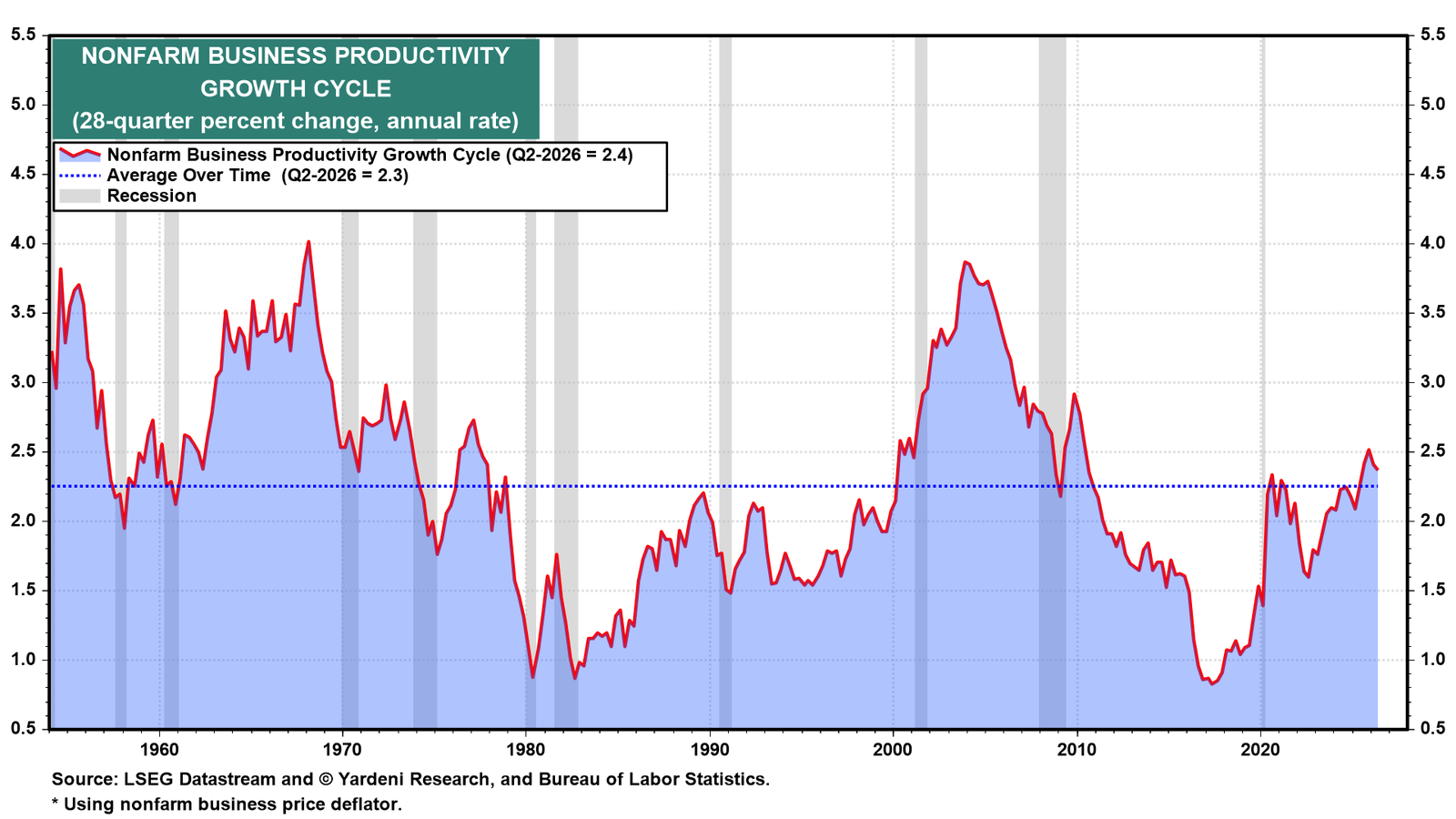
III. Fearing Artificial Intelligence. And what do we have to fear from AI? In our Roaring 2020s scenario, AI is among the technologies powering the productivity boom. We expect annual productivity growth of 3.0%-4.0% before the end of the decade, setting the stage for the Roaring 2030s. That pace of productivity growth isn't unprecedented. Productivity growth averaged roughly 3.0%-4.0% during the technology-driven boom of the late 1990s and early 2000s (chart).
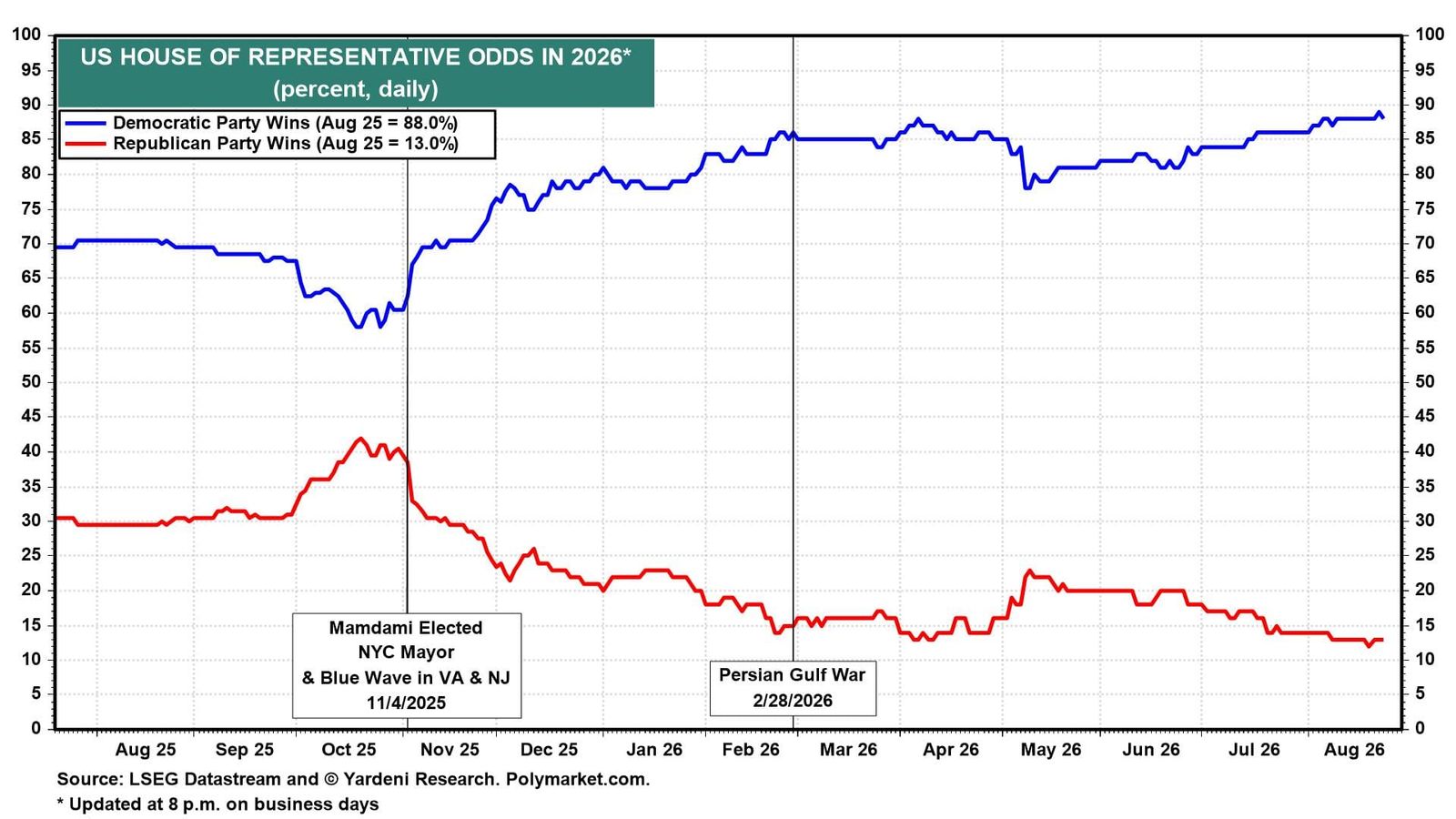
IV. Fearing Valuation, Iran, The Fed, The Midterms, Yada Yada. Of course, there are plenty of reasons to worry, and we recently updated our Worry List. The Bond Vigilantes could assert themselves if the Fed's inflation-fighting credibility comes into question. The hyperscalers may be overbuilding AI capacity and increasingly relying on debt financing. And prediction markets increasingly favor a Democratic House majority, raising the prospect of renewed political gridlock (chart). Markets typically handle gridlock well, but extreme political polarization could become problematic. While these risks bear watching, they do not alter our constructive outlook.
V. Nothing To Fear But A Recession. We continue to assign an 80% subjective probability to our Roaring 2020s scenario, with the remaining 20% allocated for recession scenarios. As long as the recession risk remains low, as it does, valuation multiples are more likely than not to remain high, and earnings growth should remain solid. We might get to 10,000 on the S&P 500 before the end of the decade (chart). (See YRI Earnings Outlook.)