Fed officials just won't listen to us! We warned them that the economy didn't need the four cuts in the federal funds rate (FFR) at the end of 2024. The Bond Vigilantes agreed with us and pushed the 10-year Treasury bond yield up by 100bps at the time (chart). The same happened late last year. The Fed lowered the FFR three times. The bond yield drifted higher and continued to do so this year.
We correctly anticipated that the FOMC would pivot from its dovish stance in April to a hawkish stance in June. Then we predicted that the committee would follow up with a rate hike in July. They didn't listen to us. Once again, the Bond Vigilantes are pushing bond yields higher. In effect, they are saying that if the Fed won't be vigilant about inflation, then they will have to maintain law and order in the economy.
Under the circumstances, we conclude that the Fed has to raise short-term rates to lower long-term rates. Talking hawkish but not acting so reduces the Fed's credibility.
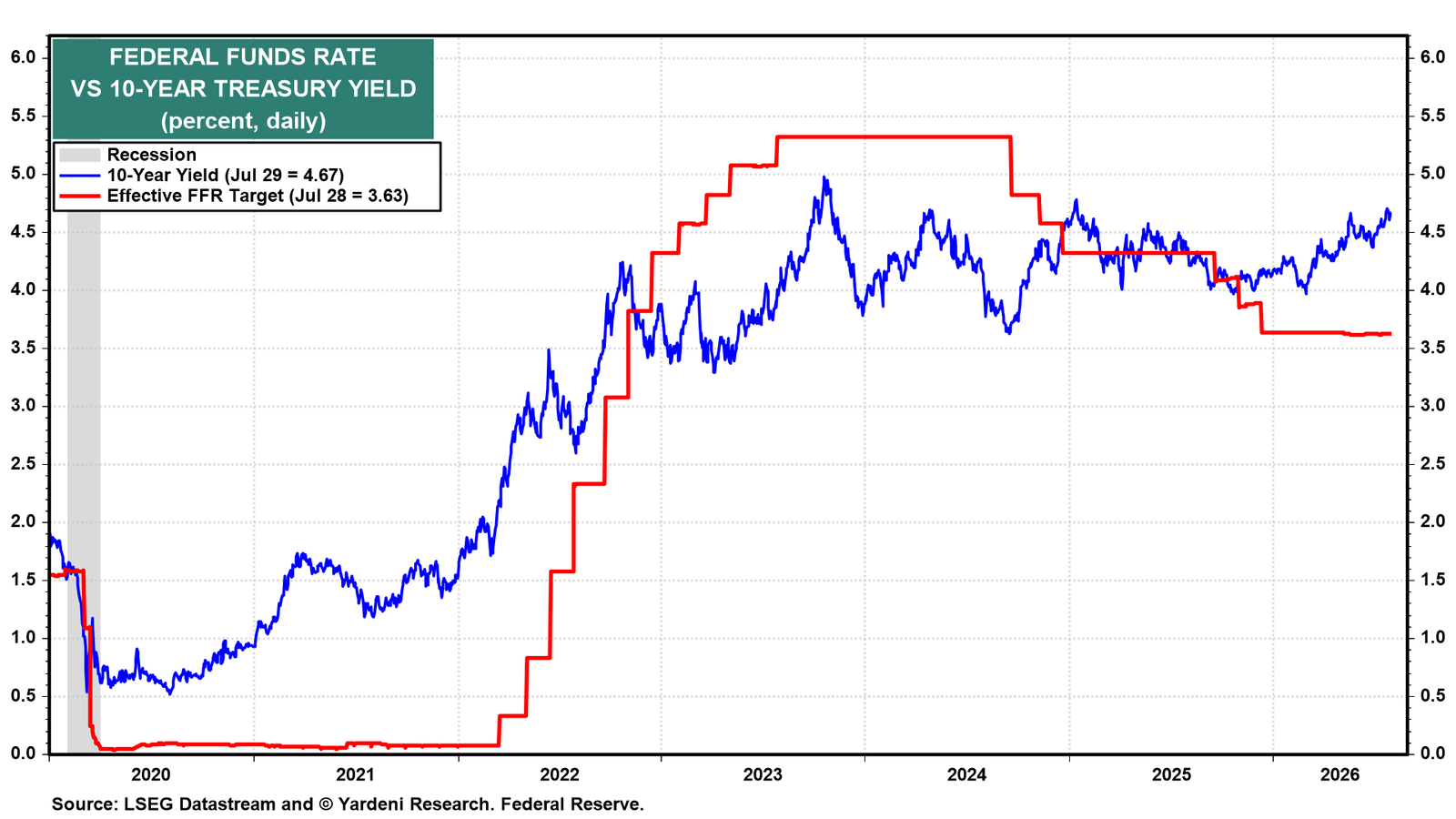
At the FOMC meeting today, the committee voted 9-3 to leave the federal funds rate (FFR) unchanged at 3.50%-3.75%. Beth Hammack, Neel Kashkari, and Lorie Logan dissented, each preferring a 25bp hike. Fed Chair Kevin Warsh struck an unambiguously hawkish tone at today's press conference. He emphasized (again) that the economy remains resilient and inflation is still above target. He reiterated that restoring price stability is the Fed's top priority. Indeed, the FOMC statement closed with the same reassuring pledge as last month: "The Committee will deliver price stability."
Delivering price stability is exactly what the Bond Vigilantes want the Fed to do. Ahead of the meeting, the 2-year Treasury yield traded roughly 75bps above the federal funds rate, indicating that the Fed should reverse last year's FFR cuts that were billed as insurance policies to protect the labor market from weakening. At the time, inflation seemed to be heading closer to the Fed's 2.0% target.
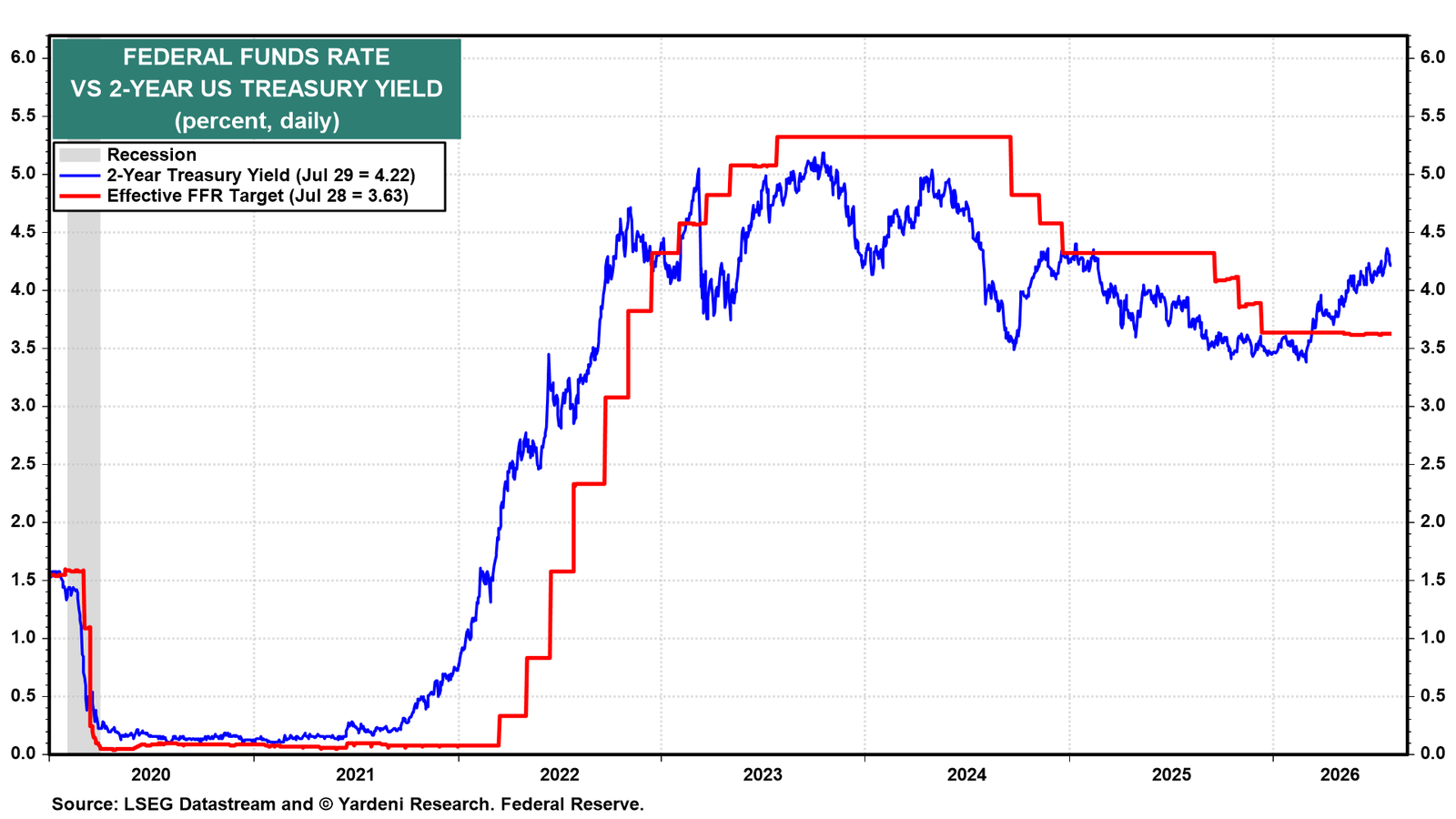
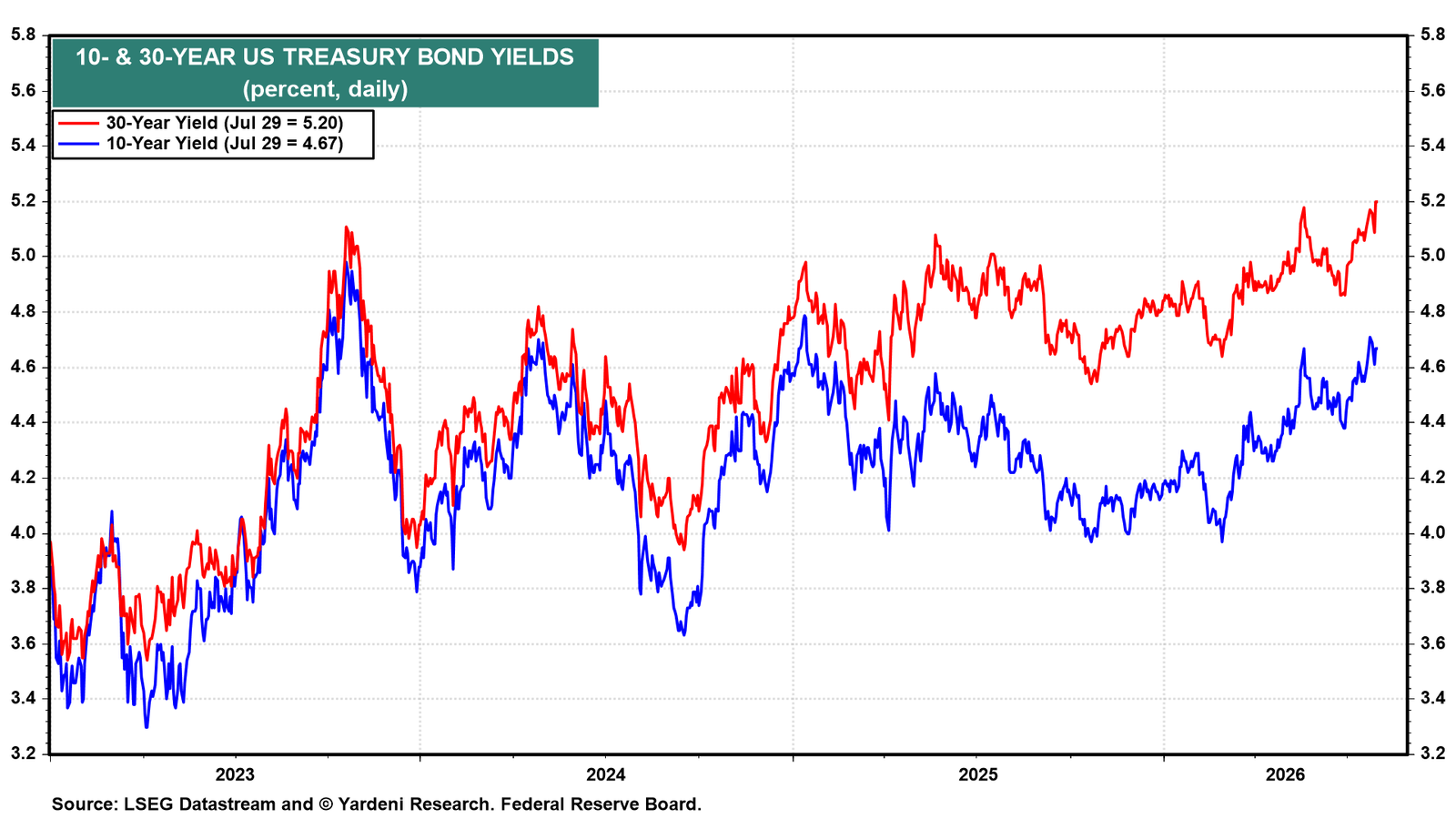
The 10-year and 30-year Treasury bond yield have been rising in recent weeks (chart). That has been a warning from the Bond Vigilantes to heed the message of the 2-year yield. Warsh talked hawkishly today. But he did not deliver a FFR rate hike. So bond yields rose. Arguably, Warsh failed his first credibility test. Warsh's own hawkish words set the standard against which he is judged.
Following Warsh's press conference today, the probability of a September FFR hike fell from 70% to 63%, and the 2-year yield declined by 6bps, suggesting that some of the conviction that the Fed will do what it takes to restore price stability faded. So the 10-year yield rose to 4.67%, and the 30-year yield climbed more than 10bps to 5.20%, its highest level in nearly two decades (chart).
Four additional themes from Warsh's presser stood out:
(1) Inflation remains the Fed's top priority. Warsh rejected any suggestion that the Fed will tolerate above-target inflation: "There is no soft inflation target. There is no soft implicit target. There's only a target, and it's 2 percent." He argued that five years of above-target inflation cannot be undone by a few favorable inflation reports and said June's softer reading influenced the decision "not much."
(2) Markets are a signal, not a guide. Warsh's effort to redefine the Fed's relationship with financial markets was a notable theme. By dialing back forward guidance, forecasts, and policy signaling, he believes market prices can offer a cleaner read on underlying economic conditions, with investors "learning to play the ball, not the referee." But he stressed that policymakers are "not going to be constrained by market prices." Markets can inform policy, but they won't dictate it.
(3) The AI boom is supporting growth while complicating inflation. Warsh repeatedly mentioned that the AI-related capex boom is boosting the economy. It is also muddying the inflation outlook, as demand for chips, memory, data center equipment, and power infrastructure pushes prices higher in parts of the economy.
(4) The FOMC paused to discuss inflation shocks. FOMC participants spent considerable time debating whether the AI-boom, tariffs, energy shocks, and supply chain disruptions are generating broad inflation pressures or merely isolated price increases. Warsh said that the Fed is "watchful thinking, not watchful waiting."
Warsh also stated, "I wouldn't characterize what we did as anything like a pause." Instead, he framed the decision to hold rates steady as a "rigorous review." He described the meeting as a deep, active evaluation of unresolved structural questions.
(5) Bottom line: Warsh talked like a hawk. However, the bond market wanted a rate hike. If incoming data continue to show resilient economic growth with full employment and persistent inflation pressures, Warsh will have to act like a hawk.