As confetti and red-and-yellow streamers rained down on the roaring crowd, the final whistle blew, and Spain lifted the World Cup trophy after a thrilling 1:0 victory over Argentina. The games are over. The fans are heading home, and an important economic tailwind is beginning to fade. According to Bank of America, the FIFA World Cup generated roughly $20 billion in economic activity across the United States, boosting spending in host cities and helping fuel the strongest surge in consumer spending in more than four years.
The stimulus from tax refunds is also fading. Thanks to the One Big Beautiful Bill Act, the total amount refunded to households rose 18.1% y/y to $324.8 billion, putting nearly $50 billion of additional cash into consumers' pockets. With both tailwinds now fading, the economic data are reflecting the slowdown. We aren't concerned. Seven years into our Roaring 2020s scenario, the underlying pulse of the US economy and American consumer remains strong.
Consider the following:
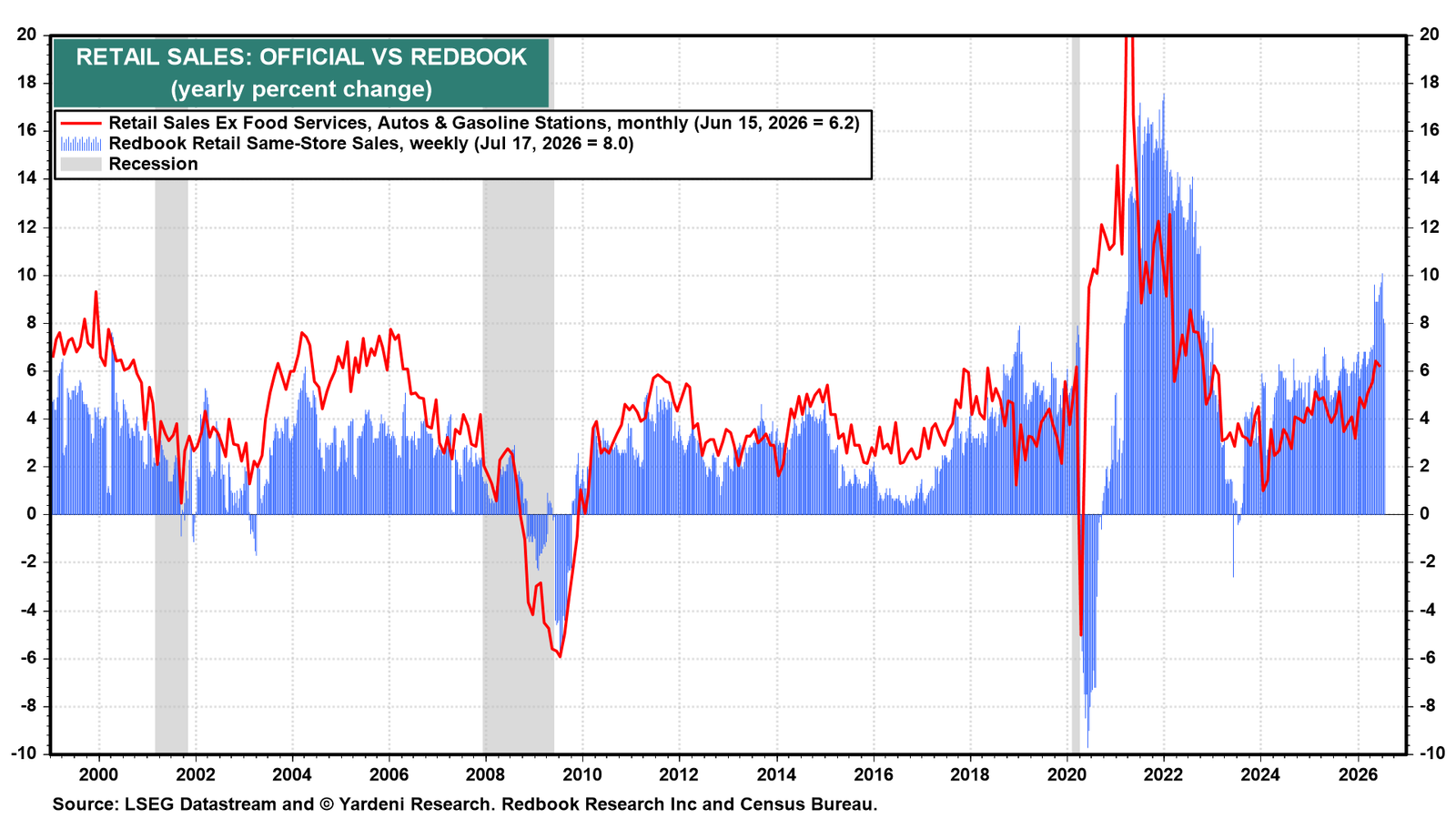
(1) Consumer spending. Redbook same-store retail sales growth cooled to 8.0% y/y in the week ending July 17, extending a pullback from exceptionally strong gains during the World Cup (chart). Sales growth remains robust by historical standards.
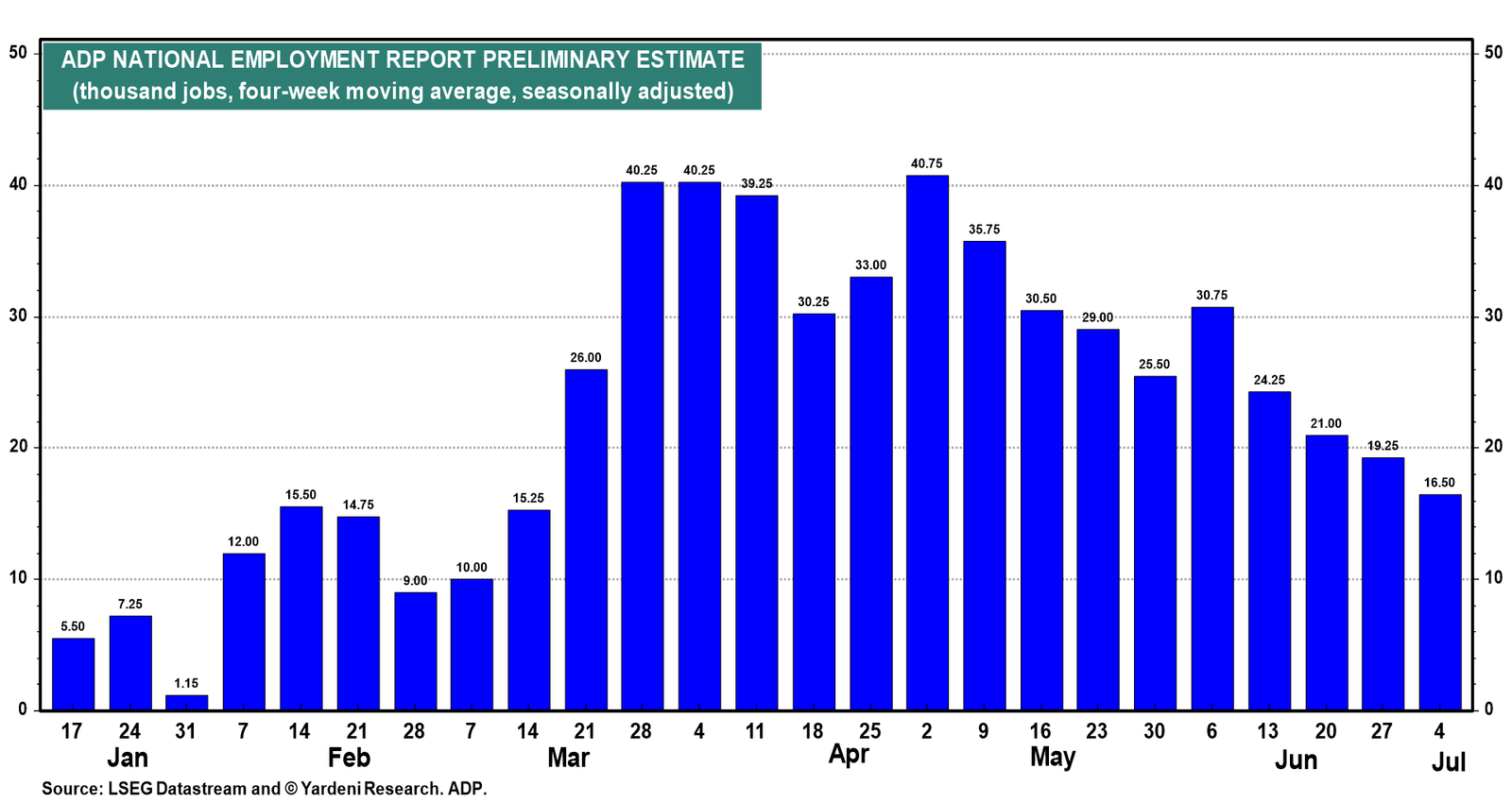
(2) Labor market. ADP hiring growth continues to slow from stronger readings during the spring. US private employers added an average of 16,500 jobs per week in the four weeks ending July 4, down from 19,250 in the prior four-week period (chart). Nevertheless, the pace remains consistent with a monthly payroll gain of roughly 66,000, i.e., around the "breakeven" rate necessary to keep the unemployment rate down.
(3) Misleading indicators. The Conference Board's Index of Leading Economic Indicators (LEI) fell 0.2% m/m in June, while the Index of Coincident Economic Indicators (CEI) rose 0.2% to a record high (chart). The LEI has long been a favorite of recession alarmists. Yet no recession has materialized, and both the LEI and the alarmists have been wrong.
We favor S&P 500 forward earnings per share as an economic indicator (chart). It rose to a record high in June. It is highly correlated with the CEI, and it is also available weekly. In recent months, it has been signaling stronger economic growth than the CEI.
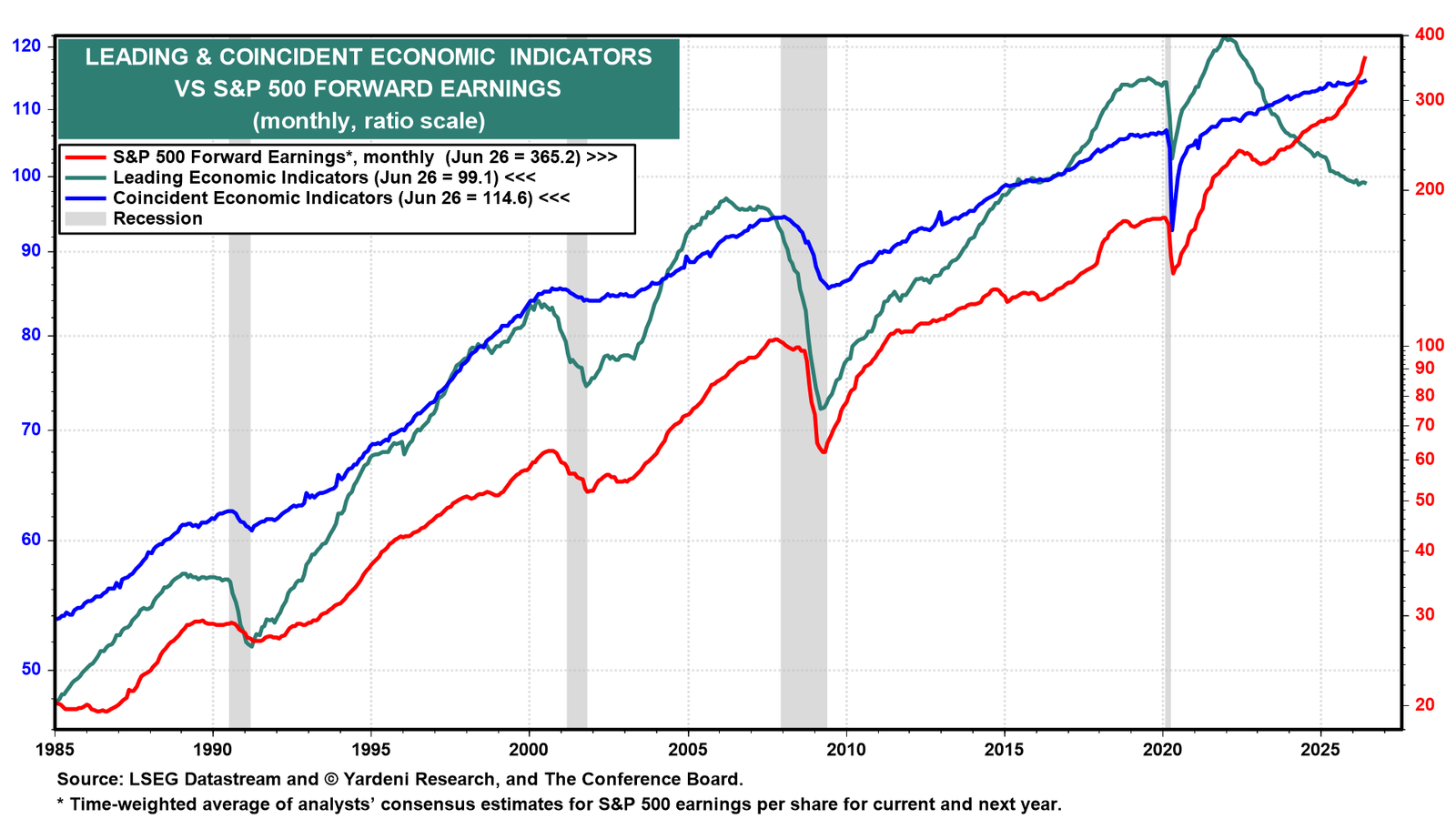
Indeed, the CEI's correlation with real GDP has weakened recently (chart). The former was up just 0.7% y/y in June, while the latter rose 2.7% y/y in Q1-2026 (chart).
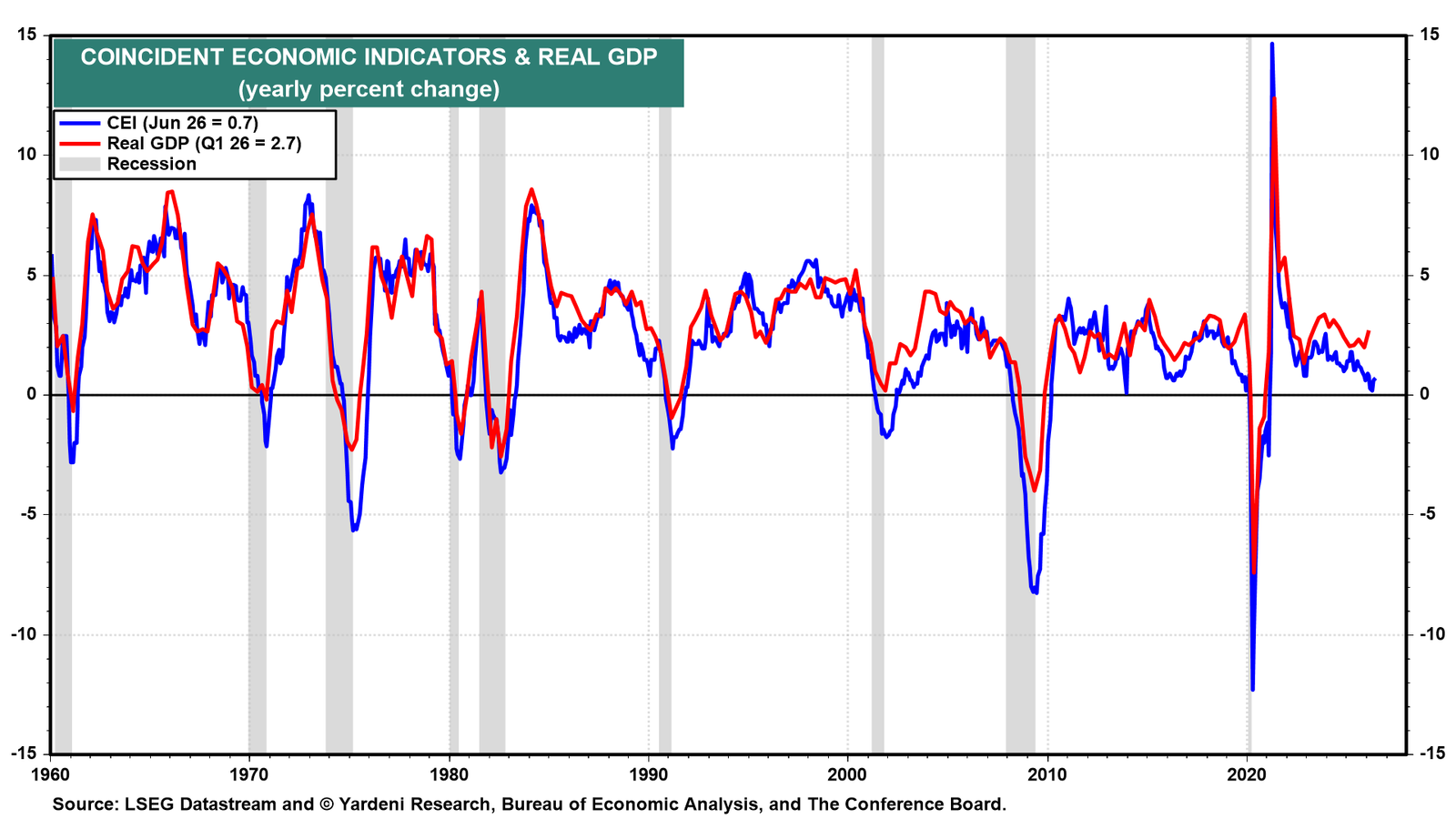
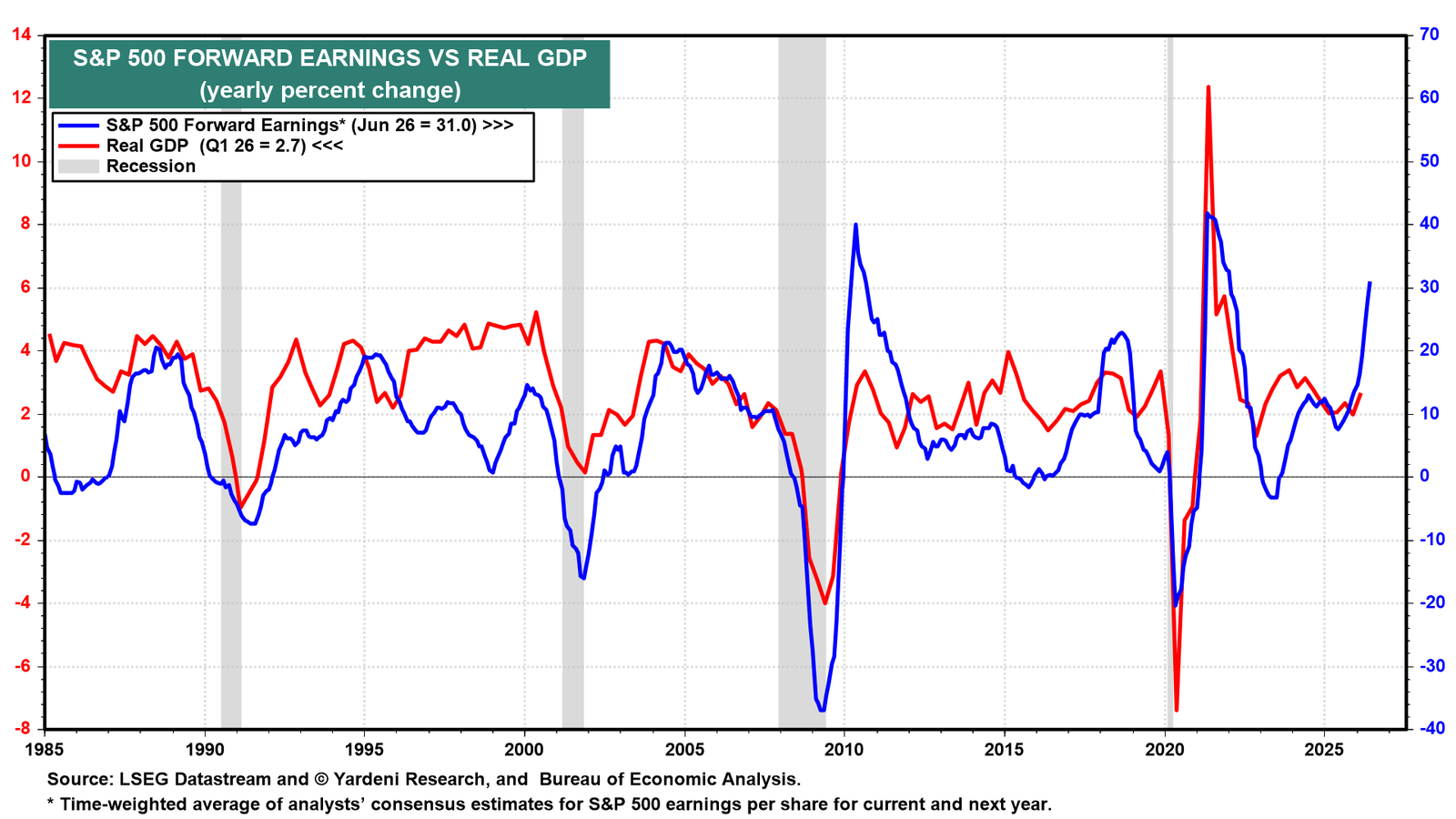
S&P 500 forward earnings growth is also highly correlated with real GDP growth, and currently signals surprising strength in the latter (chart).
(4) Upbeat bank CEOs. The Q2-2026 earnings reports of the largest US banks were strong last week. Their CEOs delivered a consistently upbeat assessment of US consumers. Bank of America's Brian Moynihan called the economy "more durable than expected, supported by the strong consumer," adding that while "affordability is a real issue," consumers are "still spending money, and that's good for the US economy in the broadest context." JPMorgan described consumers and small businesses as "resilient despite elevated gas prices and inflation." Citi's Jane Fraser pointed to a "resilient customer base" fueling "loan growth, higher spend and better credit performance than expected," while Wells Fargo's Charlie Scharf cited "broad-based economic strength." US Bancorp added that customers "are continuing to spend money" even as sentiment surveys look negative, with credit-card purchase volumes "accelerating across credit scores." The largest US banks see a consumer who continues to spend.
(5) Hawkish Fedspeak. The latest speeches by Fed officials suggest a growing consensus among them that upside inflation risks currently outweigh downside risks to the labor market, a conclusion we’ve expressed repeatedly in recent months.
Cleveland Fed President Beth Hammack noted that the Fed's dual mandate is not currently in conflict, with inflation still above target and the labor market remaining near full employment. Drawing on conversations with businesses, she highlighted broad-based price pressures tied to energy, supply chains, insurance costs, and the AI data-center buildout, while describing consumer spending and economic growth as resilient. Notably, Hammack said that for the first time during her tenure, some business contacts are urging the Fed to take action to curb inflation. Governor Lisa Cook and Vice Chair Philip Jefferson struck a similarly hawkish tone, arguing that inflation risks now outweigh employment risks and suggesting that further rate hikes could be warranted if disinflation stalls.
The emerging consensus at the Fed appears to be that rate hikes may be warranted if inflation fails to fall closer to the Fed's 2% target in the coming months. However, officials do not appear ready to advocate for a rate increase at next week's FOMC meeting. Instead, they seem willing to wait to gather more evidence on how persistent current inflation pressures are before deciding whether policy tightening is necessary.