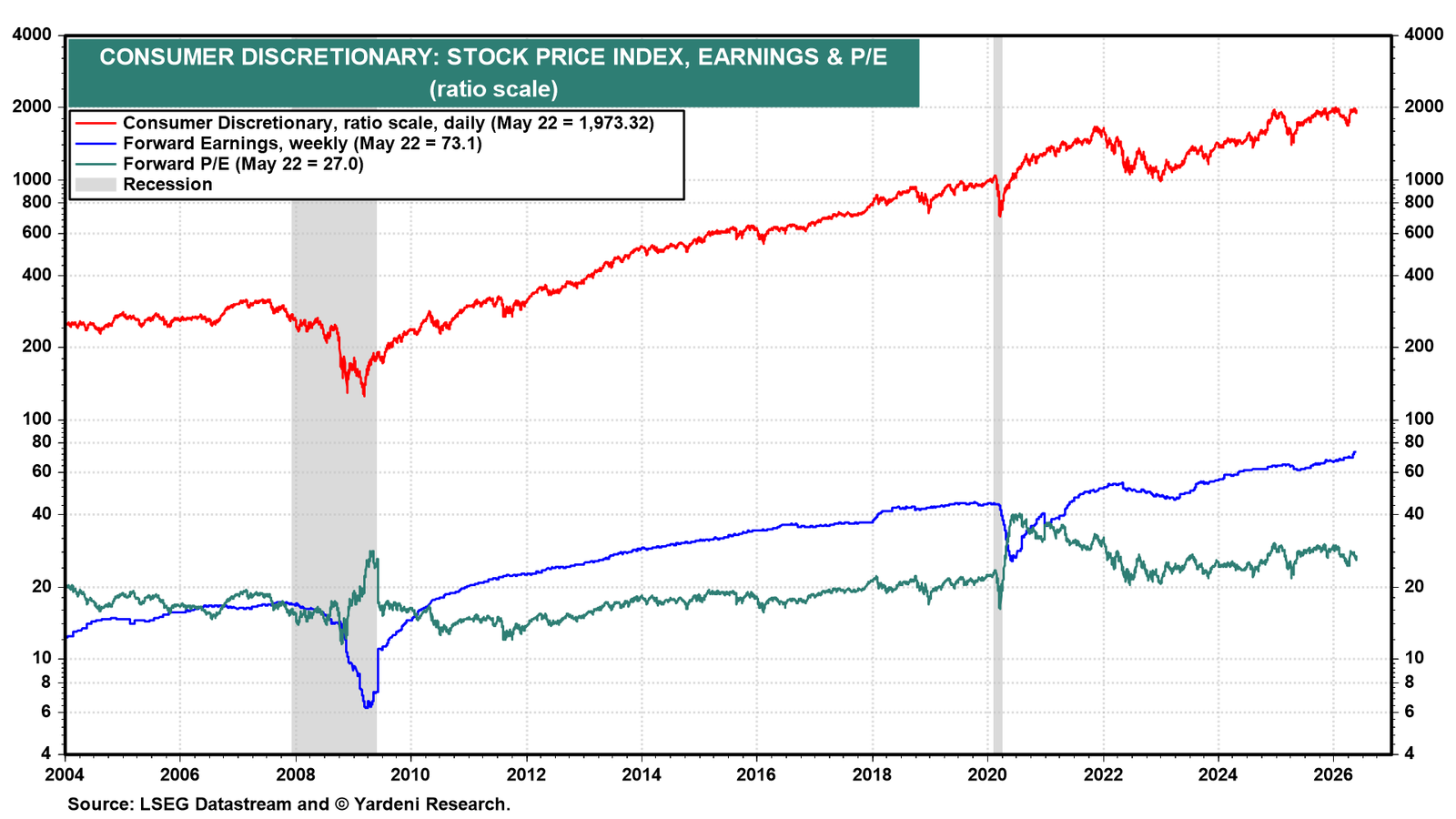
We recommend a market-weight position in the S&P 500 Consumer Discretionary sector. At first glance, the sector looks strong. Its stock price index is near a record high, forward earnings is rising, and the forward P/E has held in the mid-20s (chart). The surface-level fundamentals are attractive.
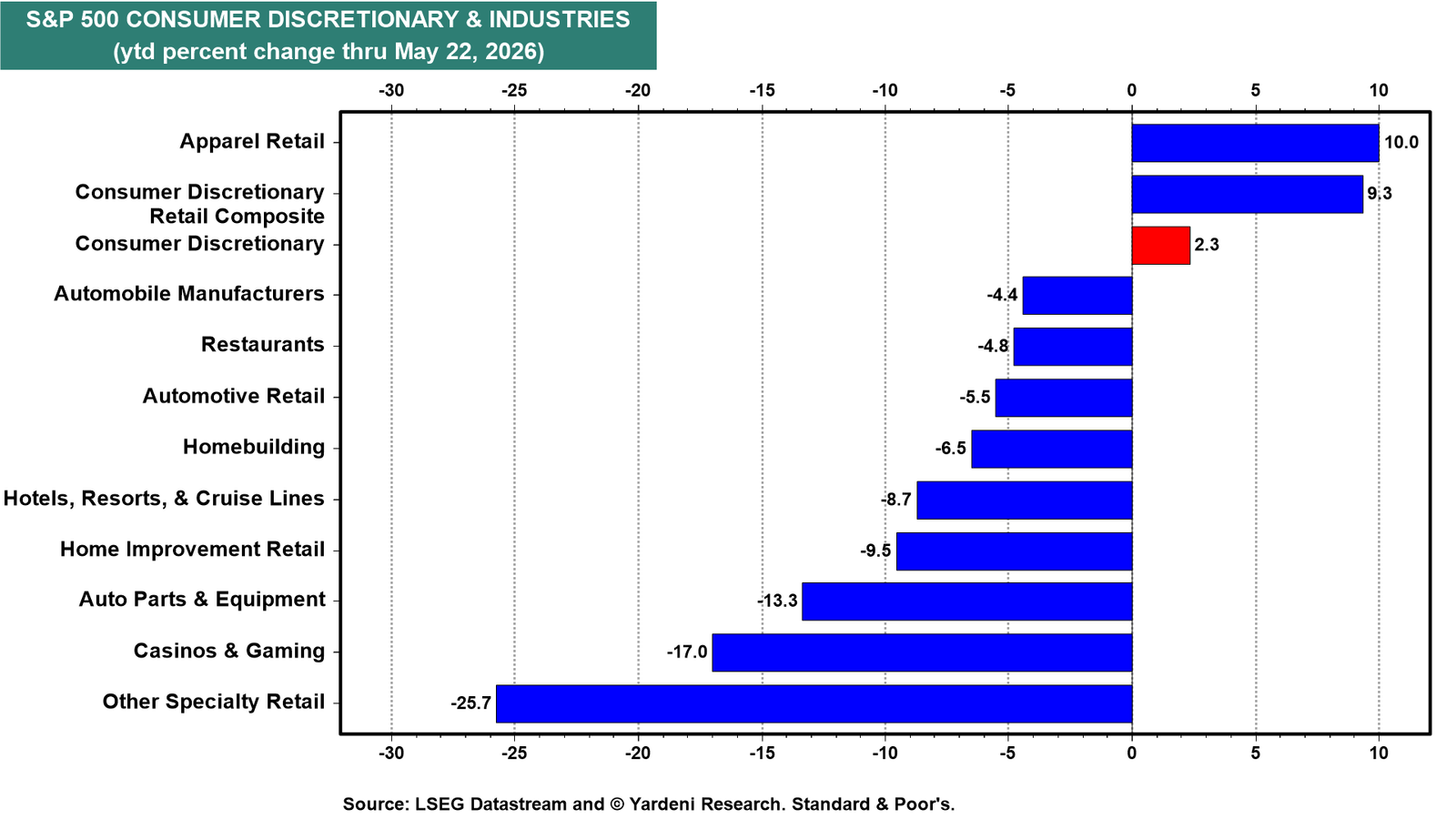
Look closer, and the strength narrows. Consumer Discretionary is up just 2.3% ytd, ninth among the 11 S&P 500 sectors. Only the sector’s retail industries are positive so far this year. The rest of its industries are down ytd by various amounts running from Automobile Manufacturers, down 4.4%, to Other Specialty Retail, down 25.7% (chart). A handful of names has carried the index’s performance while most of the sector trades lower.
Consider the following:
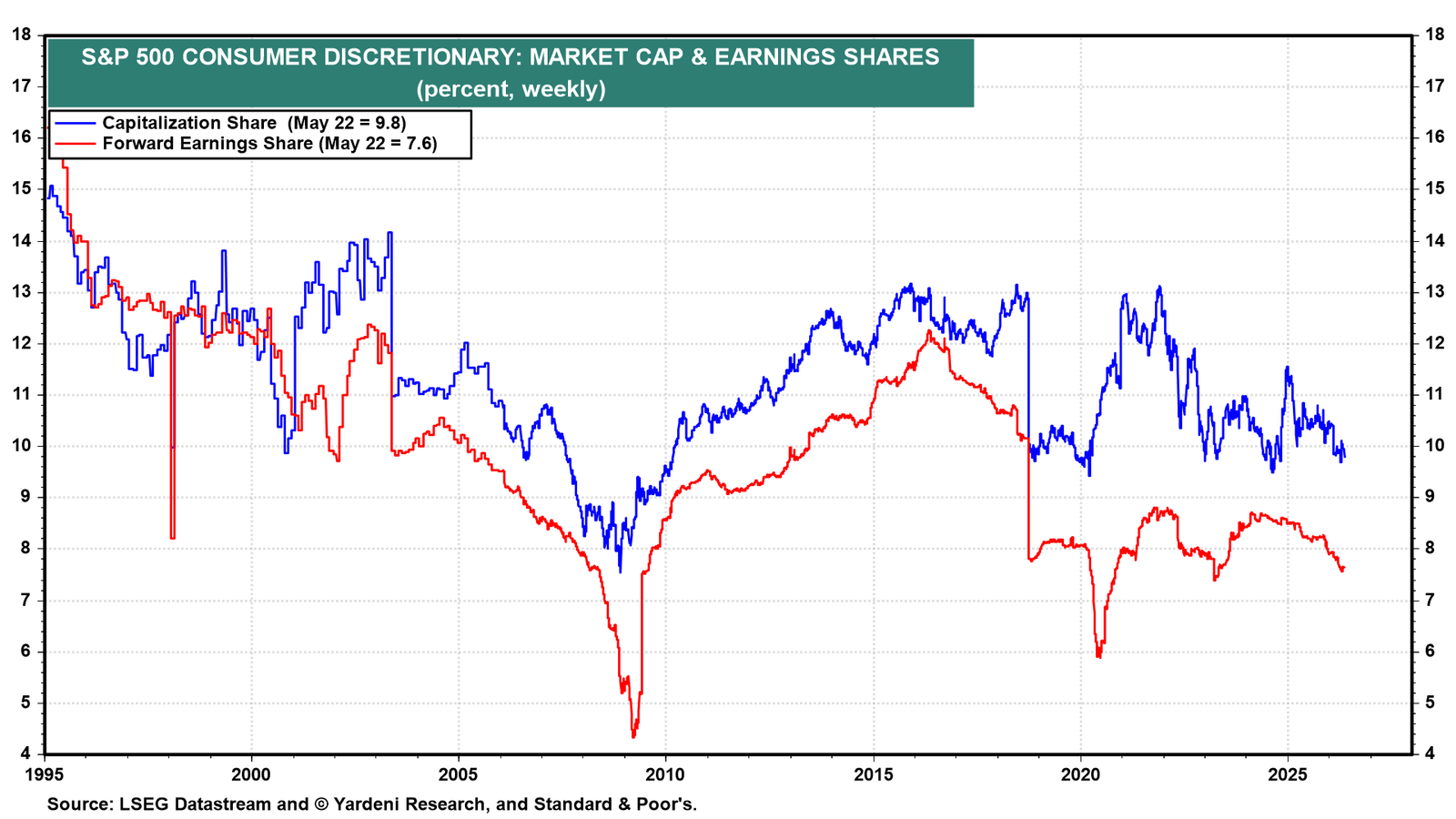
(1) Concentration. The sector accounts for just 9.8% of the S&P 500's market capitalization and 7.6% of the index's forward earnings (chart).
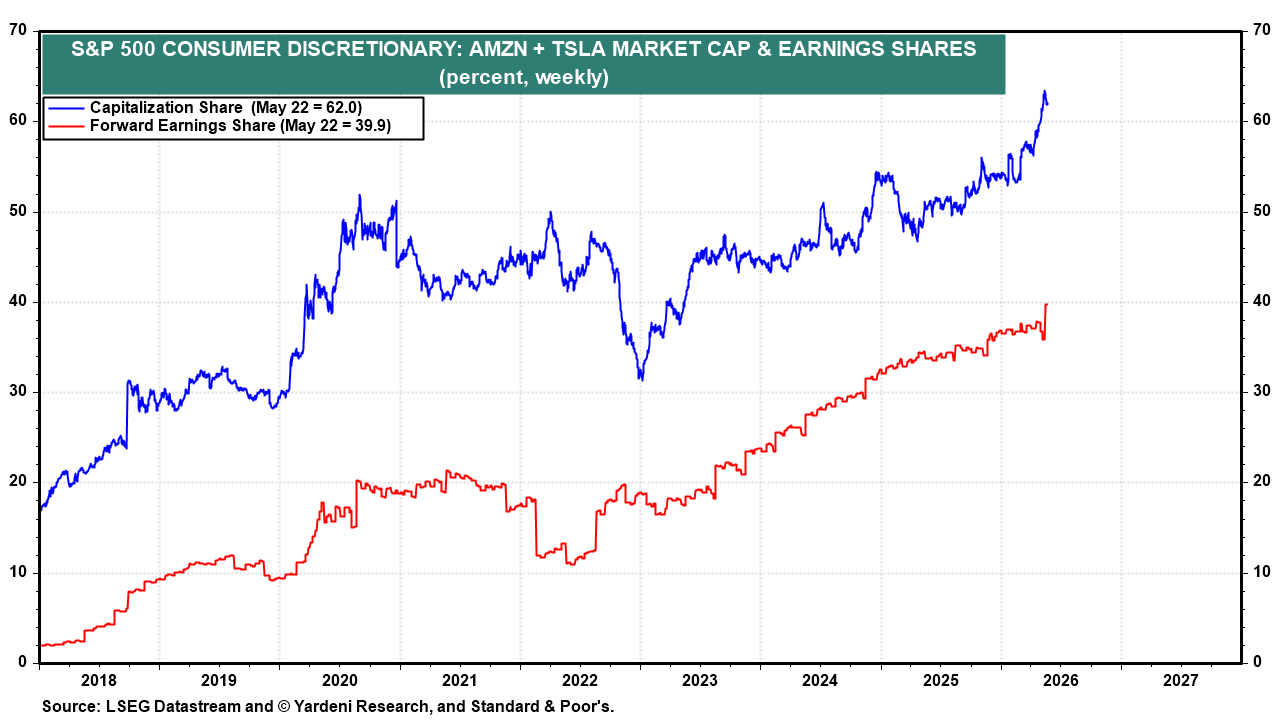
Amazon and Tesla together account for 62.0% of the sector's market capitalization and 39.9% of its forward earnings (chart). That share has surged in recent weeks. Any call on the sector is mostly a call on these two.
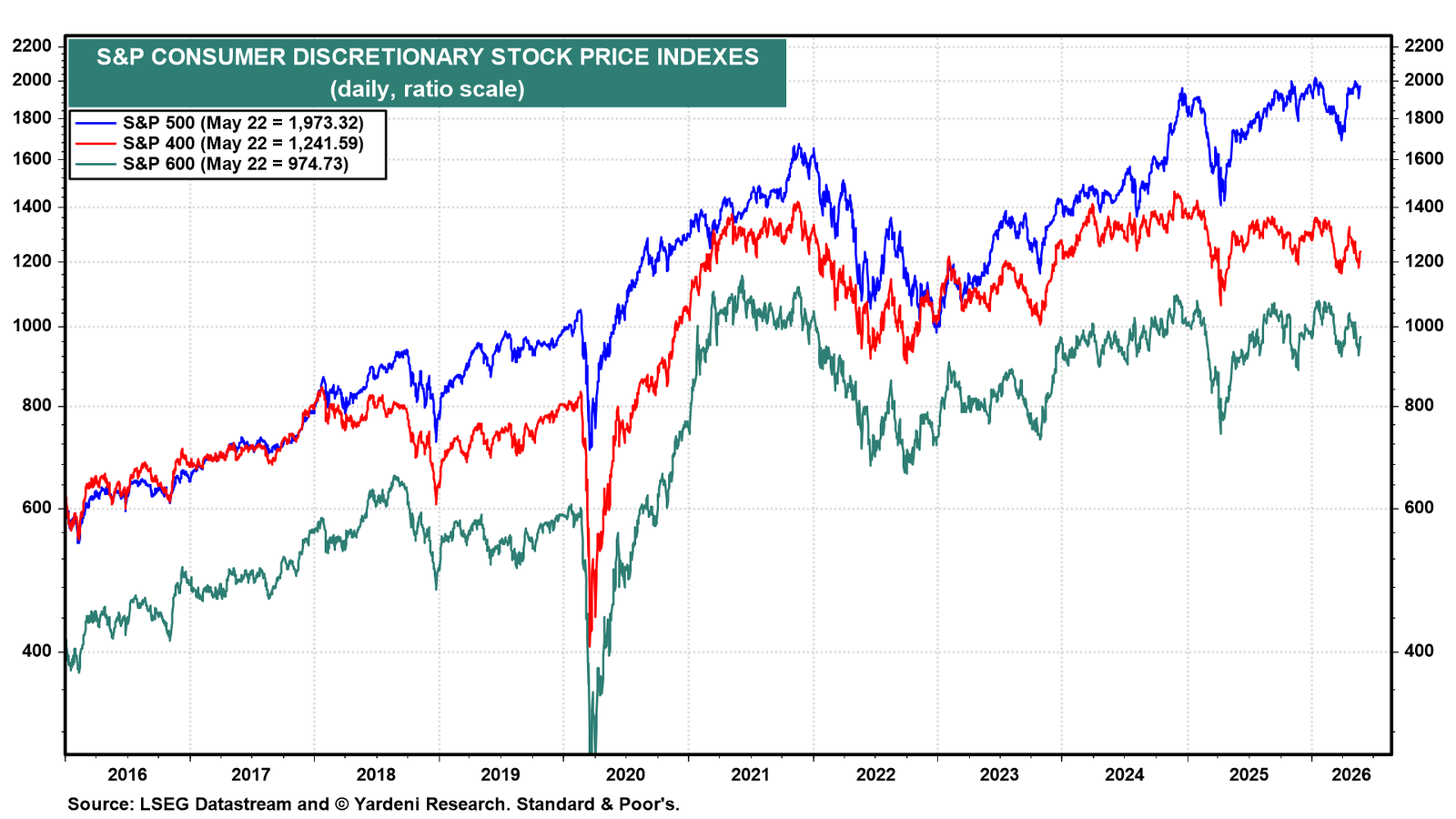
(2) Weak breadth. The S&P 500 Consumer Discretionary stock price index is near a record high, while its S&P 400 MidCap and S&P 600 SmallCap counterparts remain well below their 2021 peaks (chart). The smaller discretionary names, closer to the everyday consumer, are lagging the market. This is the K-shaped consumer showing up in the tape, with higher-end spending feeding the LargeCaps while the rest lag.
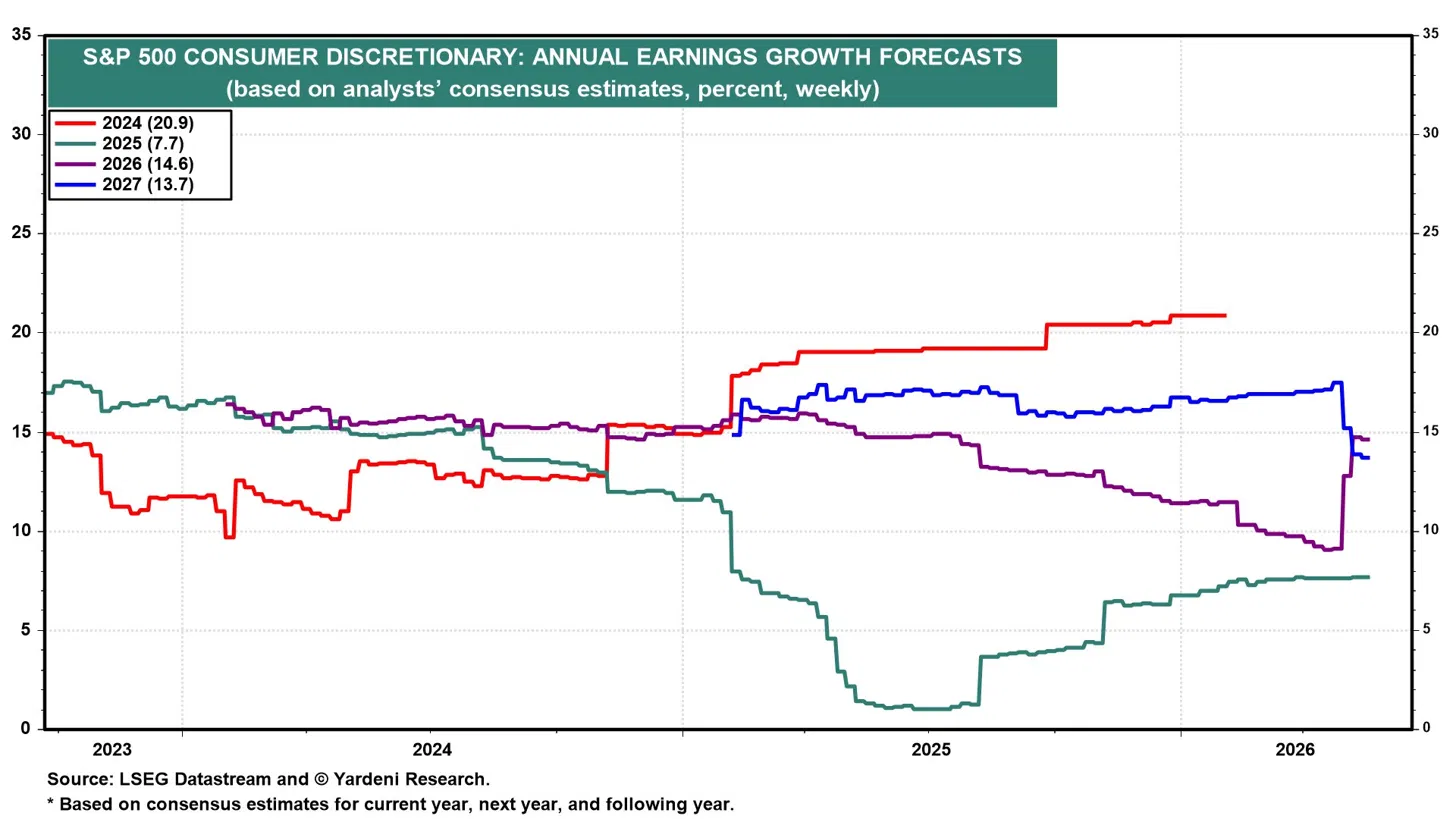
(3) Earnings and revenues growth. Sector earnings growth is set to almost double to 14.6% in 2026, up from 7.7% in 2025 (chart). Revenue growth is far more subdued, ticking up to just 7.5% in 2026 from 5.7% in 2025.
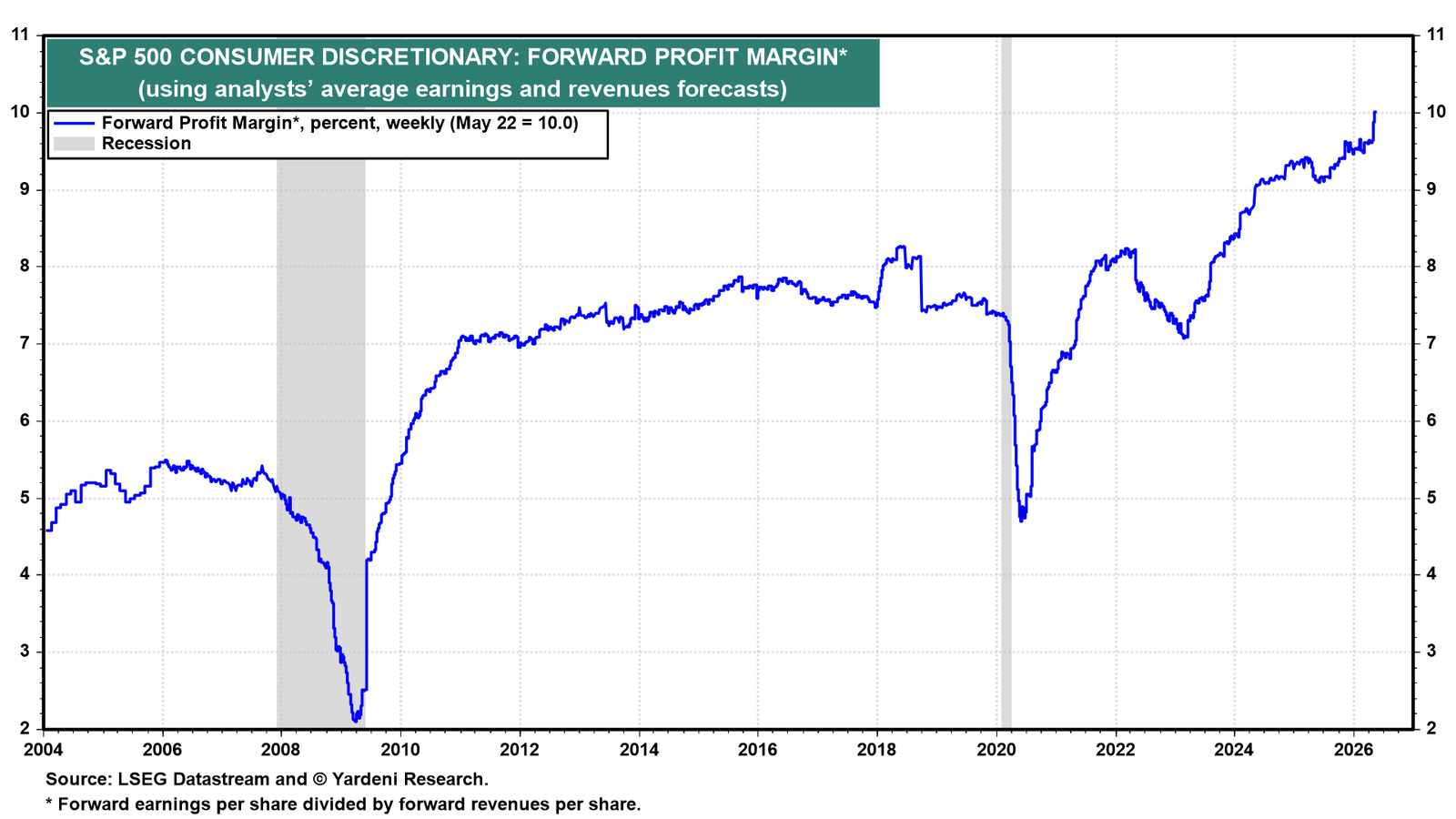
(4) Profit margin. At 10.0%, the sector's forward profit margin is the third-lowest of the 11 sectors’ margins, ahead of only Health Care’s and Consumer Staples’ (chart). Retail and autos are inherently low-margin businesses. The margin has climbed to a record over the past decade but off a low base.
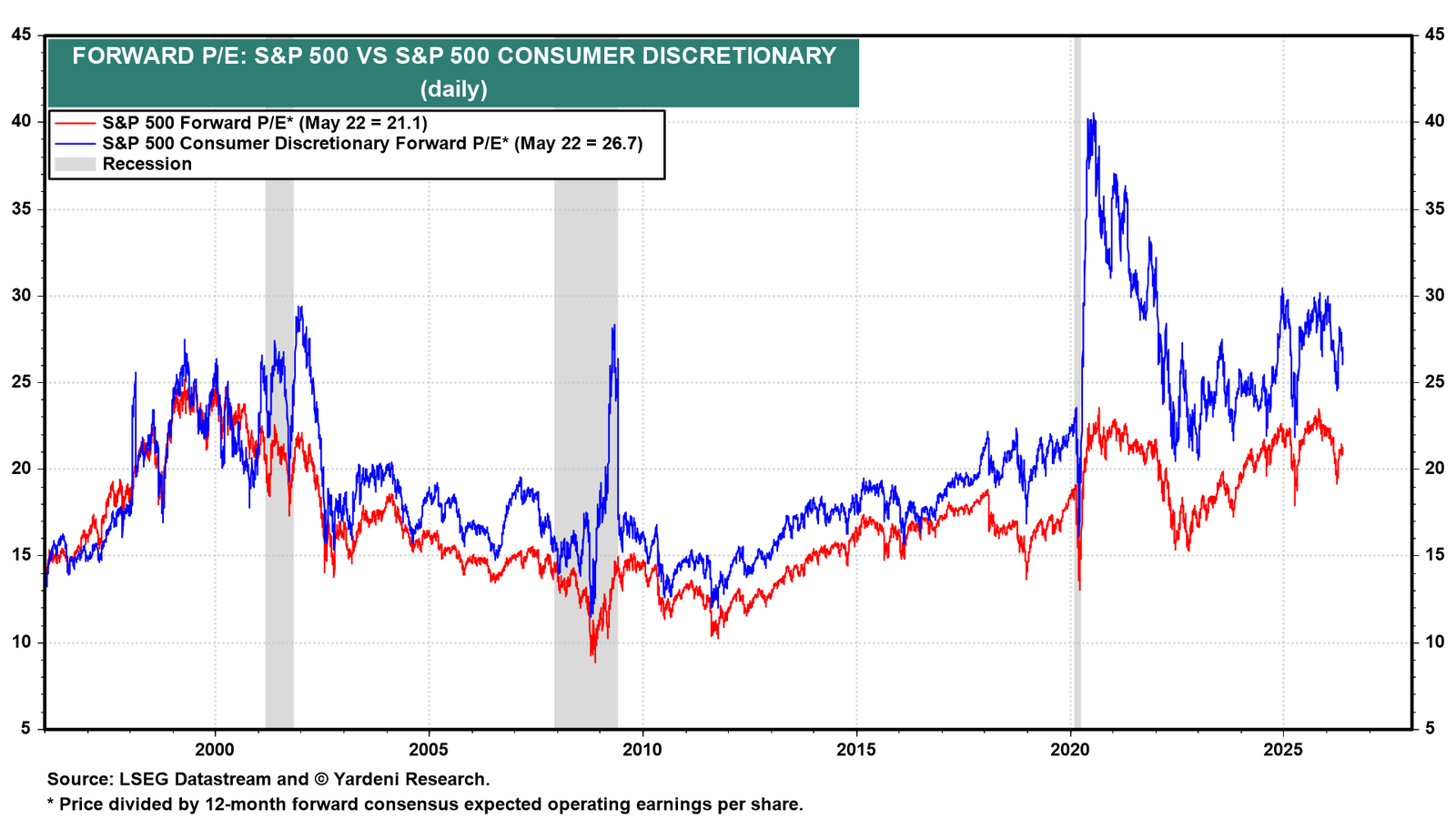
(5) Valuation. The sector's forward P/E is 26.7, well above the S&P 500's 21.1 (chart). That premium of more than five points partly reflects Tesla's 194.8 multiple, which lifts the sector reading, much as its market cap distorts the sector weight. Strip out that distortion, and the rest of the sector is cheaper than the headline implies. The multiple has been re-rated higher since 2020 and sits near the middle of that range today, neither cheap nor at a peak.
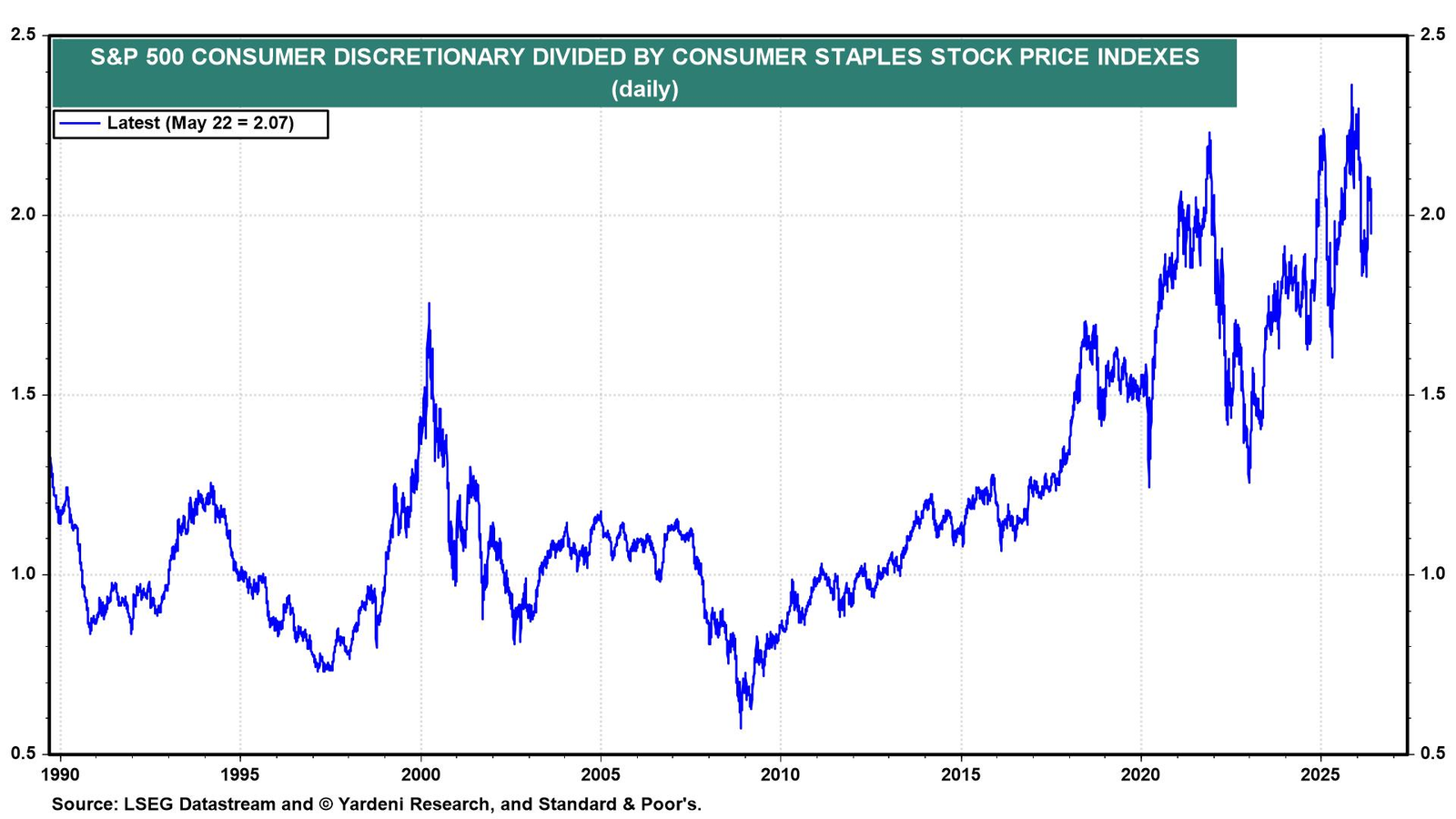
(6) Risk appetite. The ratio of the Consumer Discretionary to the Consumer Staples stock price index is 2.07, near a record high (chart). Investors still favor the cyclical consumer over the defensive one.
A strong stock price index resting on two stocks, with thin breadth, and a full multiple, is a sector to hold, not to chase. We stay market-weight. It could briefly outperform if ol prices fall in response to the end of the war in the Middle East.