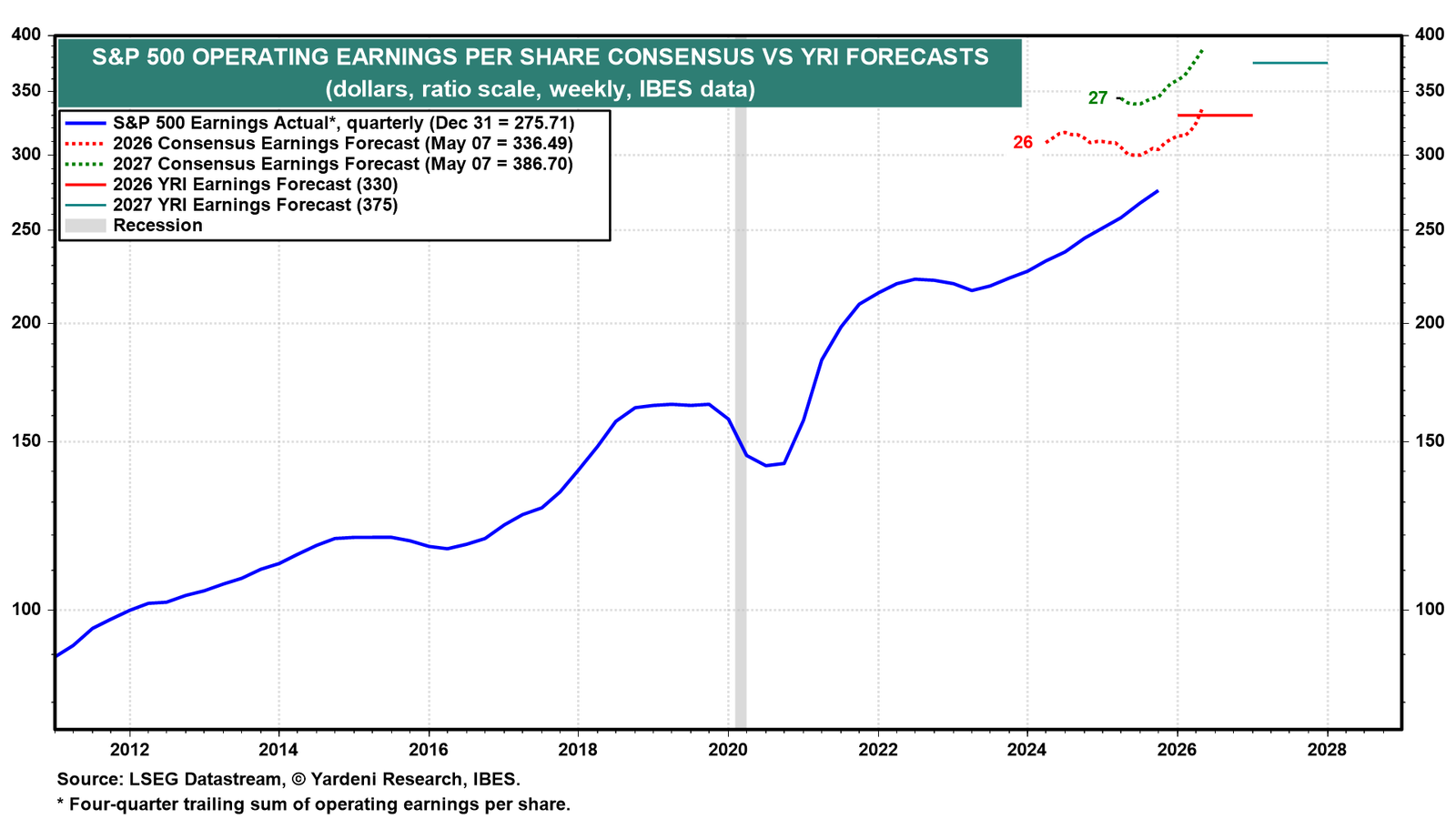
We are raising our year-end S&P 500 target from 7700 to 8250. We've been bullish on earnings but not as bullish as the recent consensus of industry analysts. We've never seen consensus earnings expectations rise so quickly for the current and coming years as they have in recent months. The result has been an earnings-led meltup in the stock market.
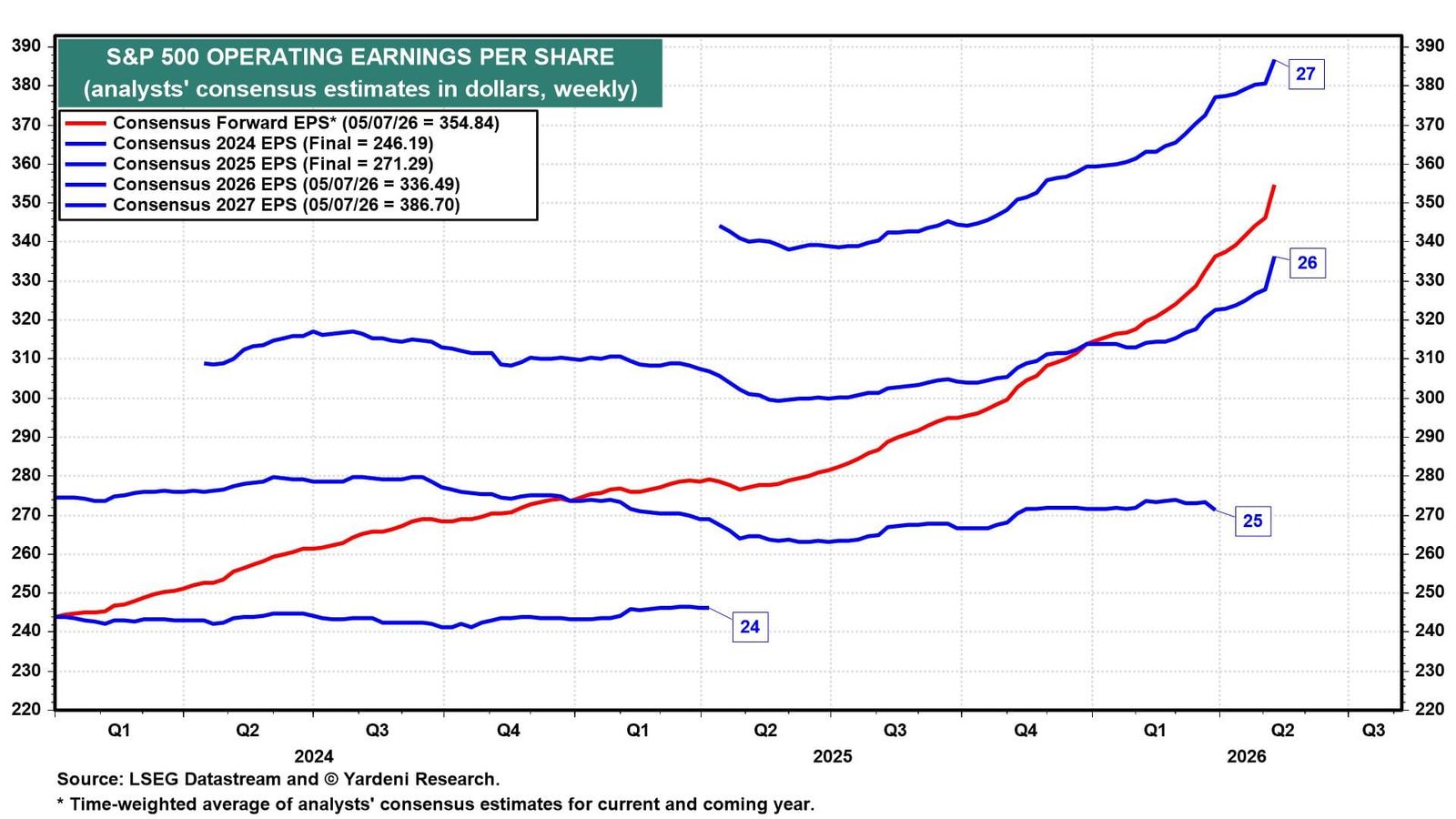
Our 2026 and 2027 EPS estimates have been $310 and $350, respectively, since late last year. Those were bullish estimates back then. Consensus EPS estimates have rocketed above our targets in recent weeks. They are currently $336.49 (up 22.0% from last year!) and $386.70 (up 14.9% from the 2026 consensus estimate) (chart).
We are raising our EPS estimates to $330 this year and $375 next year. We are sticking with our forward P/E range of 18.0-22.0, resulting in a year-end range for the S&P 500 of 6750-8250, assuming (as we do) that forward earnings per share will be will be $375 at the end of this year. The latter is already at $354.
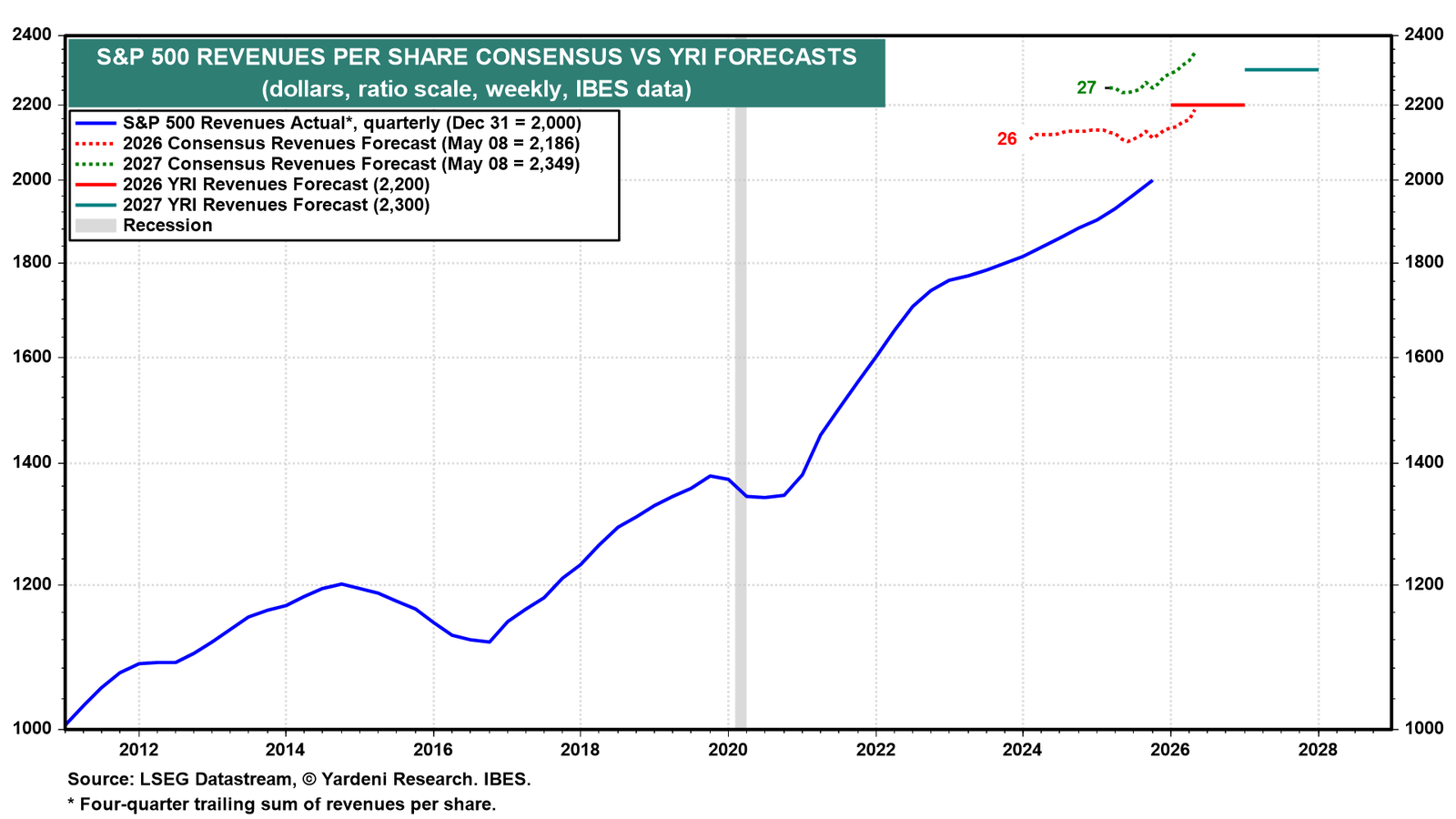
We are also raising our S&P 500 RPS by $100 for both 2026 and 2027 to $2,200 and $2,300 (chart). Those numbers are nearly the same as the current consensus.
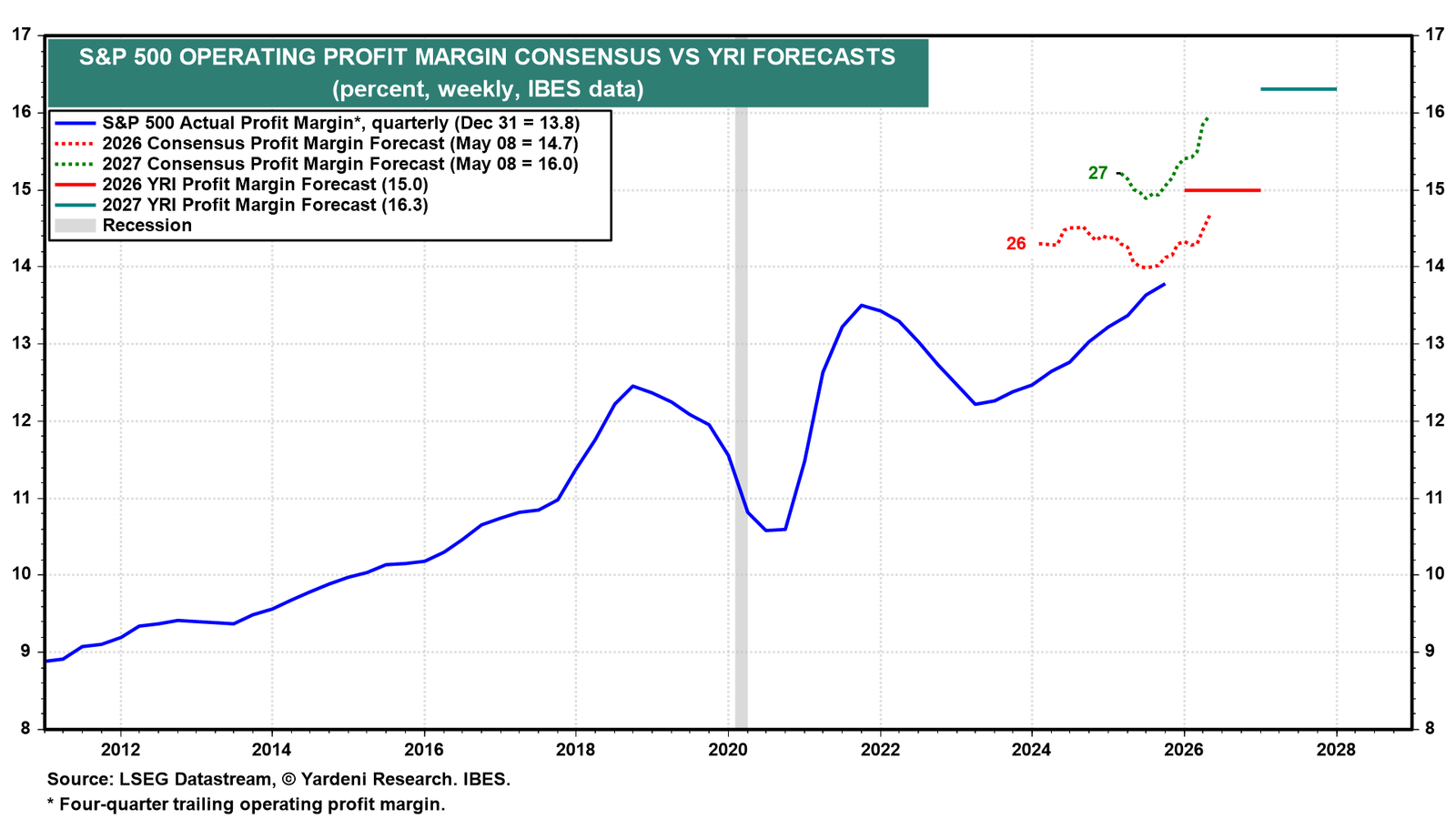
Our outlooks for EPS and RPS imply that the S&P 500 forward profit margin will rise to 15.0 this year and 16.3 next year (chart). These forecasts are a bit higher than the current consensus.
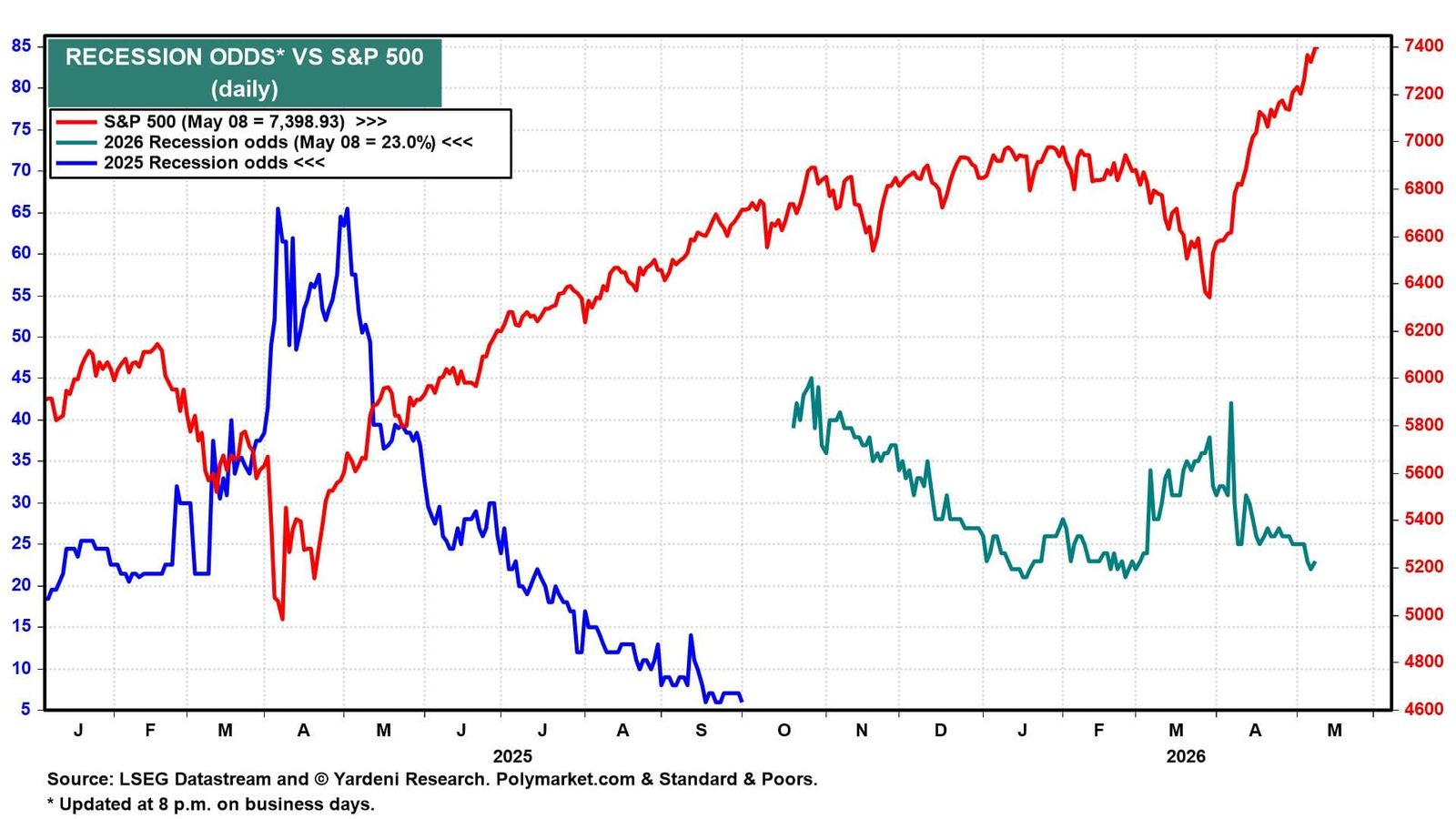
Our key assumption is that the economy will remain resilient, and so will earnings. That's been our mantra since we first started writing about the Roaring 2020s during the summer of 2020. We could certainly have another recession scare along the way, as we did in early 2025 and 2026 (chart).
We are now also raising our subjective probability of a continuation of the Roaring 2020s to 80% from 60% simply by merging it with our meltup scenario (previously at 20%). We are doing so because we believe that any meltdown will be a buying opportunity and won't trigger a recession or bear market similar to the 1999-2000 Tech Bubble and Tech Wreck. We are sticking with 20% odds of a recession that causes a bear market.
We reiterate that the upward revisions to consensus 2026 and 2027 earnings estimates have been impressive, as companies have been reporting stronger-than-expected earnings results (chart). Consequently, S&P 500 forward earnings has been rising at an accelerating pace. By definition, it will converge with the consensus 2027 estimate at the end of the year. The latter is already at $386.70. Our $375 year-end estimate for forward earnings is conservative, in case the analysts are too exuberant.
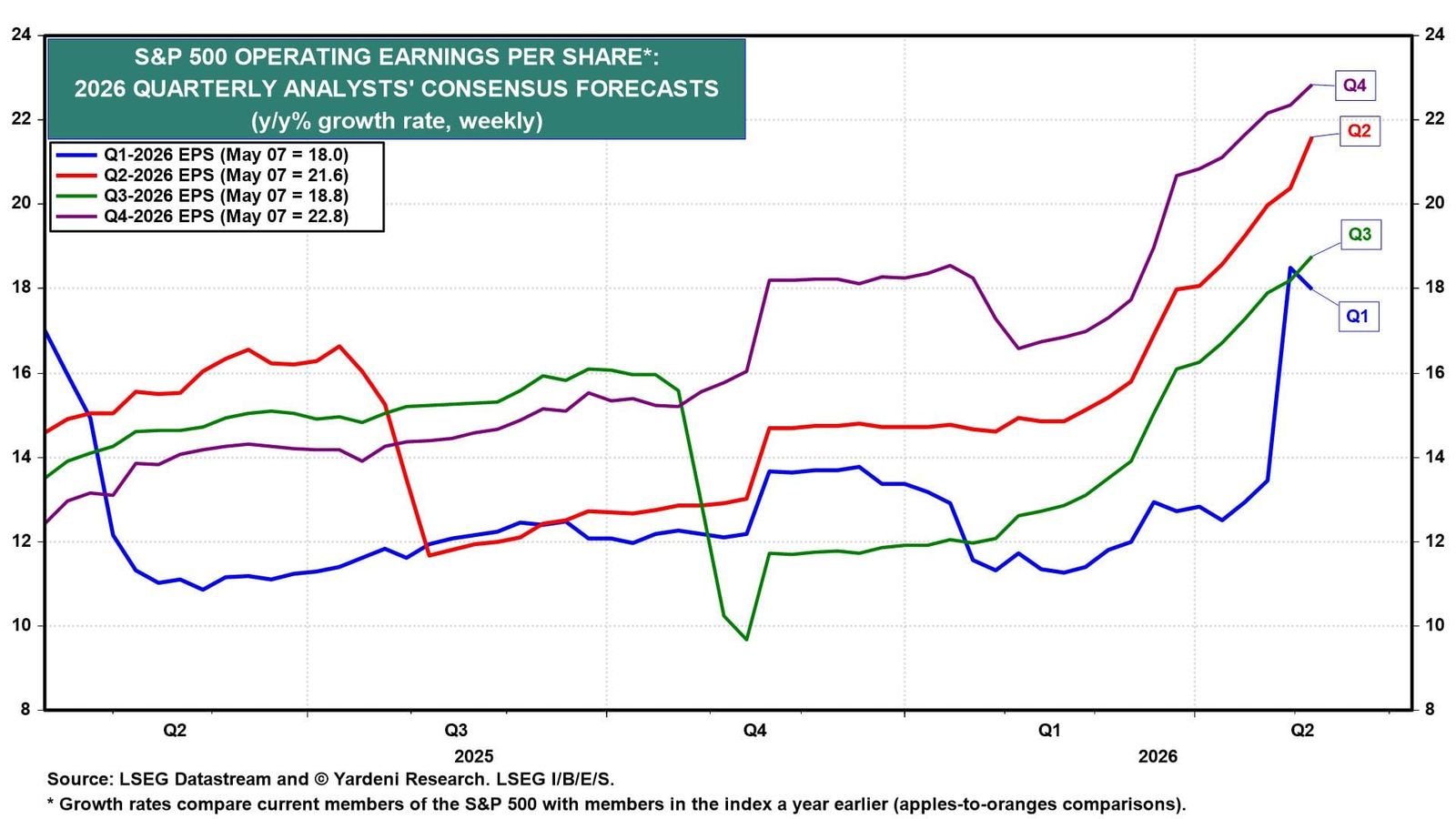
The analysts' exuberance is on full display in their consensus estimates of S&P 500 EPS growth for each of this year's four quarters (chart). Again, we've never seen anything like this.
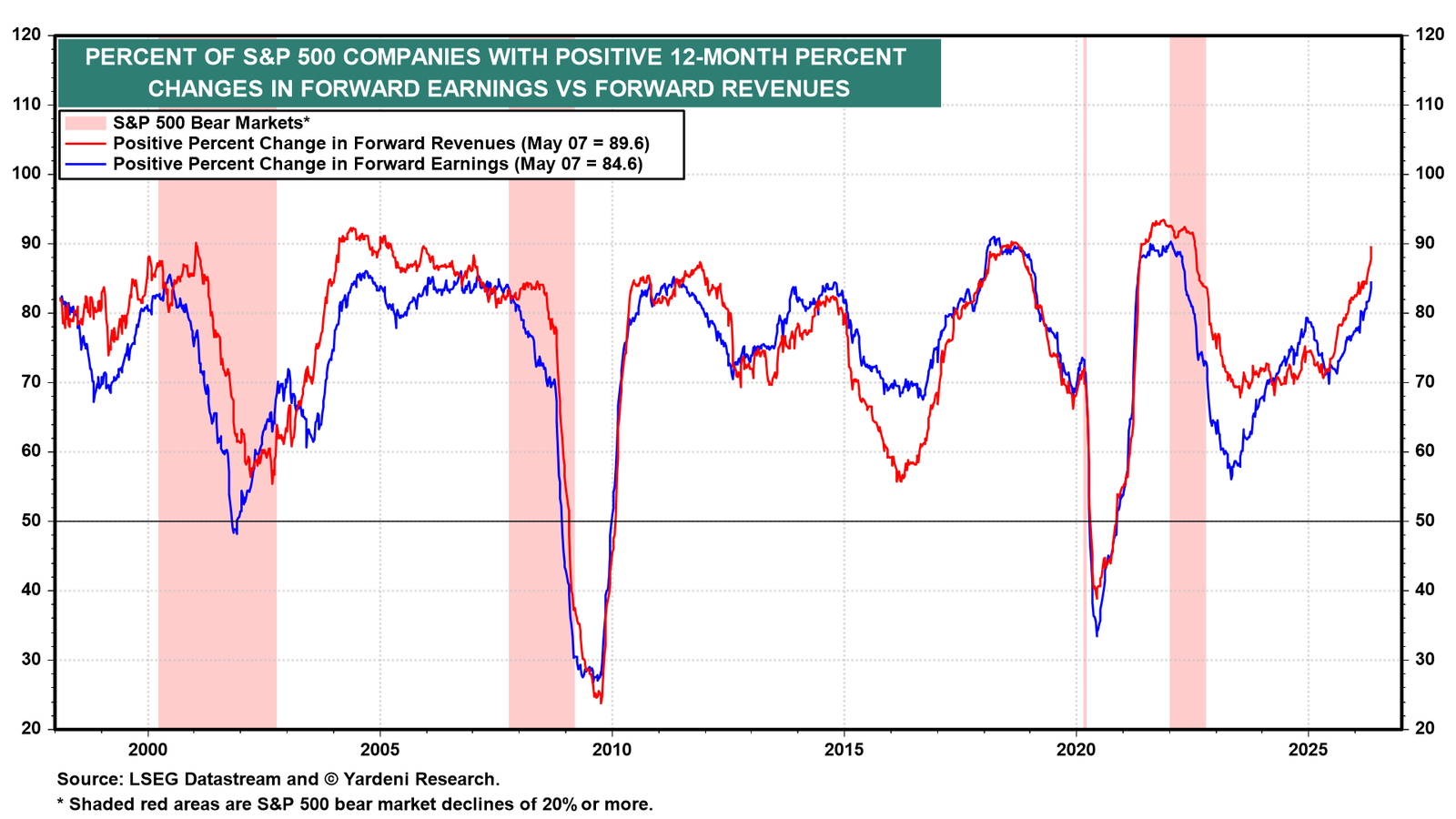
The percentages of S&P 500 companies with positive y/y growth in forward RPS and EPS continue to increase, reaching 89.6% and 84.6%, respectively, during the week of May 7 (chart). The recent rapid widening of earnings breadth is bullish.
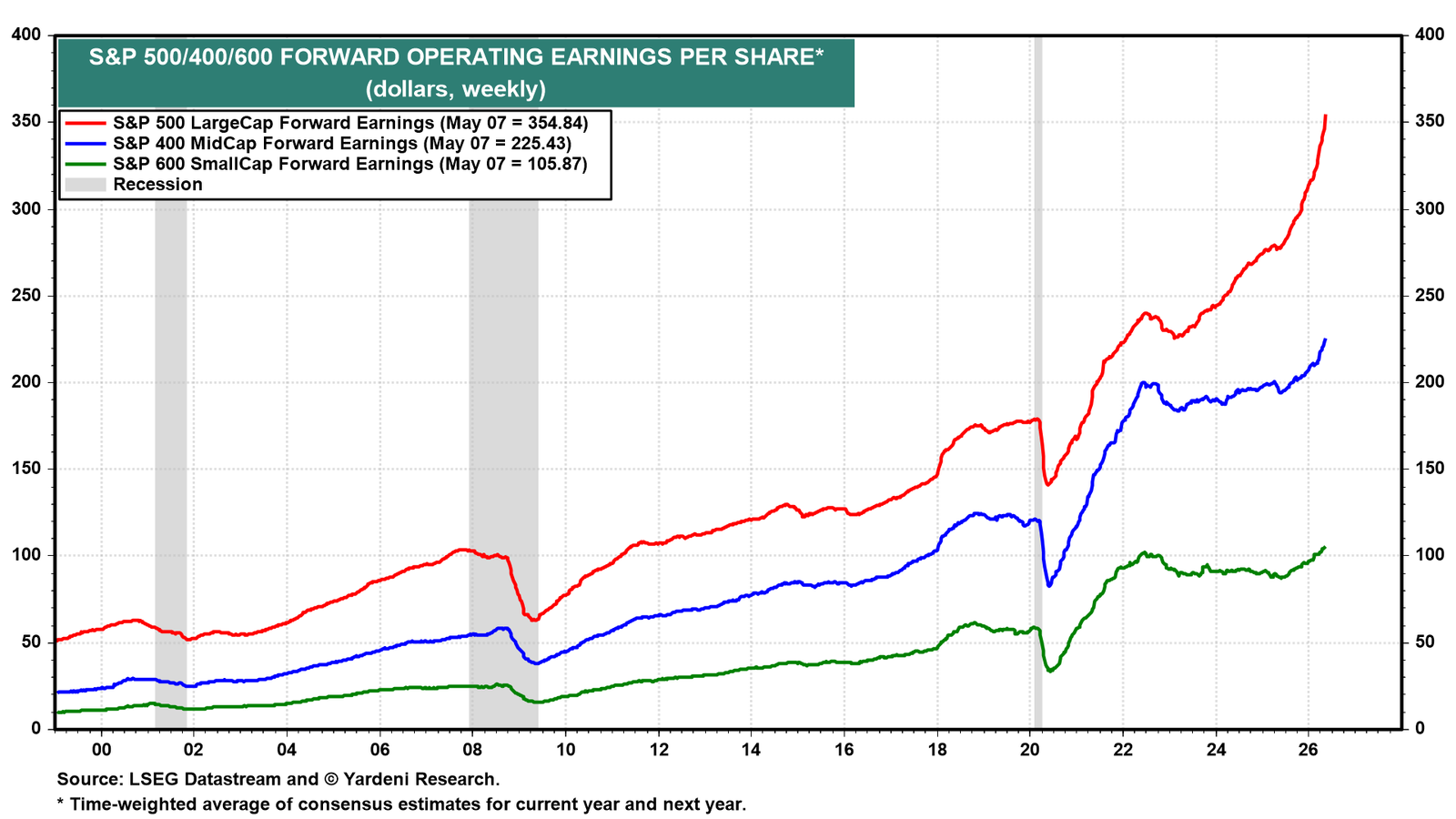
The widening of earnings breadth is also evident in the record highs in forward EPS for the S&P 400 MidCaps and the S&P 600 SmallCaps (chart).
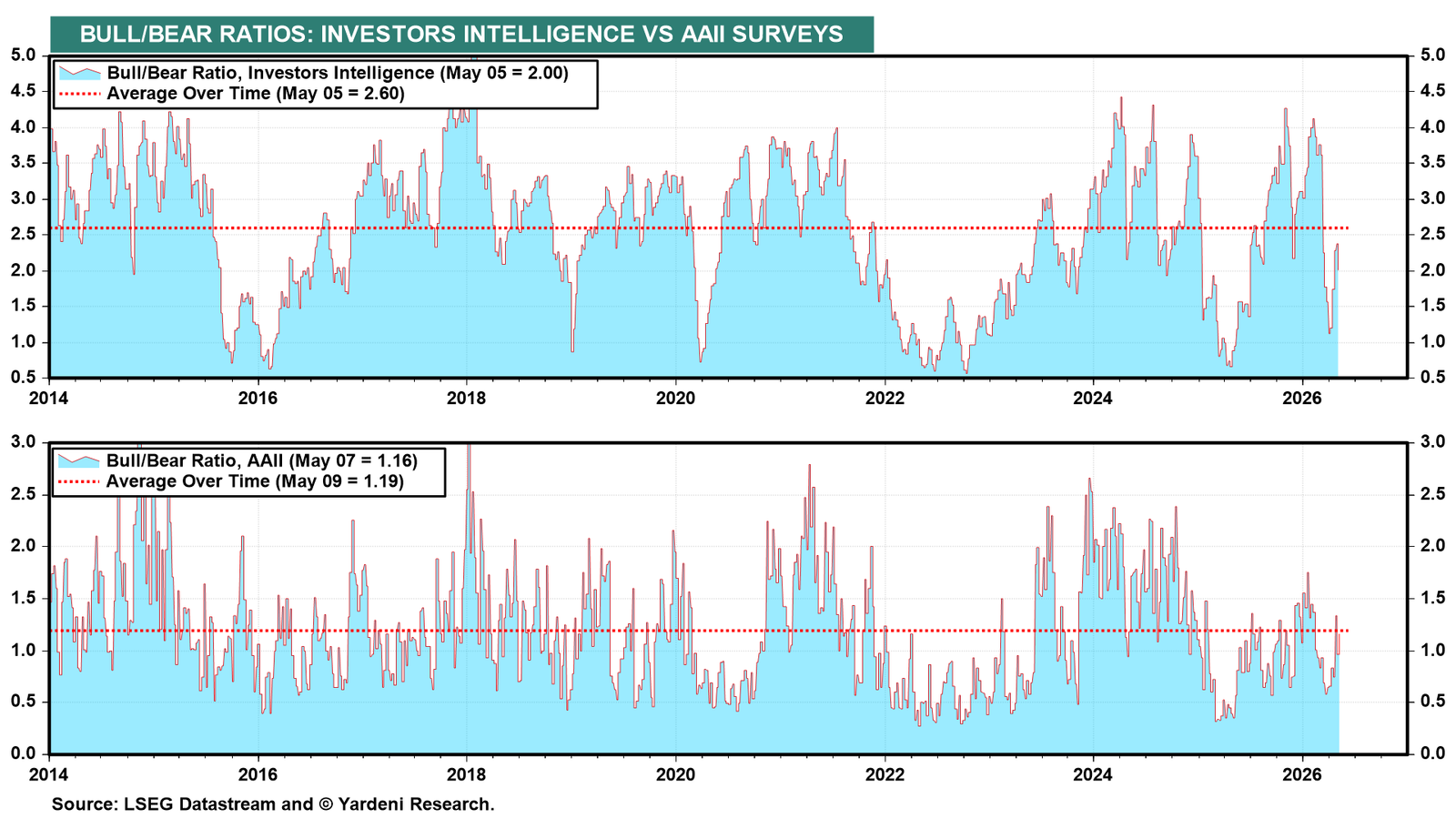
At the start of this year, we predicted a stock market pullback partly because the Bull/Bear Ratios (BBR) we monitor showed too many bulls (chart). We called the March 30 bottom one day later, partly because there were too many bears. Now the BBRs have rebounded, but they remain low enough that we aren't anticipating another pullback for now.
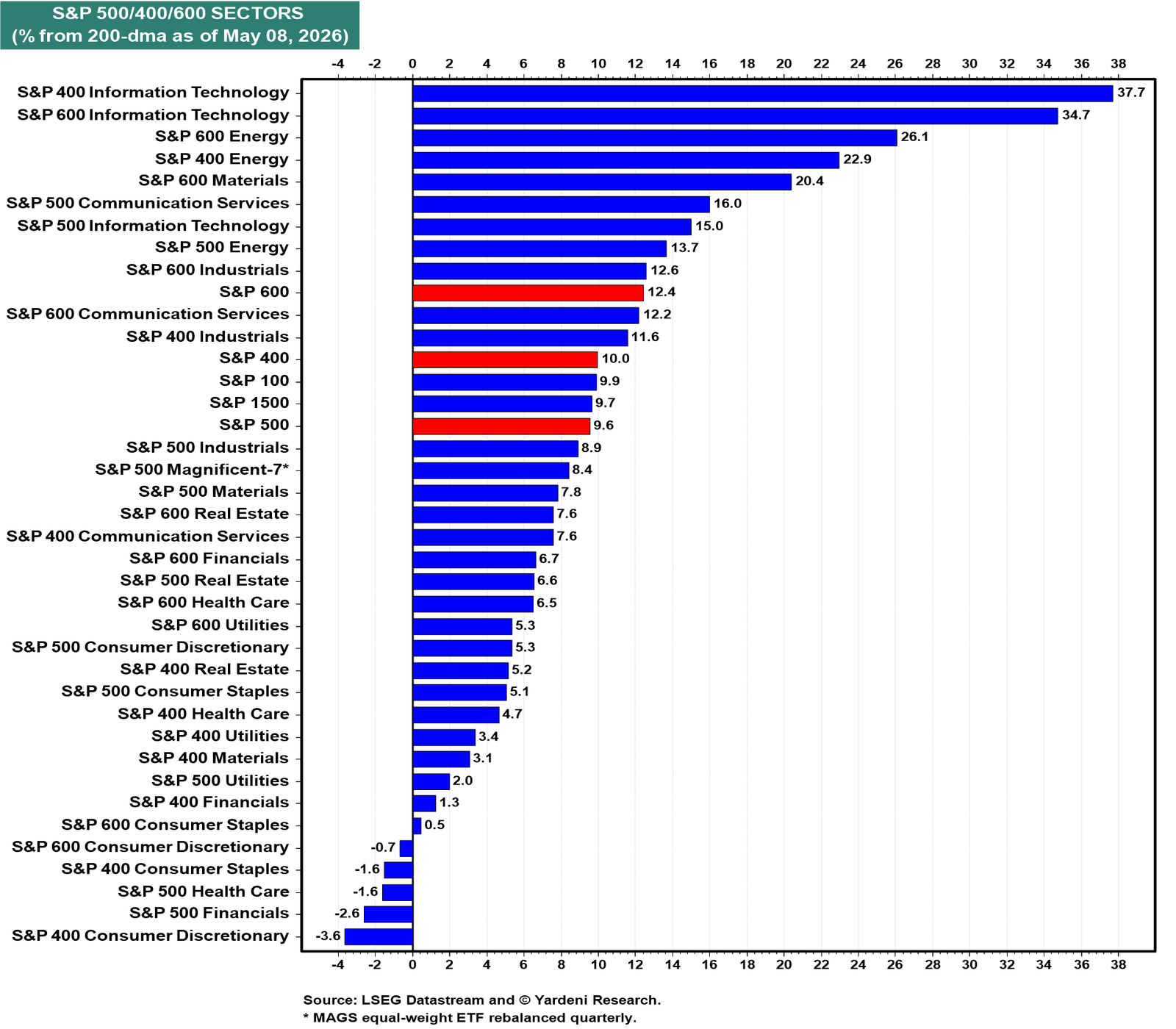
Then again, some sectors of the S&P 500/400/600 do seem overbought when comparing Friday's prices to their 200-day moving averages (chart). However, it has been an earnings-led melt-up since March 31, driven by Q1's blockbuster earnings reporting season.
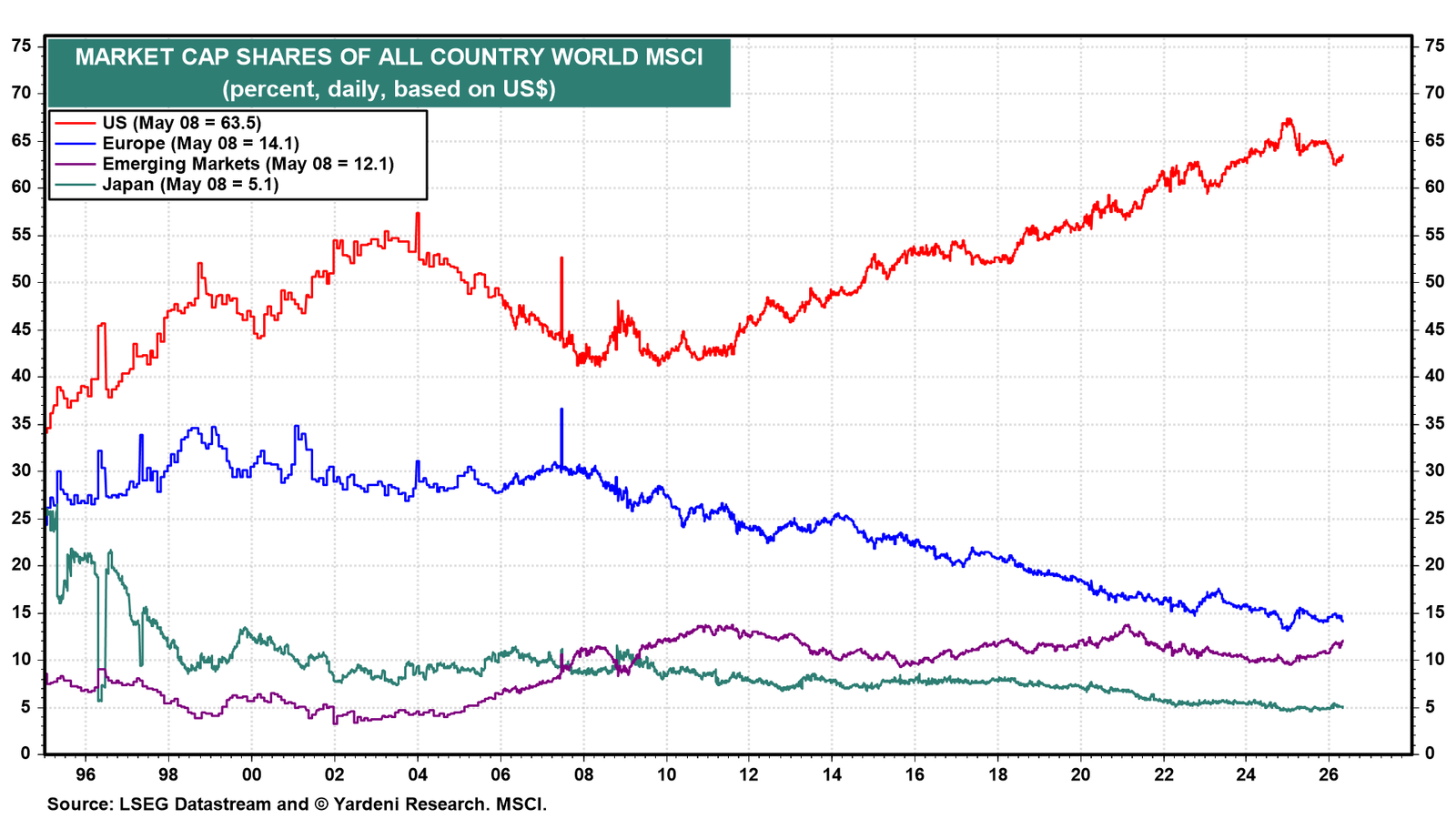
We are sticking with our Go Global recommendation, which has been our advice since December 7, 2025. The war in the Middle East upended the strategy during March. However, we think there are relatively cheaper opportunities overseas, particularly in emerging market economies, which have gained market-cap share in the All Country World MSCI index since early 2025 (chart).
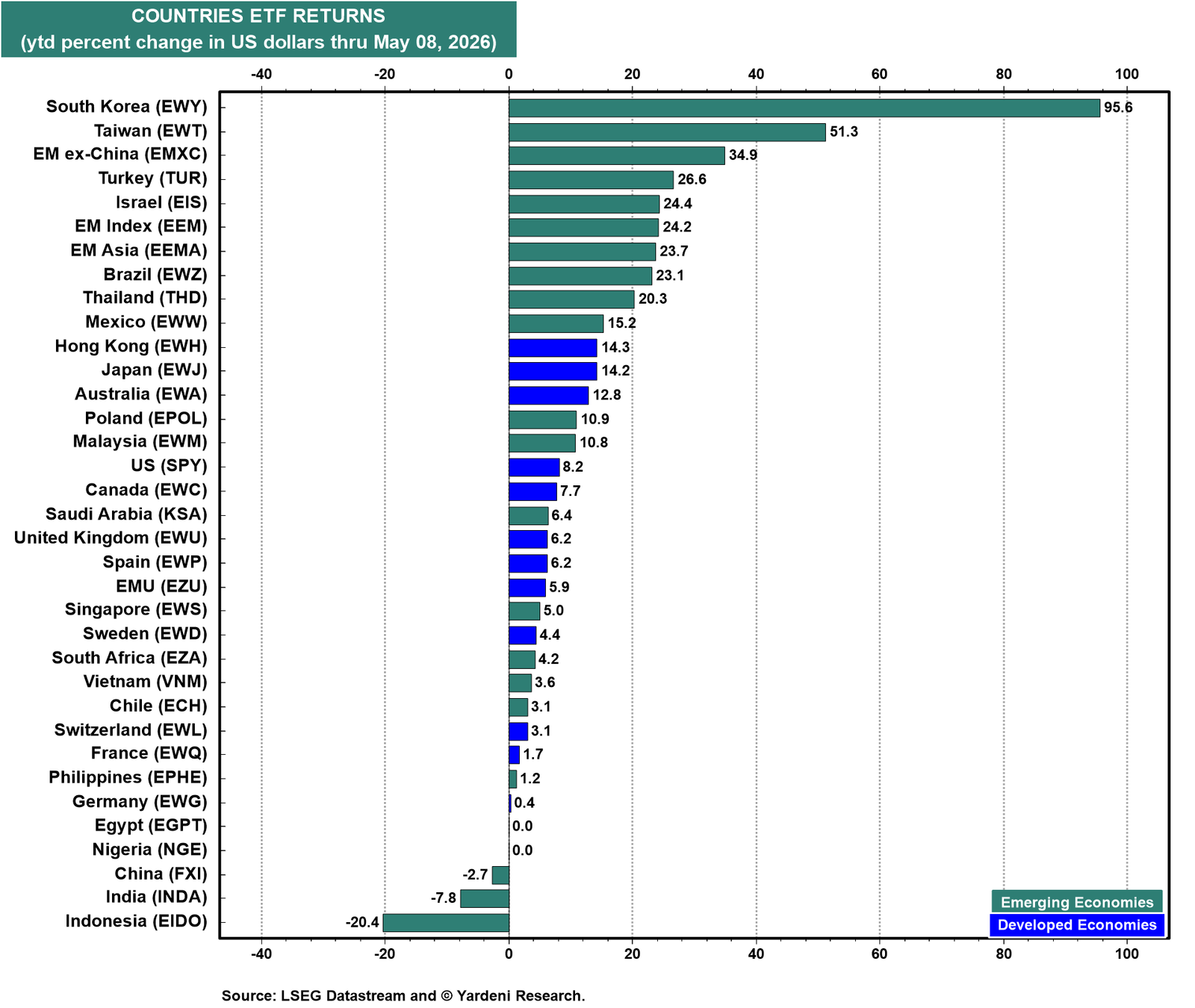
On a ytd basis and in US dollars, emerging markets have led the global performance derby (chart). We've suggested Go Global using EMXC (EM ex-China) rather than EEM (EM Index). So far, so good.
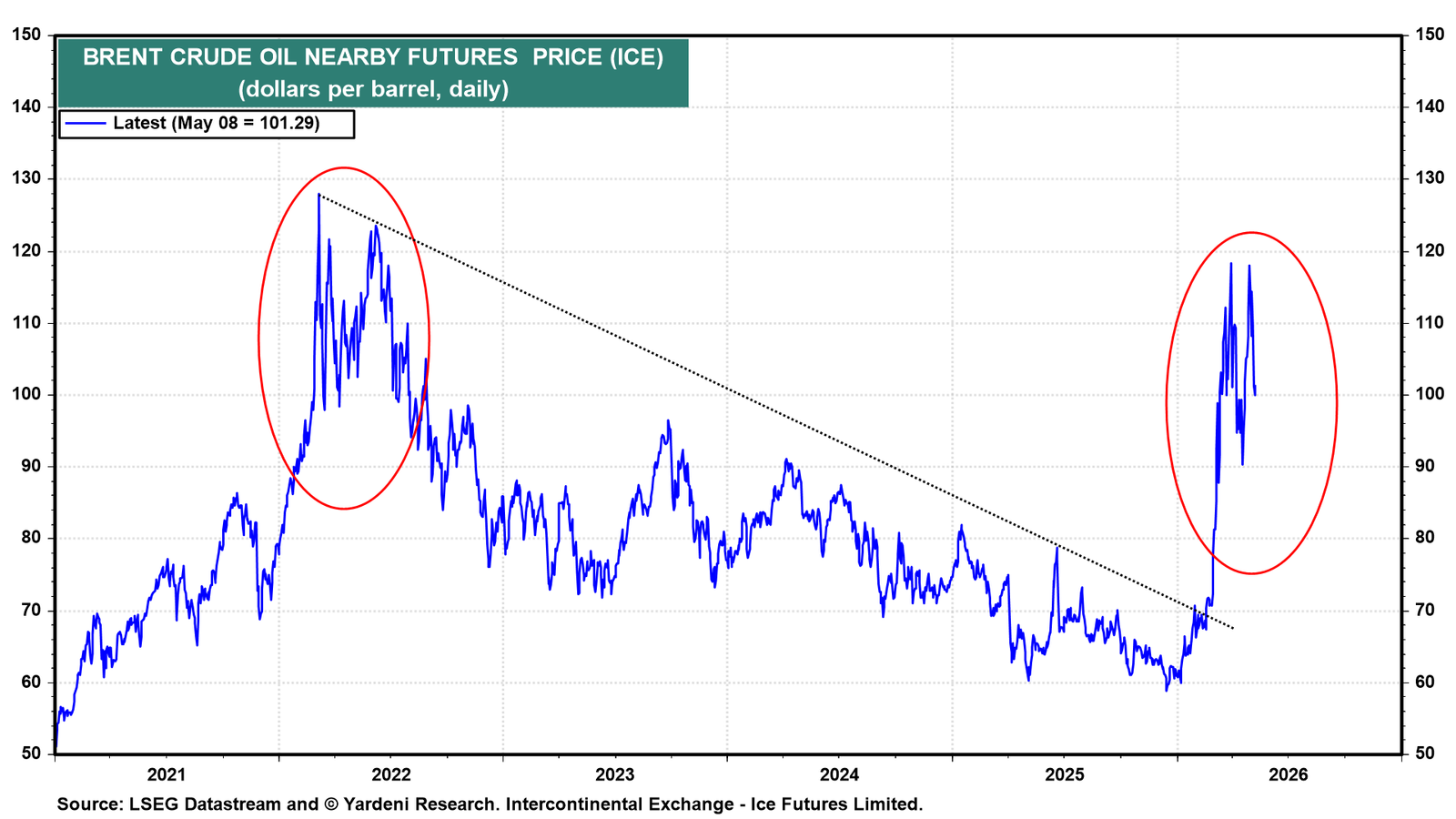
What could possibly go wrong? The war in the Middle East isn't over, though that hasn't kept stock markets from soaring around the world in April and so far in May. That's because oil prices have remained around $100 per barrel (chart). The shock waves from the war could still hit the global economy. Another round of fighting could be even more troublesome, as it could result in stagflation. A more persistent inflation problem would force central banks to raise interest rates. The Bond Vigilantes would likely push bond yields higher in this scenario.
Nevertheless, for now, we are sticking with our 10,000 target for the S&P 500 by the end of 2029. It might arrive ahead of schedule.
Happy Mother's Day!