When the labor market sneezes, ADP, Paychex, and ManpowerGroup catch colds. The stock prices of all three sold off sharply as hiring cooled starting early last year (chart). But on balance, the latest batch of labor market data suggests that employment conditions may be improving, and employment-related stocks may be bottoming (chart).
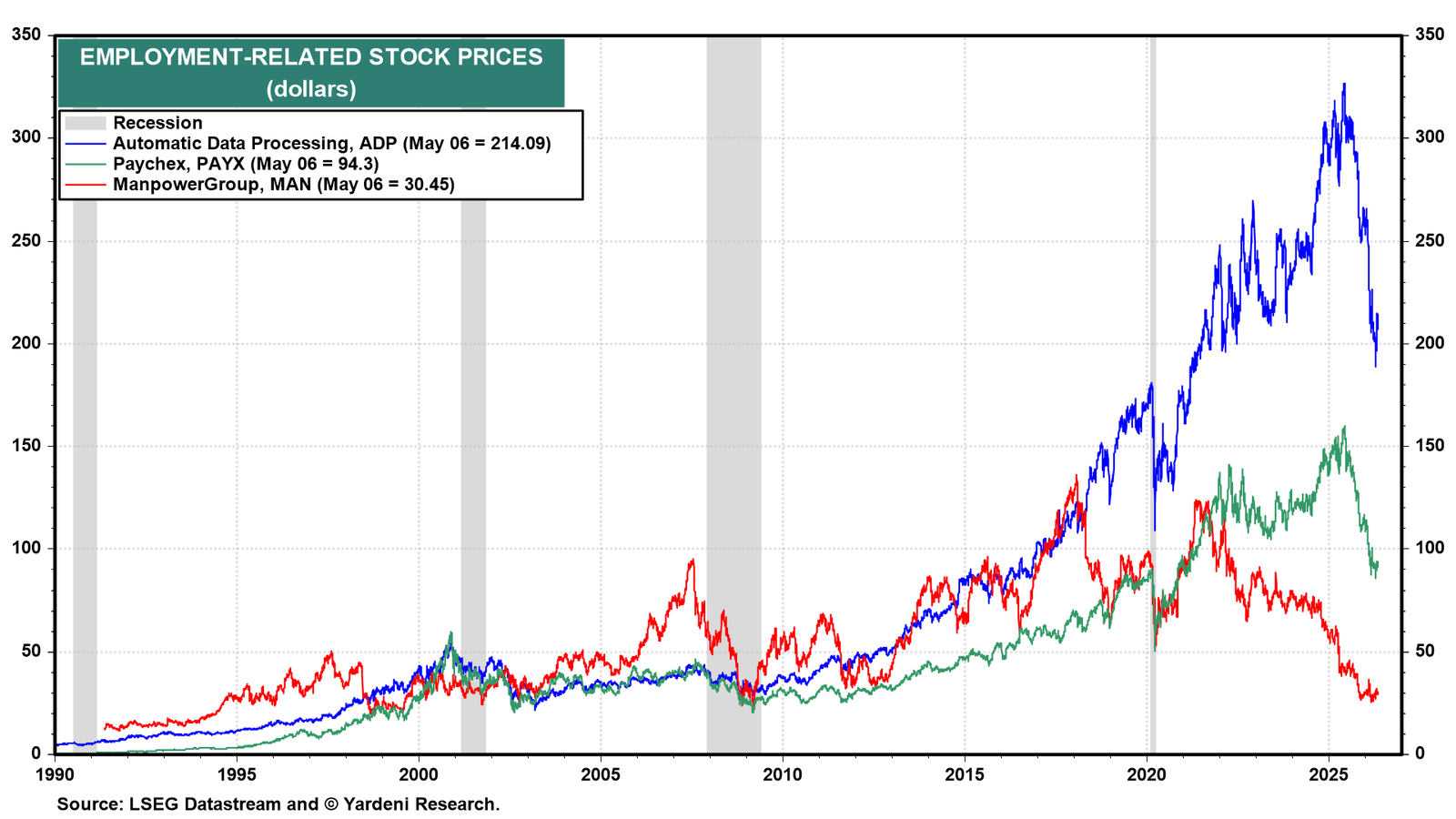
We disagree with the widely-held notion that AI is a net job killer. In our opinion, AI will create jobs on balance. Humans will use AI to achieve greater output at lower cost, creating a wealthier society that needs more and newer types of human labor. We agree with Jevons' Paradox: Making a production input more efficient lowers the cost of the final product, stimulates demand for it, and ultimately results in greater demand for the input itself, despite the productivity gain.
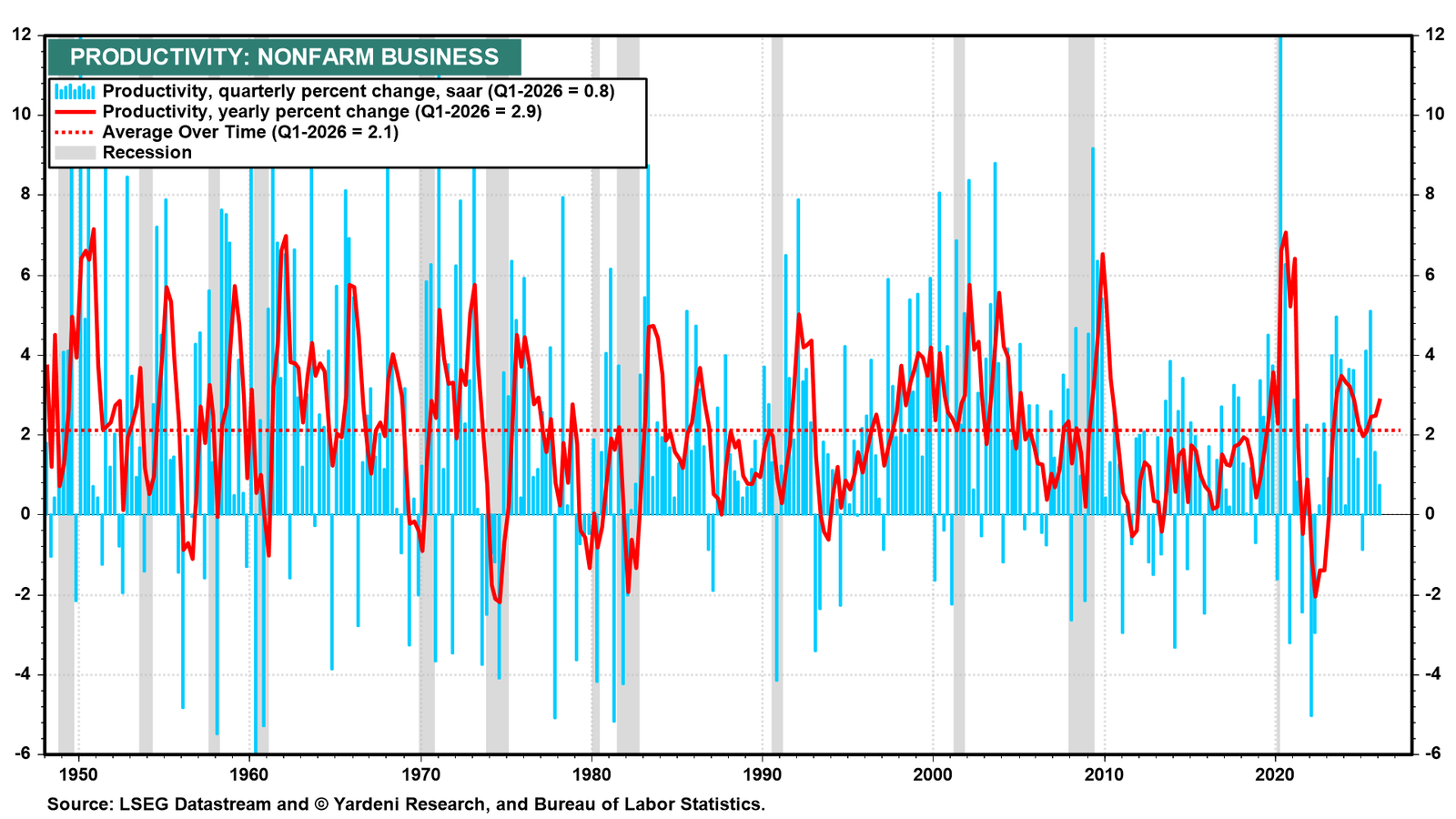
Let's review the latest productivity, labor costs, and employment data:
(1) Productivity. Productivity is measured as nonfarm business output divided by labor hours worked. Output increased 3.3% y/y in Q1-2026, solidly above the comparable 2.7% rise in real GDP. Hours worked rose only 0.4% y/y. So productivity increased 2.9% y/y, exceeding its historical average of 2.1% (chart). In our Roaring 2020s scenario, productivity growth is likely to increase to 3.5%-4.0% over the remainder of this decade and continue at that pace through the Roaring 1930s.
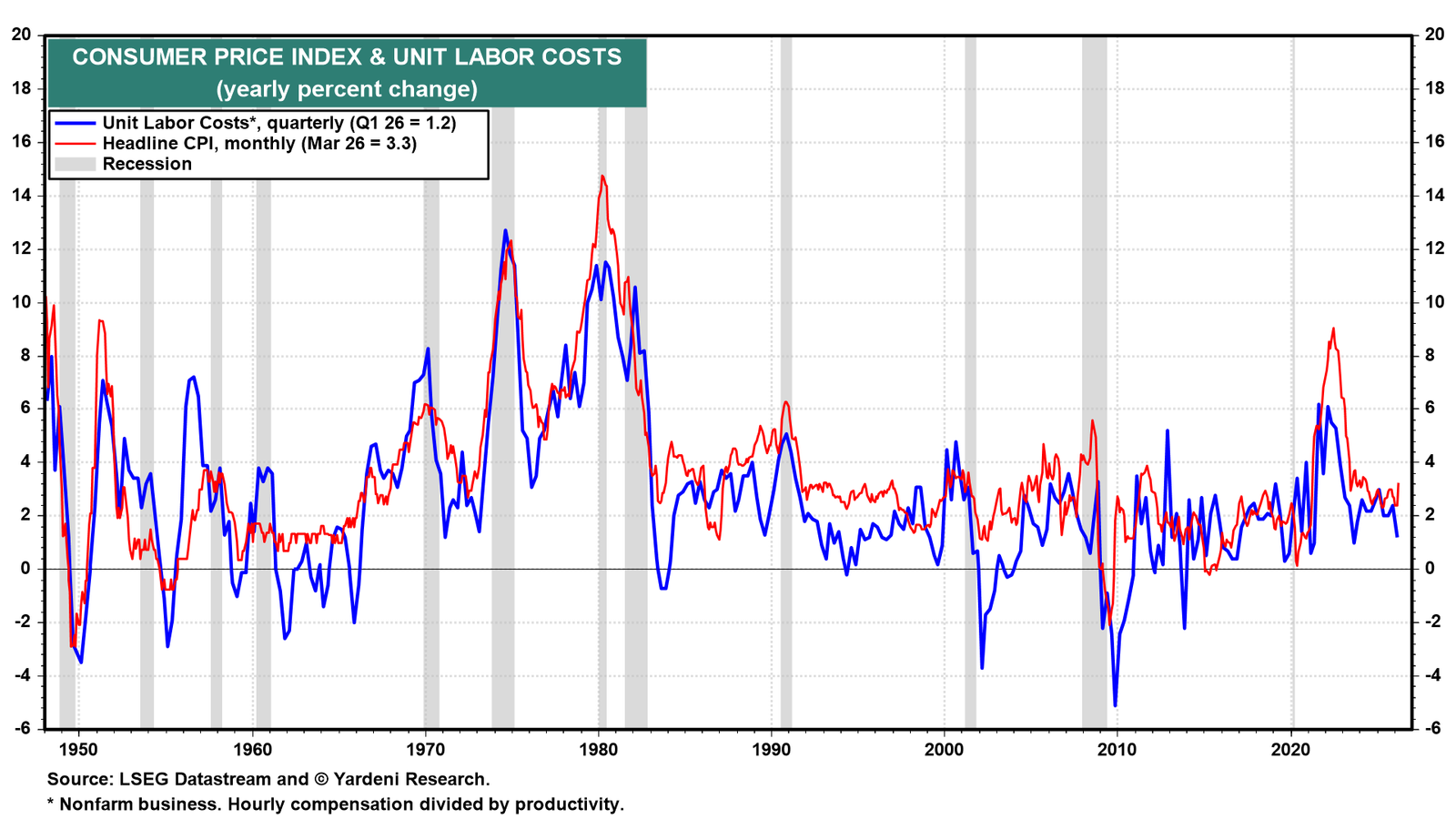
(2) Unit labor costs & inflation. Unit labor costs is measured as hourly compensation divided by productivity. It rose by 1.2% y/y in Q1-2026, the slowest pace of growth since Q3-2023 (chart). This confirms our view that the labor market isn't currently a source of inflation but rather disinflation. For now, the latter is being offset by other inflationary pressures, i.e., higher energy prices and tariff-related increases in durable goods prices.
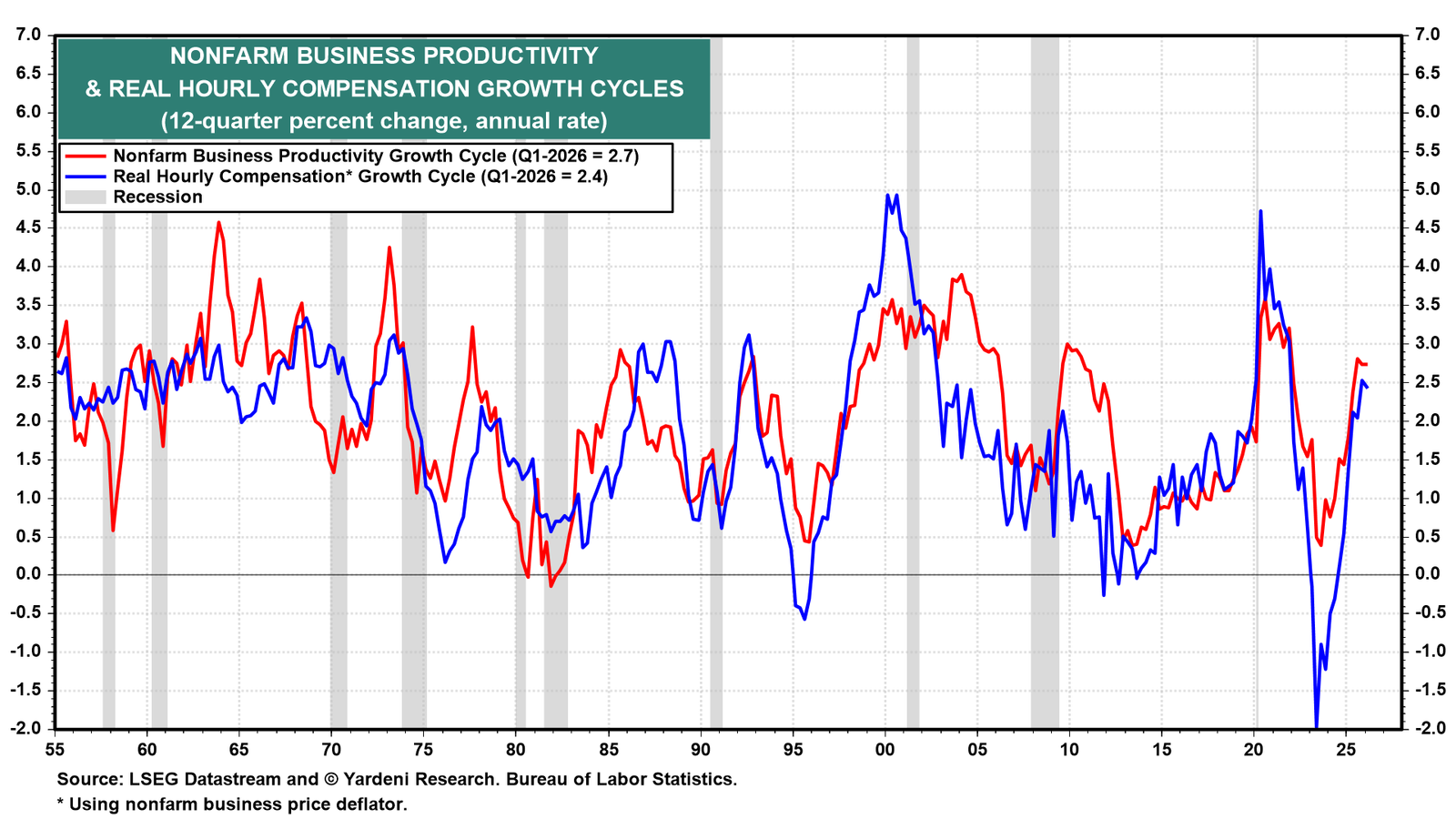
(3) Productivity & real hourly compensation. Inflation-adjusted hourly compensation is determined by productivity (chart). Businesses can only sustainably raise real pay when productivity gains provide the underlying economic value. We expect productivity growth to rise close to 4.0% by the end of the decade, supporting equivalent real hourly compensation growth (chart).
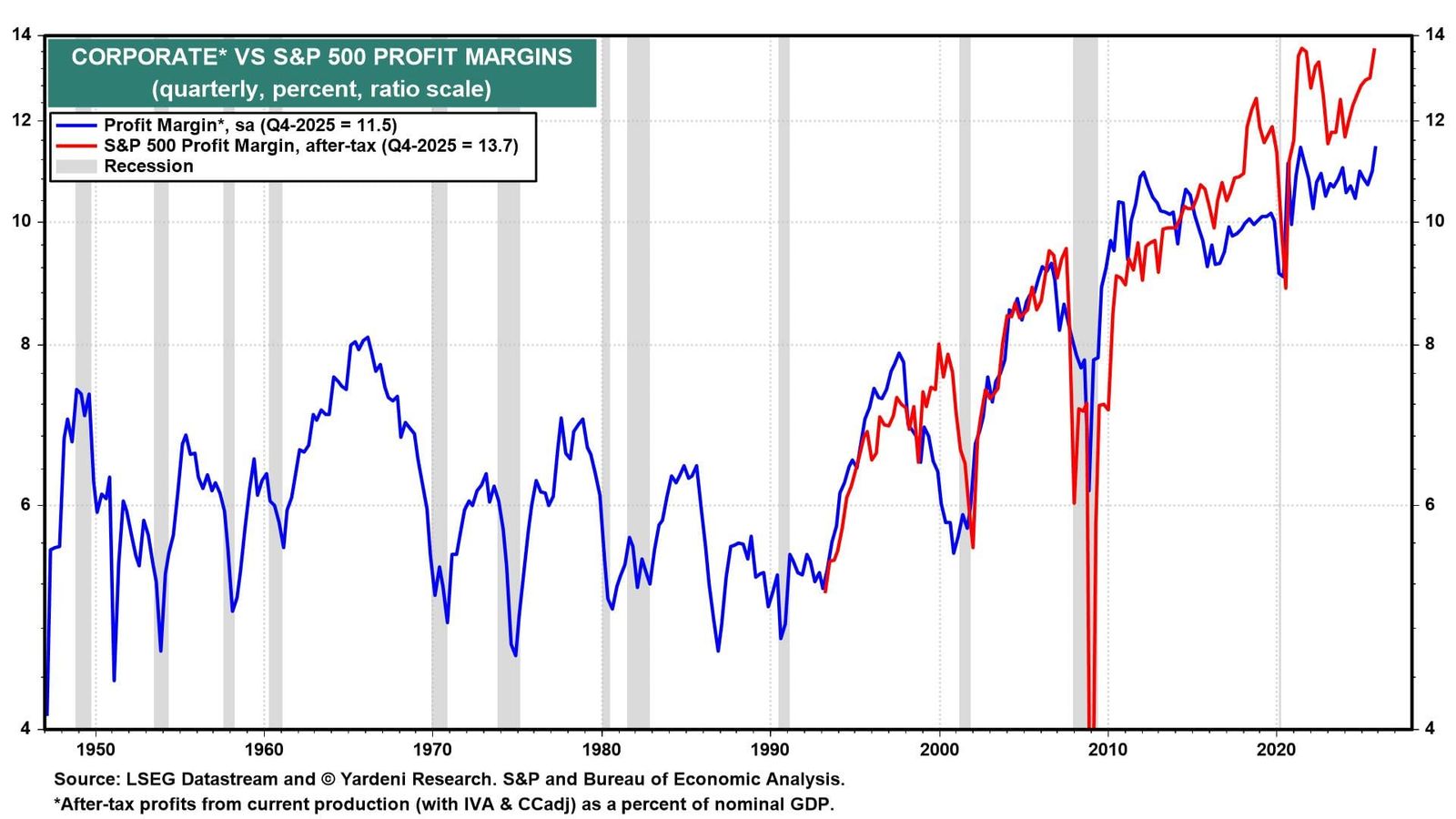
(4) Corporate profitability. Strong productivity growth tends to widen profit margins. Profit margins are currently at record highs, and boosting corporate profits (chart). S&P 500 earnings growth has been surprisingly strong as a result.
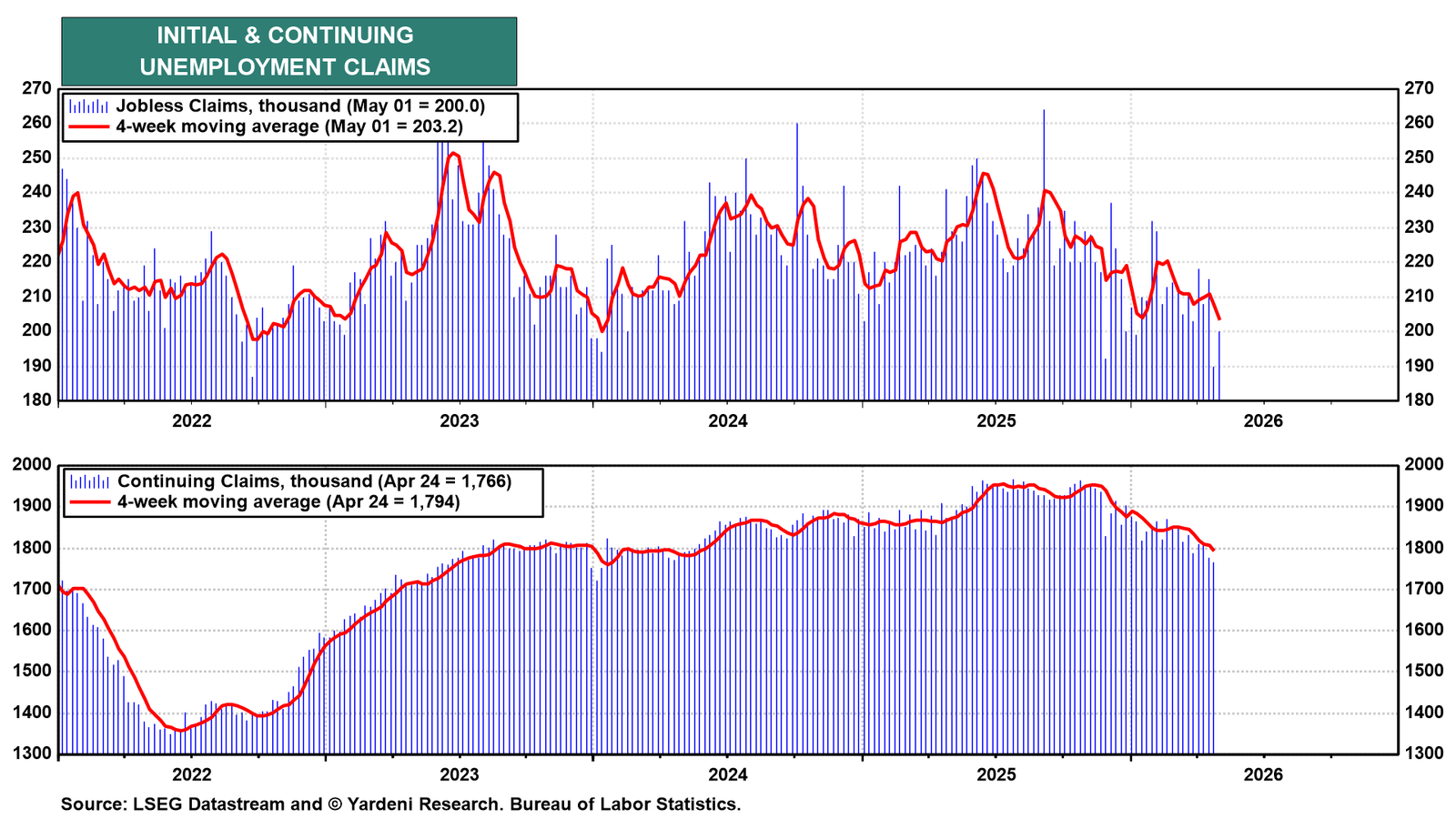
(5) Jobless claims. Initial unemployment claims ticked up modestly to 200,000, following the prior week's drop to 190,000, the lowest reading since 1969 (chart). The four-week moving average of initial jobless claims also fell to its lowest since January 2024. Continuing jobless claims dropped to 1,766,000 in the week ended May 2, their lowest level since January 2024. The four-week moving average of this series has now declined for nine consecutive weeks, the longest such streak since June 2022. Taken together, the consistent downward momentum in both series is a strong signal that hiring activity is improving, while layoffs remain very low low.
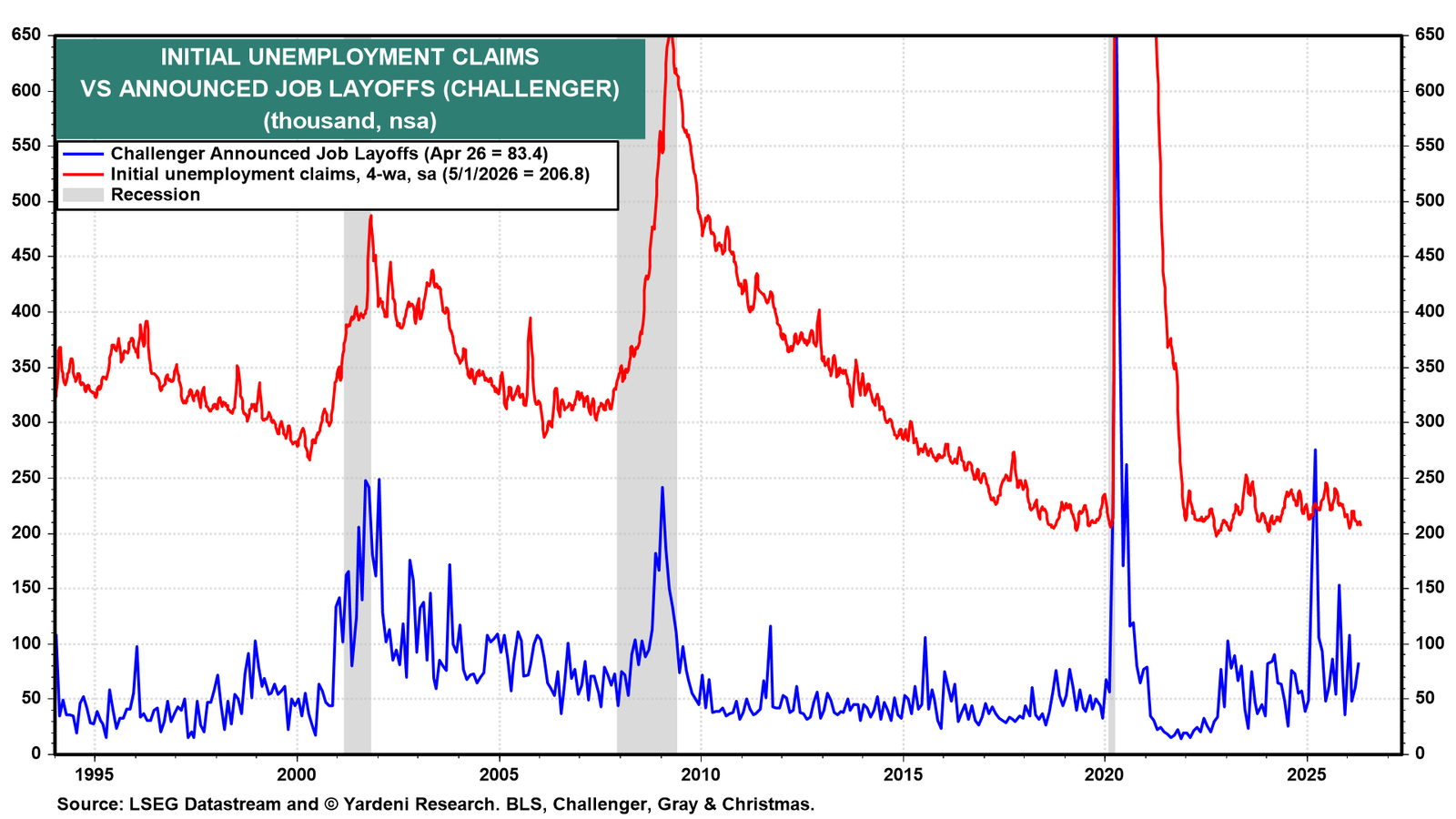
(6) Layoff announcements. The May 7 Challenger, Gray & Christmas report showed that US employers announced 83,387 job cuts in April (chart). For the second consecutive month, AI was cited as the primary reason for layoffs, accounting for 26% of all cuts (roughly 21,490 jobs). Despite the monthly jump, year-to-date layoffs remain down 50% compared to the same period in 2025. This confirms that while specific sectors are being disrupted by AI, the overall labor market remains resilient. It is also entirely consistent with our belief that AI will create jobs on net.
(7) Job growth. Yesterday, ADP reported that private-sector payrolls rose by 109,000 in April, the fastest pace of job creation since January 2025. The result is corroborated by Revelio Labs, which reported that total nonfarm payrolls rose by 66,400 in April, the most since March 2025, with gains led by health care and social services and the finance sector.
We expect that tomorrow's April employment will show a big upside surprise.