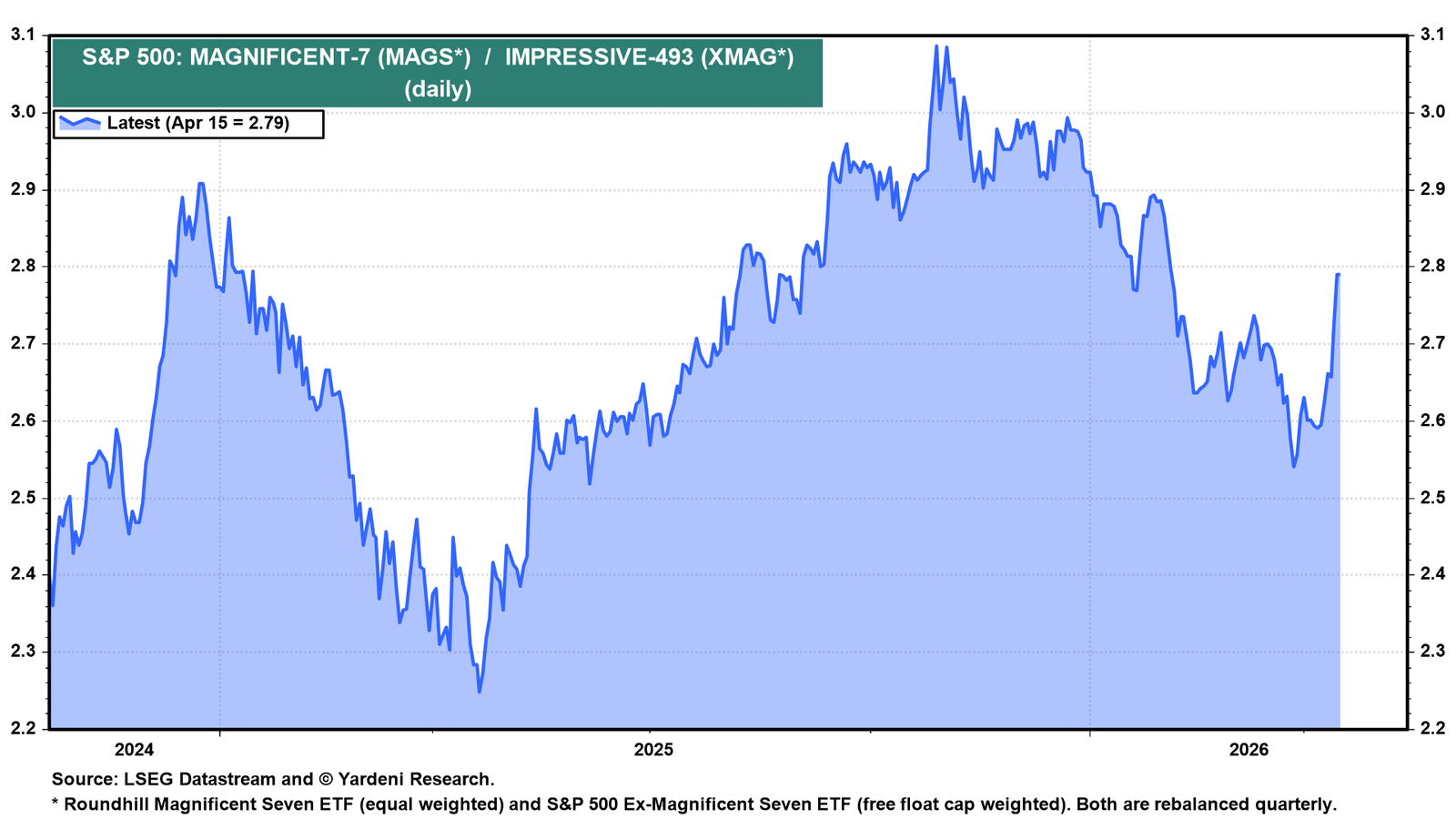
Happy days are here again! The S&P 500 and Nasdaq rose to record highs today, which just happens to be tax day. What's all the excitement about? The AI bubble hasn't burst, so far. Instead, hyperscaler stocks are leading the charge since the stock market bottomed on March 30 (chart). The private credit bubble may be losing some air, but it isn't bursting, while banks are still lending. Real GDP slowed during Q4-2025 and Q1-2026, but some of that was related to bad weather. As Chauncey Gardiner correctly predicted, "There will be growth in the Spring." In any event, S&P 500 earnings rose at a faster pace during the past two quarters to fresh record highs. And investors fear missing out on peace (FOMOOP) in the Middle East.
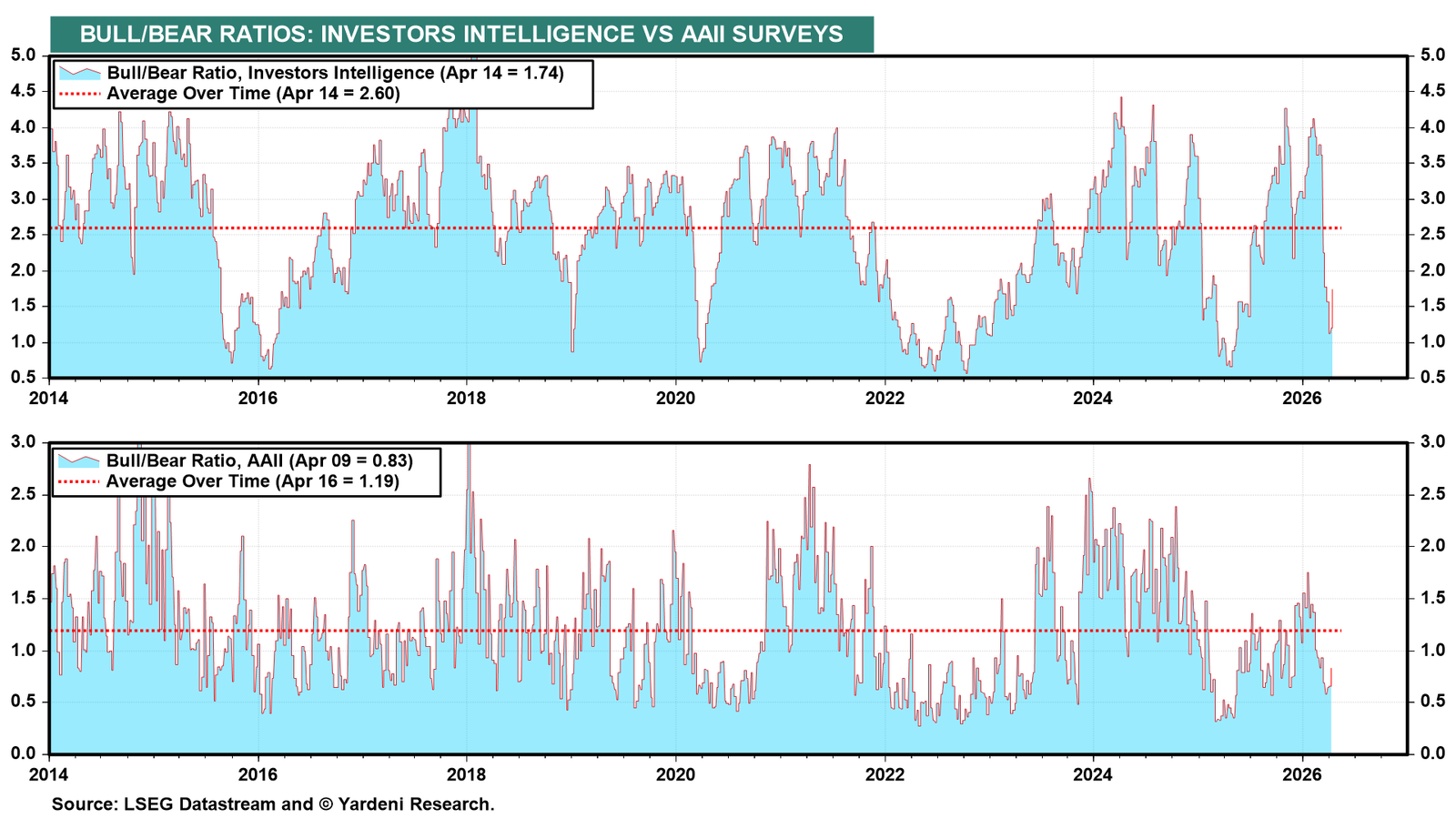
Before the war started, we anticipated a stock market pullback because our two favorite Bull-Bear Ratios were too bullish (chart). At the end of the day on March 31, we said the market bottomed on March 30, partly because these two contrarian indicators had turned too bearish. They both rebounded over the past week, but remain relatively bearish, which is bullish, from a contrarian perspective.
Nevertheless, it feels like the Roaring 2020s are back, given the strong V-shaped recovery in stock prices since March 30. So what could possibly go wrong? Obviously, the war could flare up again. Oil exports might remain blockaded in the Arabian Gulf, causing oil prices to rise again. Let's search for additional possible troubles in the economic reports of the past couple of days:
I. Fed's Beige Book Is Beige
The Fed's Beige Book was released today, covering data collected on or before April 6. The main message is that risks are skewed toward the inflation side of the Fed's dual mandate:
(1) Labor markets held steady, with employment flat to slightly up in most districts, a marginal improvement from March's more mixed picture. Wages remained modest to moderate across all districts, with no acceleration or deceleration reported.
(2) The most consequential shift from the March Beige Book is the energy price shock now hitting the economy. Higher energy costs are adding to residual tariff pressures, and an acceleration in input costs was universal across all districts. Selling price growth is lagging input cost increases, compressing margins. The short-term inflation picture has clearly worsened.
The Beige Book is broadly consistent with our view. The economy remains in good shape, but inflation risks have intensified. This supports our conviction that the Fed is unlikely to cut rates again this year.
II. Bankers Are Upbeat
Major US banks kicked off the Q1 earnings season this week. Their CEOs' commentary was uniformly upbeat about the US economy in Q1. Here is what they had to say, in brief:
(1) JPMorgan Chase. CEO Jamie Dimon described a resilient consumer and active spending environment: "The US economy remained resilient in the quarter, with consumers still earning and spending and businesses still healthy." He also flagged fiscal stimulus, deregulation, AI-driven capital investment, and the Fed's asset purchases as tailwinds.
(2) Goldman Sachs. CEO David Solomon pointed to a constructive soft-landing scenario, with economic activity holding up and credit stress remaining limited.
(3) Citigroup. CEO Jane Fraser called it an "exceptionally strong start" to 2026, with management highlighting a "constructive macroeconomic environment."
(4) Bank of America. CEO Brian Moynihan cited healthy client activity, solid consumer spending, and stable asset quality as evidence of a resilient US economy. A resilient labor market, as indicated by low initial jobless claims, continues to support consumer spending.
III. NFIB Employment Indexes
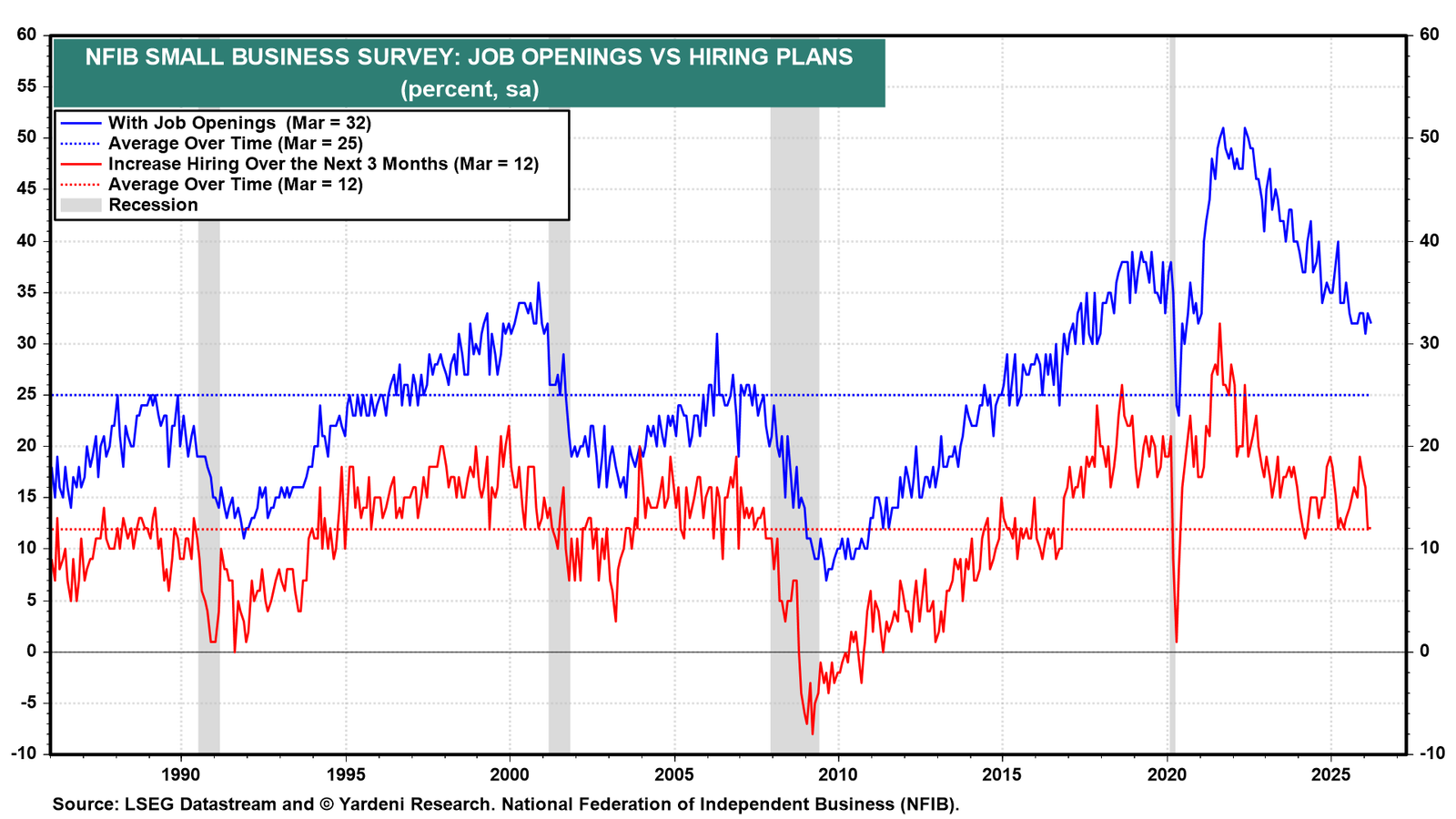
The March NFIB survey of small business owners was released yesterday. It suggests that job openings may be bottoming (chart). Hiring intentions have moderated to their long-run average. These readings are consistent with our view that the labor market remains in good shape, with supply and demand roughly in balance.
IV. Retail Sales
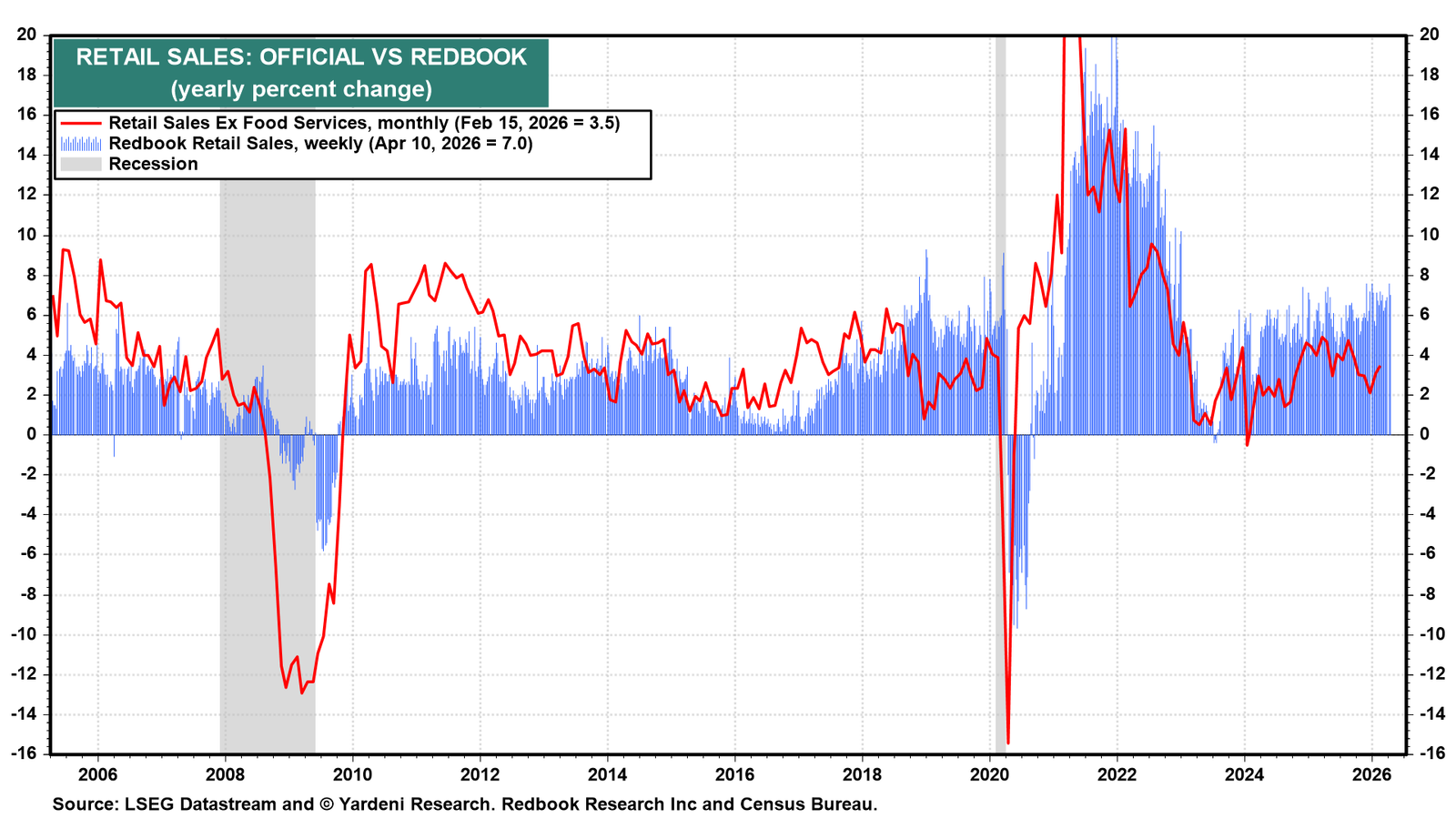
The Redbook Retail Sales Index continues to run hot. During the week of April 10, it rose 7.0% y/y, well above the 2025 full-year average of 5.8% (chart). Redbook has now increased by more than 6% y/y for 12 consecutive weeks, the longest such streak since November 2022. The four-week moving average climbed to 7.1%, its highest since January 2023. The resilience of consumer spending is fully consistent with our upbeat economic outlook. Importantly, Redbook excludes gas station sales.
V. Tax Refunds Just at the Right Time
Thanks to the 2025 One Big Beautiful Bill Act, the 2026 tax filing season is delivering a timely boost to consumers' purchasing power. Year-to-date tax refunds through the week ending March 27 are up 13.6% y/y, and the average refund is up 11.1% y/y. The larger refunds will help cushion the blow from higher gasoline prices. Gasoline prices would need to stay above $4 per gallon for quite some time to fully offset the refund tailwind.
VI. Consumer Sentiment
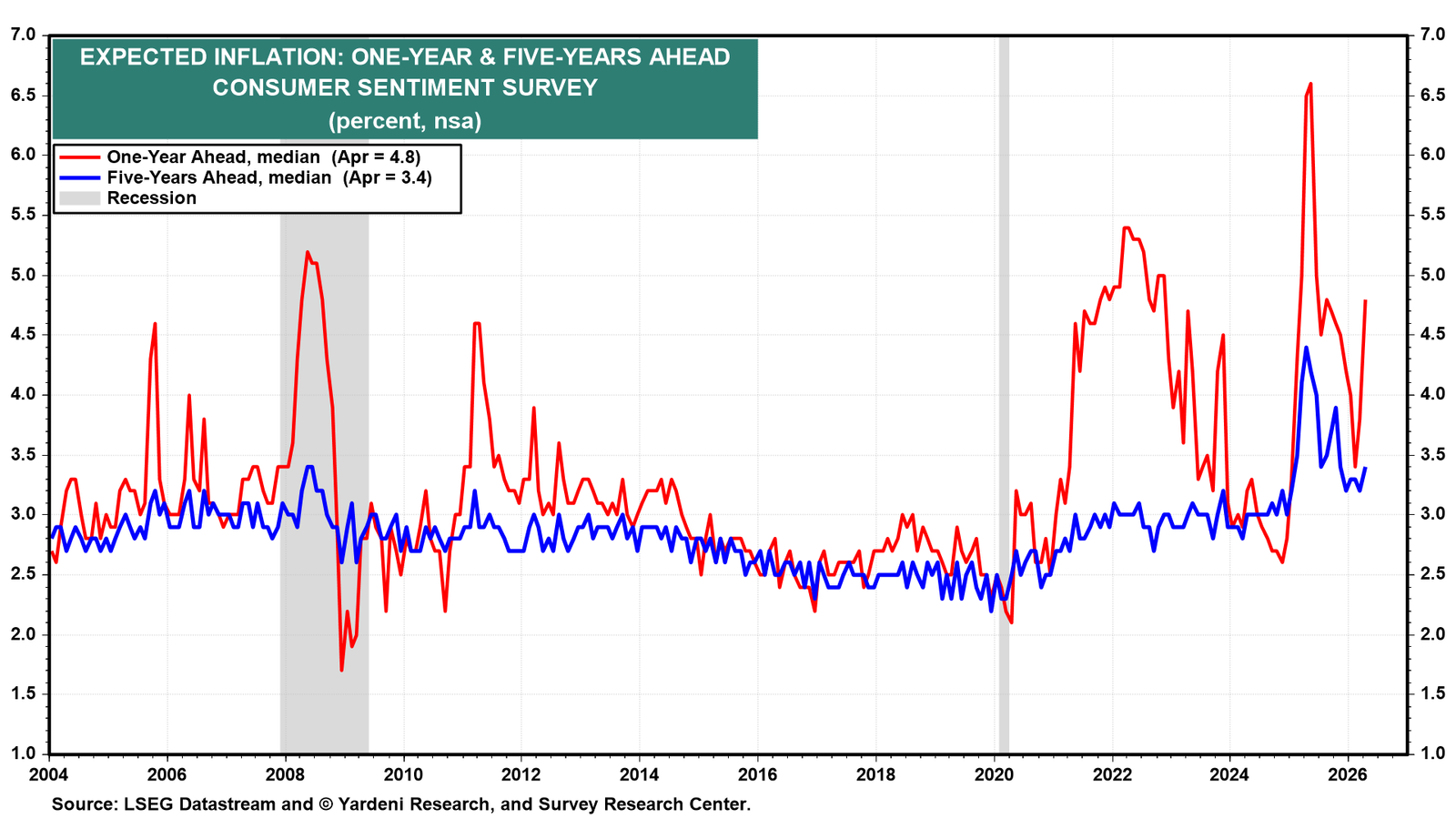
April's preliminary Consumer Sentiment Index plunged to a record low, driven by mounting fears over rising energy prices and the Middle East conflict. The headline index dropped 10.7% m/m to 47.6, with both current conditions and expectations posting double-digit monthly declines. Short-term inflation expectations surged a full percentage point m/m to 4.8%, the highest since August 2025 (chart). If the post-pandemic period has taught us anything, it's that consumer confidence surveys are a poor leading indicator of actual spending.