Forecasting the weather is easier than forecasting the timeline and outcome of a war. The expression "the fog of war" is a bit confusing because fog often lifts within hours. Wars last much longer. Today, we had "a break in the weather." The war is ongoing, but there were sighs of relief in the energy and financial markets. That's because some tankers are getting through the Strait of Hormuz, especially those heading for China and India. We said we needed to see that happen to lift the stock market (and our spirits). We've often observed that geopolitical crises are buying opportunities in the stock market. We were expecting a 10%-15% correction in the S&P 500, but the 5% decline from the January 27 record high through Friday's close might be the extent of the damage.
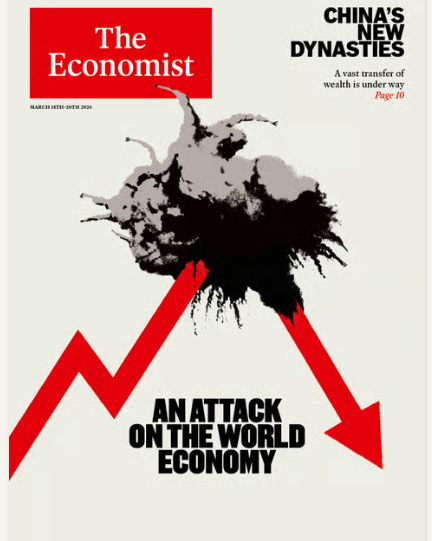
Also uplifting is this week's cover story of The Economist titled "An Attack on the World Economy." For contrarian investors, a bearish cover story is a very bullish signal. Our recommendation to Go Global might make a comeback sooner rather than later.
Financial markets were mixed today as investors weighed easing oil prices against renewed enthusiasm for the AI buildout:
(1) The S&P was up for what feels like a nice change, rising 1.01% today. It rebounded off its 200-day moving average (chart).

According to Polymarkets.com, the odds of a recession this year edged down to 31.0% today (chart). The S&P 500 tends to be inversely correlated with this series.

The stock market was boosted today by the price of WTI crude falling more than 3% to below $95 per barrel, while Brent held around $100, as traders increasingly concluded that the disruption in the Strait of Hormuz may prove less severe than feared at the start of the war (chart). Treasury Secretary Scott Bessent told CNBC that the US has allowed Iranian tankers to continue transiting the Strait to keep global supplies flowing.

Today's widening spread between the Brent and WTI prices signals traders’ recognition that the US is energy independent (chart). It wasn’t during the two oil shocks of the 1970s. We continue to believe that current events won't upend our Roaring 2020s scenario and lead to a Stagflating 1970s outcome.

(2) Meanwhile, Nvidia shares rose about 2% today after CEO Jensen Huang used the company’s GTC conference to reinforce the extraordinary scale of the AI capex cycle. Huang said cumulative purchase orders for Blackwell and Vera Rubin could reach $1 trillion through 2027, double the company’s prior $500 billion revenue opportunity estimate. The company’s forward revenues rose to a record $371 billion this week (chart).
The message was clear: Demand no longer is driven solely by training workloads and hyperscalers but increasingly by inference, agentic AI applications, and the exploding volume of tokens to be processed. Huang also stressed that the next phase of the AI buildout will depend not just on raw computing power but on performance per watt, memory expansion, and rack-scale system design, all areas in which Nvidia is attempting to widen its lead.

(3) The price of gold has been consolidating around $5,000 per ounce in recent weeks (chart). It mostly moved lower during the war so far because the US dollar's foreign exchange value has moved higher at the same time. It dipped below $5,000 today but should head higher in coming weeks, with a possible breakout toward $5,500. That's more likely to happen if the war ends soon.
