The Fed achieved its congressional dual mandate in January. The unemployment rate fell to 4.3%, and the CPI inflation rate was down to 2.4% y/y. Those round down to what we call “Nirvana” readings, i.e., the low unemployment level of 4.0% and the Fed’s inflation target of 2.0% (chart). Fed officials should celebrate and go on a long vacation. They can leave the federal funds rate (FFR) alone at its current 3.50%-3.75%. By their own definition, that must be the "neutral" FFR, the level that’s consistent with full employment and stable prices. Why mess with success?

The Misery Index is the sum of the unemployment and inflation rates (chart). It was 6.7% in January, only 0.7 percentage points above the Nirvana sum and well below the long-term average of 9.0% (chart). It has been fluctuating around 7.0% since June 2023. We've been in Nirvana for a while!

The Fed has cut the FFR by 175bps since September 2024 (chart). It's not obvious to us that this easing was necessary to keep us in Nirvana. In the past, the Fed slashed the FFR in an emergency response to financial crises that rapidly morphed into economy-wide credit crunches, triggering recessions. That's not the scenario now.
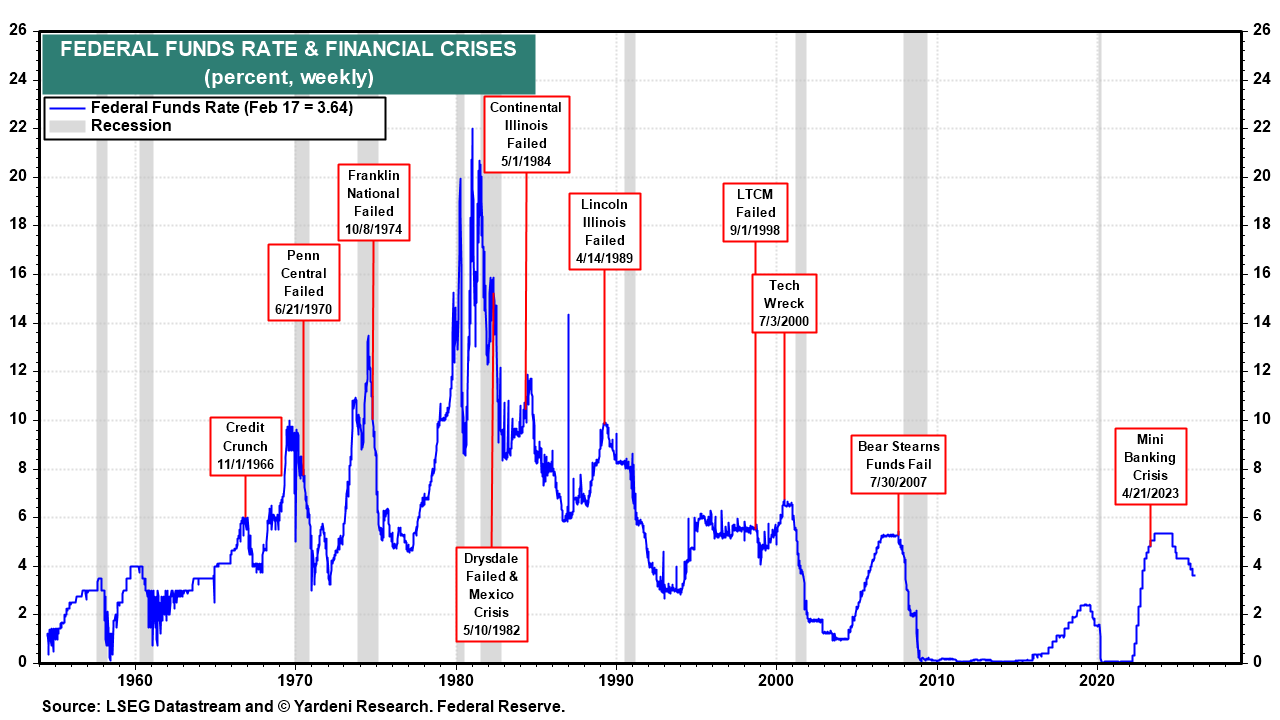
The inflation-adjusted FFR is back down to its long-term average of 1.01% (chart). There is no reason to lower this real FFR from here.

The steepening yield curve and the acceleration in bank loan growth confirm that monetary policy has eased enough (chart).

At the end of last year, the FOMC's 19 participants each estimated the "long-run" FFR (chart). The median projection was 3.0%, but some thought it was higher while others thought it was lower. On balance, they judged that the FFR remains a bit restrictive and might need to be lowered a couple more times this year.
Today's release of January's FOMC minutes reveals a divided Fed. Several participants would opt to cut if inflation declines as expected, but a larger group wants firm confirmation that disinflation is back on track before they’d vote to cut, and some even kept hikes on the table if inflation merely stalls above the 2.0% target. The majority judged that labor market risks have diminished while inflation remains a concern.
We do expect inflation to fall to the Fed's 2.0% target in the coming months. However, lowering the FFR is unlikely to stimulate jobs growth while risking both a revival of consumer price inflation and more asset price inflation.

Kevin Warsh, who was nominated by President Donald Trump to replace Fed Chair Jerome Powell in May, wants to lower the FFR. The problem is that the Fed has already done so by 175bps since September 2024, yet that hasn’t brought down the 10-year Treasury yield or mortgage rates. Both are as high today as they were back then (chart).

Warsh believes that reducing the Fed's balance sheet via quantitative tightening (QT) while lowering the FFR is the way forward for monetary policy. The balance sheet remains large even after successive rounds of QT, reflecting the post-Great Financial Crisis regime of abundant reserves (chart). The January minutes reinforce that this framework is entrenched: Reserve management purchases are ongoing, money markets are stable, and reserves are projected to fluctuate around $3 trillion. Nothing in the minutes signals renewed QT urgency. For Warsh, that means that any effort to materially shrink the Fed's footprint could confront operational constraints and resistance from other Fed officials, who might not want to tie another round of QT to rate cuts.

By the way, one reason mortgage rates remain high is that the Fed remains committed to paring its holdings of mortgage-backed securities (MBS) to zero, not replacing them as the securities mature. In early January 2026, President Trump directed Fannie Mae (FNMA) and Freddie Mac (FHLMC) to purchase $200 billion in MBS using their own cash reserves. Mortgage rates briefly dipped below 6.0% on the announcement, but didn’t stay down. Warsh's intention to reduce the Fed's holdings of securities (including MBS) is likely to keep mortgage rates elevated.

|
|