Excerpt from the February 2 Morning Briefing of Yardeni Research.
The Fed I: Direct From Central Casting
I spent the weekend reading up on Kevin Warsh, who will replace Jerome Powell as Fed chair in May. My friends at the Financial Times asked me to write an 800-word op-ed on him. Sharing those thoughts with readers here leaves me with plenty of additional space to elaborate on what I have learned about the next Fed chair.
Warsh was nominated for the position by President Donald Trump on Friday. He must be confirmed by the Senate. That should be easy once the President calls off his judicial attack on Powell. Trump has made clear that he doesn’t like Powell, especially because the Fed lowered the federal funds rate (FFR) by 50 bps before the November 2024 presidential election, presumably boosting the Democrats’ chances of holding onto the White House. Powell continued to drop it further after Trump was elected, but the moves didn’t come fast enough or go low enough for Trump.
Trump likes Warsh partly because he looks the part of a Fed chair. In his typical style, Trump used the phrase “central casting” to describe Warsh, emphasizing that he possesses both the professional pedigree and the physical presence that Trump values in high-ranking officials. On Friday, Trump told reporters, “He’s very smart, very good, strong, young, pretty young. He was the central casting guy that people wanted.”
Now I know why I wasn’t a candidate: I’m too old, though I think I look the part. I’ve often offered to have Yardeni Research do what the Fed does for half the price. We would do it remotely, so the renovations on the Fed’s headquarters building could stop.
I’ve written two books on the Fed: Fed Watching for Fun & Profit (2020) and The Fed and The Great Virus Crisis (2021).
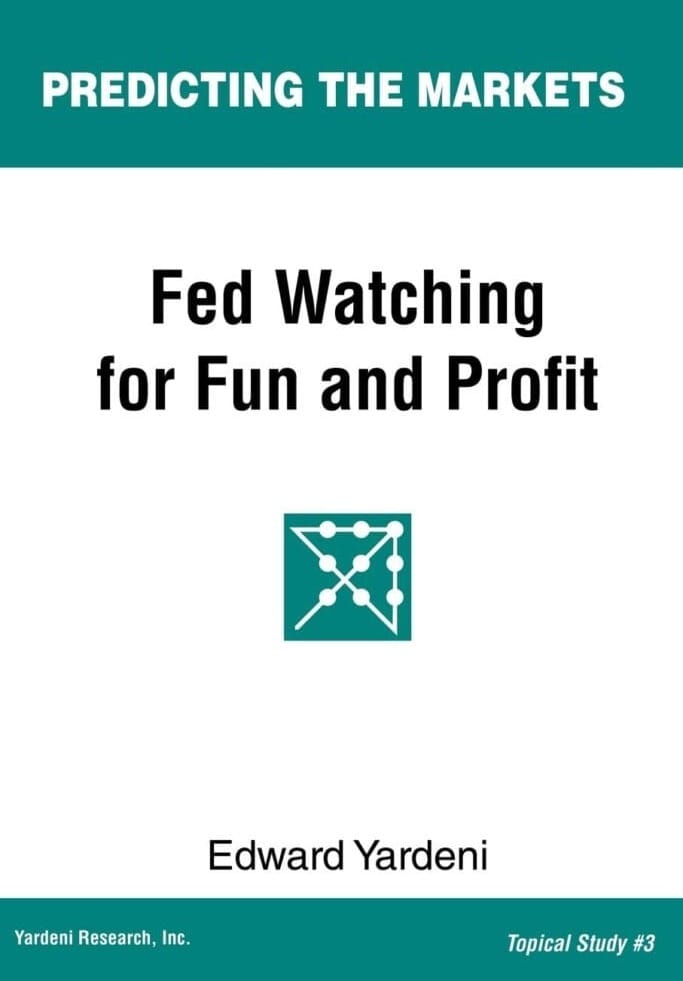
In the first one, focused on the Fed chairs, I wrote:
“Predicting monetary policy is obviously important for predicting financial markets. To do so, I learned early in my Wall Street career the importance of thinking like the Fed chairs, who head up the Board of Governors of the Federal Reserve System and preside over the Federal Open Market Committee (FOMC). I’ve had to think like Paul Volcker, Alan Greenspan, Ben Bernanke, Janet Yellen, and Jerome Powell. As I explain below, Volcker was the Great Price Disinflator, Greenspan was the Great Asset Inflator, and Bernanke was the Great Moderator. Yellen was the Gradual Normalizer. Jerome Powell, the current Fed chair, has been the Pragmatic Pivoter—so far, as of December 2019.”
My preliminary take on Kevin Warsh is that I’ll be dubbing him the “Supply-Sider,” for the reasons I discuss below.
(My two books are available to our accounts by clicking on the links above.)
The Fed II: A Man for All Seasons?
But this isn’t about me; it’s about the new candidate for the most important economic position in the world. Consider the following:
(1) A stellar resume. Warsh served as a member of the Federal Reserve Board of Governors from 2006 to 2011 and was a top advisor to Fed Chair Ben Bernanke during the Great Financial Crisis (GFC) of 2008. Before that position, he was on the National Economic Council (2002-06) and an executive director in Morgan Stanley’s mergers and acquisitions department (1995-2002).
Warsh’s M&A skills came in handy during the GFC, when he was a central figure in the 2008 acquisition of Bear Stearns by JP Morgan Chase, the AIG bailout, the conversion of Morgan Stanley and Goldman Sachs into bank holding companies, and the shotgun wedding of Merrill Lynch and Bank of America. During his Senate confirmation, I hope that he will be asked why Lehman was allowed to fail just one day before Morgan Stanley and Goldman Sachs were rescued. In any event, no wonder that Fed Chair Ben Bernanke said that Warsh was the Fed’s primary “bridge” to Wall Street.
Warsh is currently the Shepard Family Distinguished Visiting Fellow in Economics at the Hoover Institution and a lecturer at the Stanford Graduate School of Business. In addition, after leaving the Fed in 2011, he became a partner at Stan Druckenmiller’s Duquesne Family Office.
Interestingly, Treasury Secretary Scott Bessent also worked for Druckenmiller, at Soros Fund Management from 1991-2000 as the managing partner of the London office. Bessent was a key figure in the 1992 “Black Wednesday” trade, where the firm profited by over $1 billion from betting against the British pound. After Druckenmiller left Soros in 2000 to focus on Duquesne, Bessent also left to start his own fund. Bessent later returned to Soros from 2011-15 as Chief Investment Officer—the same year Kevin Warsh joined Druckenmiller at Duquesne.
Odds are that Bessent favored Warsh above the other candidates considered for the Fed chair position. My hunch is that the President really wanted Bessent to take the job, but Bessent wanted to stay at the Treasury. Bessent probably convinced the President that he would work best with Warsh.
(2) A supply-sider. In a November 8, 2010 op-ed in The Wall Street Journal, written when Warsh was still a Fed governor, he crossed the line by opining on fiscal policy. He championed supply-side, pro-growth fiscal policies, including a simpler tax code and less regulation, rather than less conventional monetary policies. Notably, he also wrote: “[T]he creep of trade protectionism is anathema to pro-growth policies. The U.S. should signal to the world that it is ready to resume leadership on trade.”
Not surprisingly, Warsh shares many of Bessent’s views. In an internal memo to his colleagues at Keysquare Capital Management dated January 31, 2024, Bessent wrote: “Our base case is that a re-elected Donald Trump will want to create an economic lollapalooza and engineer what he will likely call ‘the greatest four years in American history.’ Economist Ed Yardeni believes that post-Covid America has the potential to have a boom similar to the ‘Roaring Twenties’ of a century ago. We believe that a returning President Trump would like this to be his legacy. In this scenario, the greatest risk factor, in our opinion, would be a sudden rise in long-end rates.”
Like Bessent, Warsh believes that the US is entering a productivity-led boom, largely driven by artificial intelligence (AI), tax cuts, and deregulation. He believes these supply-side improvements will act as a disinflationary force, allowing the economy to grow rapidly without sparking inflation. This view provides his intellectual justification for supporting the lower interest rates favored by the Trump administration.
Warsh often uses the phrase “inflation is a choice,” suggesting that price stability results from a combination of sound monetary and fiscal policy. He rejects the traditional Phillips Curve model (which suggests that low unemployment naturally causes inflation), arguing instead that productivity and private-sector investment are the true drivers of sustainable, non-inflationary growth.
In Warsh’s ideal supply-side world, fiscal policy’s job is to cut taxes and regulations to spur economic activity, while monetary policy’s job is to keep interest rates low to support investment. The Fed should also keep the size of its balance sheet small and avoid unconventional monetary policy tools.
(3) From hawk to dove. During the GFC, Warsh became known as one of the most prominent “hawks” at the Fed. While he supported the Fed’s emergency liquidity measures to save the banking system, he was deeply skeptical of cutting interest rates too far or keeping them low for too long. He feared that inflation would flare up. He believed that prolonged low rates (and later, QE) would subsidize inefficient firms and financial engineering rather than productive investments in the real economy.
Circumstances have changed, and so has Warsh’s view. Currently, he seems to believe that inflation is temporarily stuck around 3.0% (i.e. above the Fed’s 2.0% target) as a result of Trump’s tariffs, which he believes are causing a one-shot boost to prices, without longer-term inflationary consequences.
He believes that Trump’s fiscal policies are setting the stage for a “Golden Age” in America, with productivity led growth boosting economic growth and subduing inflation. He believes that the Fed should do its part to make this happen by lowering the FFR.
(4) A Fed critic. In an excellent spring 2025 article in The International Economy titled “The Fed’s New ‘Gain-of-Function’ Monetary Policy,” Bessent criticizes the Fed for attempting to manage the economy with unconventional monetary tools. He rightly observes that the Fed successfully ended the GFC by implementing the first round of quantitative easing (also known as “QE1”) in late 2008 and early 2009. In that round, the Fed purchased $1.25 trillion in mortgage securities and $300 billion in Treasuries.
QE1 was consistent with what arguably is the primary job of any central bank: to provide liquidity during such crisis periods. Indeed, the Fed was created at the end of 1913 in response to previous financial crises. Its original central mission was to maintain financial stability. Both Bessent and Warsh agree that the Fed’s subsequent three rounds of quantitative easing (QE2, QE3, and QE4) were mistakes.
Warsh has been a vocal critic of QE, arguing that the Fed’s bloated balance sheet has subsidized Wall Street and “financial engineering” rather than helped Main Street. A core supply-side tenet he espouses is that the Fed should shrink its footprint in financial markets to allow the private sector to allocate capital more efficiently.
(5) Regime change. Warsh has frequently called for a “regime change” at the Fed. He argues that the current institution has become too insular, relying on outdated models that fail to capture the modern economy. Warsh vehemently opposes the Fed’s current “data-dependent” posture, which he views as reactionary and “backward-looking.”
In a March 2023 WSJ article, Warsh opined that the Fed “should get out of the business of forward guidance” and “stop providing forecasts for the path of interest rates.” So Fed watchers might have to do without the Fed’s quarterly Summary of Economic Projections, which includes the widely followed “dot plot” showing the interest-rate projections of each participant of the policy-setting Federal Open Market Committee. Though he hasn’t said so, I suspect that Warsh might even end the tradition of press conferences by the Fed chair following FOMC meetings.
Warsh argues that by reacting to every monthly CPI or jobs report, the Fed creates unnecessary market volatility. He famously said that “rolling Fed incantations [i.e., forward guidance] waxing and waning with the latest data release” are counter-productive to long-term stability.
Warsh frequently slams the Fed for being “stuck with models from 1978,” referring to the traditionally relied upon Phillips Curve model that assumes a trade-off between low unemployment and high inflation. Warsh believes such models fail to account for AI-driven productivity gains, which he thinks can keep inflation low even if the economy grows rapidly.
The most significant—and controversial—part of Warsh’s platform is his call for a “New Treasury-Fed Accord.” This is a direct reference to the 1951 Accord, which officially separated the Fed’s monetary policy from the Treasury’s debt management after World War II. So it established the Fed’s independence from fiscal policymaking.
Warsh’s new accord would have the Fed work more closely with the Treasury. By keeping the size of the Fed’s balance sheet down, the Fed would “create space” for more cuts in the federal funds rate. The new accord appears to commit the Fed to supporting a supply-side economic model with lower interest rates. If so, then wouldn’t the Fed be less independent under the “Bessent-Warsh Accord?”
(6) One of a dozen. It won’t be easy for Warsh to win his colleagues’ support on the Federal Open Market Committee (FOMC). After all, he has been criticizing them for quite some time. He certainly hasn’t come to Powell’s defense against Trump’s attacks. His views are a threat to the Fed’s status quo, independence, and groupthink.
At the last meeting of the FOMC at the end of January, only two of the 12 members of the committee who vote for policy changes wanted to lower the FFR. They were Governors Stephen Miran, who soon will leave the Fed and probably return to the Council of Economic Advisers, and Christopher Waller, who might turn less dovish now that he isn’t running for the Fed chair position.
When Warsh joins the Fed in May, he might be the lone dissenter calling for a rate cut at the June meeting of the FOMC. By then, the pace of economic activity could be even stronger than it is now, and inflation might still be stuck around 3.0%, above the Fed’s 2.0% target. He’ll say that strong economic growth isn’t inflationary and that the effect of Trump’s tariffs on boosting inflation will be transitory. He might not convince the other 11 voting members.
(7) What about the Bond Vigilantes? If the Fed signs up for the Bessent-Warsh Accord, might the Bond Vigilantes protest? Bessent often has acknowledged that the administration needs a vote of confidence from them before a Golden Age can happen.
I am all for the administration’s “growth is good” agenda. The White House’s view is that better-than-expected economic growth would boost the federal government’s revenues, thus reducing the fiscal deficit and lowering the deficit-to-GDP ratio. Lower interest rates would help by reducing the federal government’s net interest outlays.
That works for me, but I’m not sure that the Bond Vigilantes will buy the supply-side narrative, especially since the President has called for a 50% increase in spending on national defense from about $1.0 trillion this year to $1.5 trillion next year. Moreover, there will be more Treasuries to sell if the Fed reduces the size of its balance sheet under Warsh. Bessent is counting on stablecoin issuance to increase the demand for Treasuries.
(8) Financial stability. The odds of our Roaring 2020s scenario (a.k.a. the Golden Age) might increase if the Fed lowers interest rates. However, no one wants to see the decade end as badly as the 1920s did. Ideally, the Roaring 2020s will set the stage for the Roaring 2030s. That might be less likely if the Fed fuels a stock market bubble by cutting interest rates, which would exacerbate wealth inequality during the stock market meltup. The subsequent financial and economic meltdown would reduce wealth and income inequality as everyone gets poorer.
|
|