The financial press was flooded with "American Exceptionalism" narratives throughout 2023 and 2024, and into early 2025. The April 15, 2024 cover story of The Economist was titled, "Riding High: The lessons of American exceptionalism." On May 25, 2024, the cover story of The Economist was "The almighty dollar." It focused on the dollar's enduring global dominance.
The "Sell America" trade—the contrarian bet that the multi-year era of American economic and market outperformance is finally ending—began gaining significant traction in the financial press late in 2024 and accelerated in 2025. Last year, the US dollar was weak, and the US stock market underperformed the All Country World ex-MSCI stock price index.
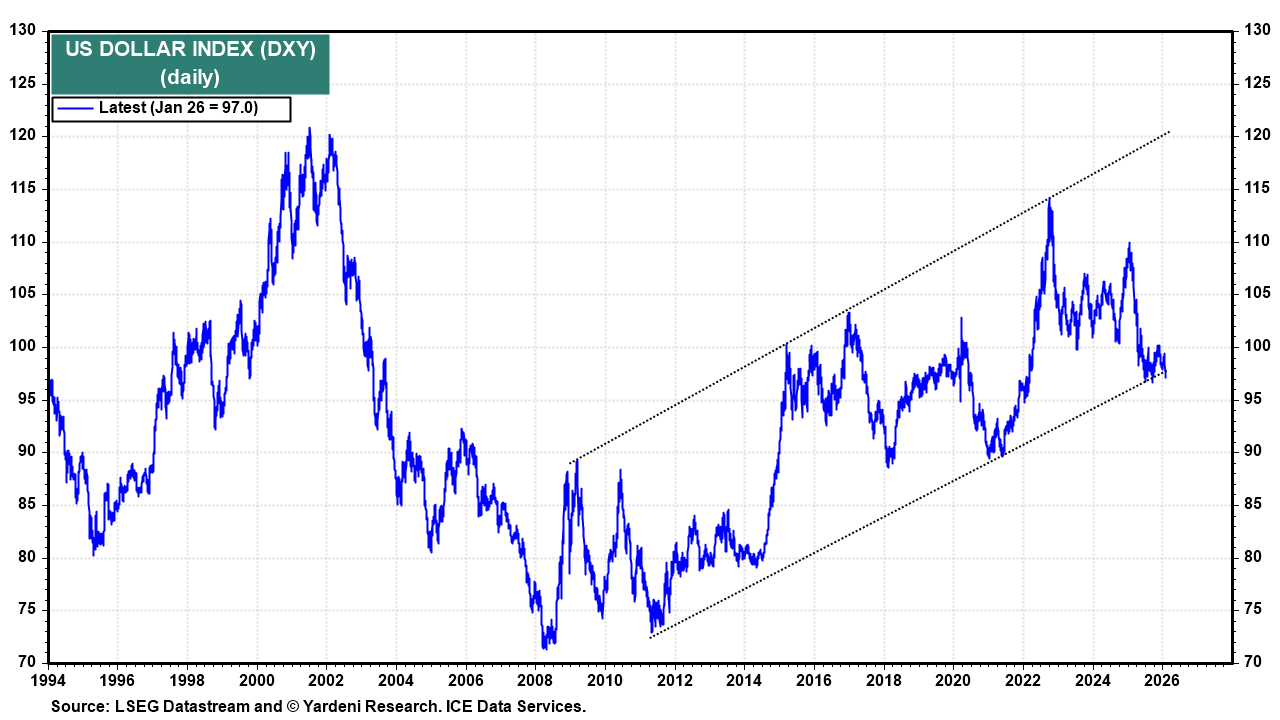
The consensus view was that global investors were selling their US stocks and bonds to buy more of such securities in Europe, Japan, and emerging markets. Soaring precious metals prices last year and so far this year are giving the Sell America trade even more credibility, as is the weak dollar, which seemed to be finding support above its rising uptrend line. It edged below it today as the yen bounced from its recent fall (chart).
We had championed a Buy America investment strategy (which we called "Stay Home" rather than "Go Global") since 2010. It worked very well, as evidenced by the uptrend in the ratio of the US MSCI to the All Country World ex-US MSCI in both local currency and dollar terms (chart). On December 7, 2025, we recommended moving from Stay Home toward Go Global. We don't view it as a Sell America call, but rather as a rebalancing call.

We still believe in American Exceptionalism, but that's been fully discounted by the rising market-cap share of the US in global portfolios from 45% in 2010 to 65% in 2025 (chart). Overseas stock markets are cheaper and include lots of exceptional companies. Emerging markets are especially appealing, as we've discussed in recent weeks.

Now, let's examine the relevant data to assess the Sell America trade. The US Treasury compiles data on net capital inflows. Over the past 12 months, through November 2025, foreign official accounts sold $51 billion in US securities, but private foreign accounts purchased $1.5 trillion in the US capital markets, near a recent record high (chart).

Private foreigners purchased a near-record $664 billion in US equities and a whopping $949 billion in US bonds over the past 12 months (chart).

Over the past four quarters through Q3-2025, foreign direct investments in the US totaled $324 billion (chart). Over the next few years, foreign direct investment could increase significantly if recent commitments made to President Donald Trump by foreign companies and countries are realized.

Foreign official holdings of US dollar reserves by central banks have been quite steady at around $7.0 trillion dollars since 2014, according to the IMF (chart). The same can be said for foreign official holdings of US Treasuries, which have been hovering around $4.0 trillion since 2012. The IMF data show that international gold reserves (based on national valuations) have increased significantly over the past couple of years. Much of that increase may be due to the sharp rise in gold prices over that period. (Contrary to the popular notion, foreign official accounts still hold more US Treasuries than gold.)

Finally, foreigners altogether own a record $9.4 trillion in US Treasuries (chart). There is no sign of Sell America trades in the data. Then again, this analysis does not examine whether US investors are selling US securities to buy foreign ones. We are working on that analysis. Stay tuned.

|
|